
Summary of Overclocking Arduino with liquid nitrogen cooling
The author overclocks an Arduino UNO using liquid nitrogen to explore cryogenic electronics behavior and maximize AVR performance. Challenges included a lack of stability tests, missing frequency generators, and component failures, all of which were resolved. The project also highlights the cost-effectiveness of locally sourced liquid nitrogen compared to expensive vendors.
Parts used in the Overclocking Arduino with Liquid Nitrogen:
- Arduino UNO
- ATmega328P microcontroller
- Liquid Nitrogen (LN2)
Before I start I guess I must answer 2 questions which would be asked inevitably:
1) Why? Because I can. To learn how electronics behave at cryogenic temperatures. And just curios how much juice you can squeeze out of AVR if you push hard enough  This also produced some results relevant to desktop processors overclocking with liquid nitrogen cooling.
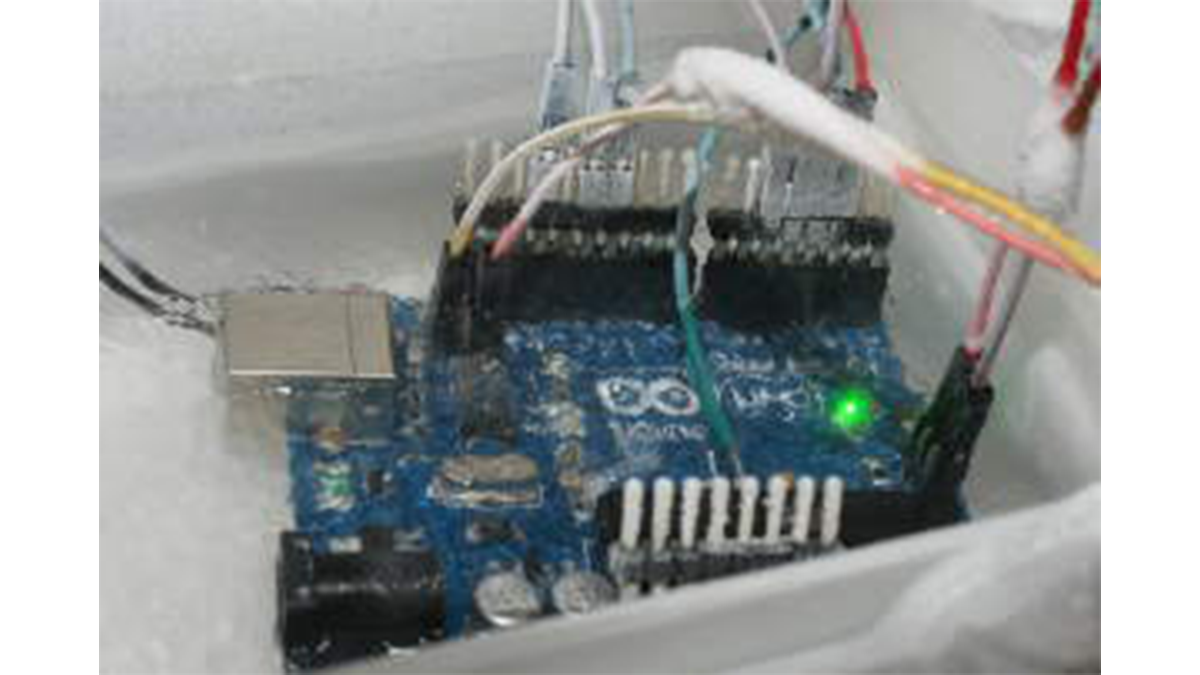
2) Why Arduino UNO (ATmega328P-based) while there are many faster microcontrollers? Just because it seems that Arduino is more popular among geeks and amateurs. For practical applications it is easier and cheaper to just use Cortex-M3/M4 based microcontrollers or FPGA (and I had these devboards too).
Overclocking microcontrollers with liquid nitrogen cooling promises to be harder, than overclocking desktop processors : there are no stability tests, no on-board programmable frequency generator (at least on AVR microcontrollers), no programmable supply voltage. Also, it appeared that a number of on-board components were failing – so I had to deal with them individually. Luckily for me all these problems were sorted out at the end.
Liquid Nitrogen
I wanted to play with LN2 for quite some time. It appeared that here in Moscow a number of companies selling it to individuals. Nearest to my home was NII KM – 1.5$/liter while some other companies were shamelessly asking 8$/liter.
Liquid Nitrogen is literally made from air – it’s liquefied and gases are separated in fractionating column. Another way – separate nitrogen from the air first (using for example zeolite filter) and then liquefy. It appeared that there are even compact machines making liquid nitrogen from the air, electricity cost for manufacturing 1 liter of LN2 is ~0.15-0.3$/liter. Now I definitely know what I going to to ask Santa
For more detail: Overclocking Arduino with liquid nitrogen cooling
- Why did the author choose the Arduino UNO?
The author chose it because Arduino is more popular among geeks and amateurs, even though faster options like Cortex-M3/M4 or FPGA exist. - What are the main challenges when overclocking microcontrollers with liquid nitrogen?
Challenges include the absence of stability tests, on-board programmable frequency generators, and programmable supply voltage, along with failing on-board components. - How much does liquid nitrogen cost from the nearest vendor mentioned?
The nearest vendor, NII KM, sells liquid nitrogen for 1.5 dollars per liter. - Can you make liquid nitrogen at home using electricity?
Yes, compact machines can manufacture liquid nitrogen from air, costing approximately 0.15 to 0.3 dollars per liter in electricity. - Is overclocking microcontrollers harder than desktop processors?
Yes, it is harder because there are no stability tests and specific hardware controls like frequency generators are often missing. - Did the author encounter any component failures during the project?
Yes, a number of on-board components failed, requiring individual attention to sort out the problems.
