
Summary of TI has low noise chip for monitoring brain waves
The ADS1299 is an 8-channel, simultaneous-sampling, 24-bit ΔΣ ADC with integrated PGAs, internal reference and oscillator, designed for low-noise EEG and biopotential measurement. It supports data rates from 250 SPS to 16 kSPS, programmable gains, lead-off detection, bias drive, and flexible power modes. Cascadable for high-channel systems, it targets compact, low-power medical and research EEG/ECG applications.
Parts used in the ADS1299 Project:
- ADS1299 8-channel, 24-bit ΔΣ ADC with PGA (TQFP-64)
- Analog supply (4.75 V to 5.25 V)
- Digital supply (1.8 V to 3.6 V)
- External reference (optional)
- Pull-up or pull-down resistors for lead-off detection (optional)
- Excitation current sink or source for lead-off detection (optional)
- SPI-compatible serial interface wiring
- Bias drive amplifier connections (internal)
- Onboard oscillator (internal)
Description
The ADS1299 is a low-noise, multichannel, simultaneous-sampling, 24-bit, delta-sigma (ΔΣ) analog-to-digital converter (ADC) with a built-in programmable gain amplifier (PGA), internal reference, and an onboard oscillator. The ADS1299 incorporates all commonly-required features for electroencephalogram (EEG) applications.
With its high levels of integration and exceptional performance, the ADS1299 enables the creation of scalable medical instrumentation systems at significantly reduced size, power, and overall cost.
The ADS1299 has a flexible input multiplexer per channel that can be independently connected to the internally-generated signals for test, temperature, and lead-off detection. Additionally, any configuration of input channels can be selected for derivation of the patient bias output signal. The ADS1299 operates at data rates from 250 SPS to 16 kSPS. Lead-off detection can be implemented internal to the device, either with an external pull-up or pull-down resistor or an excitation current sink or source.
Multiple ADS1299 devices can be cascaded in high channel count systems in a daisy-chain configuration. The ADS1299 is offered in a TQFP-64 package specified from –40°C to +85°C.
Features
- Eight Low-Noise PGAs and Eight High-Resolution Simultaneous-Sampling ADCs
- Very Low Input-Referred Noise:
1.0 µVPP (70-Hz BW) - Low Power: 5 mW/channel
- Input Bias Current: 300 pA
- Data Rate: 250 SPS to 16 kSPS
- CMRR: –110 dB
- Programmable Gain: 1, 2, 4, 6, 8, 12, or 24
- Unipolar or Bipolar Supplies:
- Analog: 4.75 V to 5.25 V
- Digital: 1.8 V to 3.6 V
- Built-In Bias Drive Amplifier,
Lead-Off Detection, Test Signals - Built-In Oscillator
- Internal or External Reference
- Flexible Power-Down, Standby Mode
- Pin-Compatible with the ADS1298IPAG
- SPI™-Compatible Serial Interface
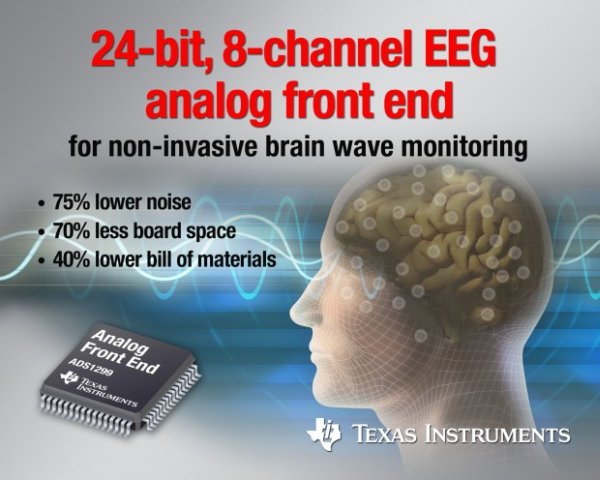
Texas Instruments has introduced a very low noise electroencephalography (EEG) analogue front end AFE device.
It is used for non-invasive monitoring of brain waves. The 24-bit, 8-channel ADS1299 is the first simultaneously sampling EEG AFE with input-referred-noise as low as 1µVpp.
The ADS1299 was designed for manufacturers of extra-cranial biopotential measurement equipment who want to reduce board space, design time and cost while improving performance.
It can be used in EEG equipment to monitor bispectral index, evoked potentials and event-related potentials to diagnose brain injuries, strokes and sleep disorders.
The ADS1299 can also be used in ultra-high-performance medical diagnostic and research-grade electrocardiogram (ECG) equipment.
For more read: TI has low noise chip for monitoring brain waves
- What is the ADS1299 used for?
It is used as a low-noise analog front end for EEG and other biopotential measurements, and can also be used in ECG equipment. - How many channels does the ADS1299 have?
It has eight channels with simultaneous sampling. - What is the resolution of the ADS1299?
It is a 24-bit delta-sigma ADC. - What data rates does the ADS1299 support?
It supports data rates from 250 SPS to 16 kSPS. - Can multiple ADS1299 devices be combined for more channels?
Yes, multiple devices can be cascaded in a daisy-chain configuration for higher channel counts. - What supply voltages are required for the ADS1299?
Analog supply from 4.75 V to 5.25 V and digital supply from 1.8 V to 3.6 V. - Does the ADS1299 include lead-off detection?
Yes, it supports internal lead-off detection using an external pull-up or pull-down resistor or an excitation current sink or source. - What programmable gains does the ADS1299 offer?
Programmable gains of 1, 2, 4, 6, 8, 12, or 24 are available. - Is there an internal oscillator or reference?
It includes a built-in oscillator and supports an internal or external reference.
