
Summary of MorphESP 240 ultimate ESP32-S2 dev board
MorphESP 240 is an open-hardware, Arduino- and CircuitPython-compatible ESP32-S2 development board featuring a built-in 240×240 IPS-color ST7789 display, Wi‑Fi, on-board battery and charging, and ample GPIOs for makers, students, and product designers. It ships from Crowd Supply ($39 US, $9 worldwide shipping) with design files (schematics, KiCAD, DXF/STL/SolidWorks) available for customization and enclosure fabrication; shipping expected March 2021.
Parts used in the MorphESP 240:
- ESP32-S2 WROOM module (240 MHz single-core MCU)
- 240 × 240 pixel ST7789 SPI-driven display (IPS color)
- WS2812B multi-color RGB LED
- JST-connected rechargeable battery
- USB charging module for battery
- 5 V to 3.3 V voltage regulator
- PCB with plenty of GPIO pins
- Kicad project files and schematics (design files)
- DXF, STL, and SolidWorks files for enclosure fabrication
Developers, makers and enthusiasts looking for a ESP32-S2 development board may be interested in the MorphESP 240 created by the development team at Morpheans. The MorphESP 240 is an easy-to-use, Arduino- and CircuitPython-compatible, open hardware ESP32-S2 dev board with a built-in high-resolution, IPS-color display.
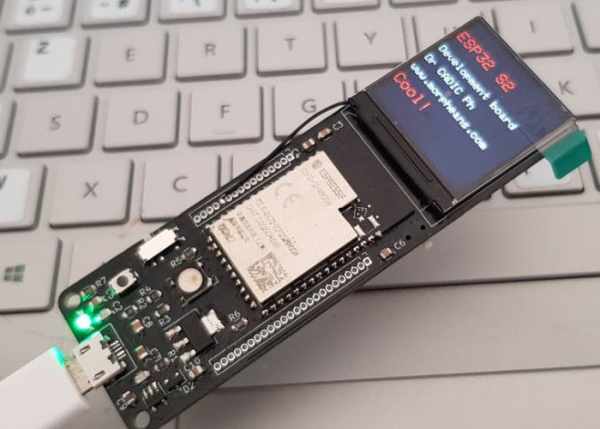
The MorphESP 240 is now available to purchase from the Crowd Supply website priced at $39 with free shipping throughout the United States included. Worldwide delivery is also available for an extra nine dollars and shipping is expected to take place during March 2021.
MorphESP 240 is open source to its core. Please help yourself to our schematics; our KiCAD project source; and the DXF, STL, and Solidworks files you’ll need if you want to lasercut or 3D print yourself an enclosure. And if you want to fabricate your own dev shield, have at it! We only ask that you let us know if you make any improvements.
Whether you’re a student, a maker, or a product designer, MorphESP 240 provides an affordable, versatile, fully-integrated platform with Wi-Fi connectivity. Learn, experiment, and create while avoiding overpriced, proprietary hardware with limited functionality.
The world of possible applications for MorphESP 240 includes IoT gateways, sensor networks, test and measurement equipment, wireless input devices, radio communication platforms, media streaming appliances, imaging technologies, and prototyping projects for just about anything.”
Features of the MorphESP 240 ESP32-S2 board include:
– An ESP32-S2 WROOM with
– A 240 MHz single-core microcontroller
– 128 KB of ROM
– 320 KB of SRAM
– 802.11 b/g/n/ 2.4 GHz Wi-Fi
– An on-board, SPI-driven, 240 x 240 pixel ST7789 display
– A classic, multi-color WS2812B RGB LED
– A built-in, JST-connected battery with a USB charging module
– A 5 V to 3.3 V regulator to feed additional modules
– Plenty of GPIOs to play with
Source: MorphESP 240 ultimate ESP32-S2 dev board
- Can I program the MorphESP 240 with Arduino?
Yes, it is Arduino-compatible according to the article. - Does the MorphESP 240 support CircuitPython?
Yes, the board is CircuitPython-compatible as stated in the article. - What display does the MorphESP 240 use?
It uses a 240 × 240 pixel SPI-driven ST7789 IPS-color display. - Is the MorphESP 240 open source?
Yes, it is open source and provides schematics, KiCAD source, and DXF/STL/SolidWorks files. - Where can I buy the MorphESP 240 and how much does it cost?
It is available on Crowd Supply priced at $39 with free US shipping and $9 for worldwide delivery. - When was shipping expected for the MorphESP 240?
Shipping was expected to take place during March 2021. - Does the MorphESP 240 include Wi-Fi connectivity?
Yes, it includes 802.11 b/g/n 2.4 GHz Wi-Fi via the ESP32-S2 module. - Does the board include a battery and charging circuitry?
Yes, it includes a JST-connected battery and a USB charging module. - Are there voltage regulation options for additional modules?
Yes, it includes a 5 V to 3.3 V regulator to feed additional modules. - What applications are suggested for the MorphESP 240?
The article suggests IoT gateways, sensor networks, test and measurement, wireless input devices, radio platforms, media streaming, imaging, and prototyping.
