
Summary of AN AFFORDABLE EDGE-COMPUTING DEVICE FOR HIGH-PERFORMANCE AND POWER-EFFICIENT ROBOTICS AUTOMATION
snickerdoodle is a palm-sized, full-stack development board by krtkl that serves as a central, software-reconfigurable brain for industrial robotics. It integrates multiple processors, a programmable FPGA, and built-in Wi-Fi/Bluetooth to simplify connectivity, sensor/actuator interfaces, and custom control or vision tasks, reducing development time, cost, and complexity for manufacturers. EU SME Instrument funding supported feasibility, go-to-market planning, and supply-chain setup.
Parts used in the snickerdoodle project:
- Multiple processors (main processor for general-purpose and/or real-time OS)
- Programmable logic FPGA (brain)
- Wireless connectivity modules (Wi-Fi)
- Wireless connectivity modules (Bluetooth)
- Interfaces for sensors and actuators
- Hardware-software platform components for integration, control and monitoring
- Power and component integration elements (as required for board)
Industrial automation offers greater quality control, flexibility and safety for manufacturing. snickerdoodle is a customisable, affordable, palm-sized device that minimises the time, effort and cost of setting up industrial robotics.
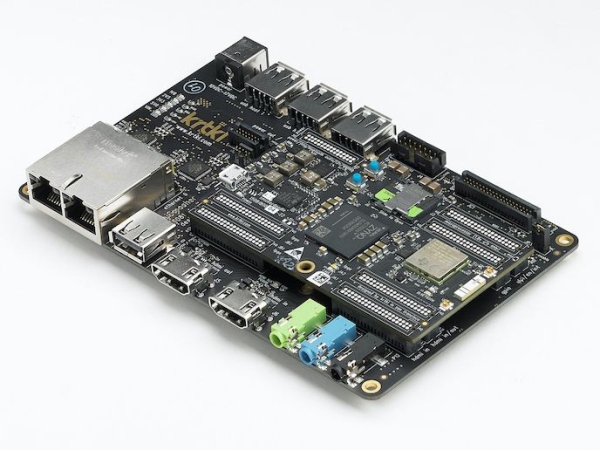
Older manufacturing systems lack the benefits of new digital sensing and connectivity technologies (robotics and Internet of Things). But upgrading infrastructure necessitates building hardware-software platforms and customising for performance, power and component integration requirements. This involves significant capital and personnel investments, planned well in advance. These investments need to be weighed against the risks of manufacturing downtime, avoidable equipment damage and process inefficiencies. Under the snickerdoodle project, krtkl (pronounced ‘critical’) created the first, full-stack development board for robotic systems. This houses a central ‘brain’ for various manufacturing component and subsystem connectivity, integration, control and monitoring operations. As the underlying hardware is software reconfigurable, snickerdoodle simplifies the challenge of enabling interfaces for a wide array of sensors, actuators and communication protocols. This offers operators easy-to-understand information and control options. EU SME Instrument funding enabled the project to complete a feasibility assessment and a go-to-market strategy and establish a manufacturing supply chain.
Simplified Implementation And Development Time
snickerdoodle is comprised of multiple processors, software which can be customised by end users who can program the built-in FPGA and wireless connectivity. All this is contained in a device the size of a business card. The main processor runs general purpose and/or real-time operating systems to take care of higher-level tasks, such as machine-to-machine networking or motor control loops. The programmable logic, or FPGA (the ‘brain’), allows both customisation of a system’s inputs and outputs, ranging from interfacing with motors and sensors to becoming a pure video-processing machine. This can be useful in production line monitoring, or computer vision, for example. The FPGA also runs complex control and data-processing algorithms. The system has built-in Wi-Fi and Bluetooth to make integration with modern networks more straightforward. “After years of working in mechatronics and embedded systems, developing one-off solutions for companies to bring new automation products to market, it became obvious that what was needed was a central ‘brain’. This needed to be quickly and easily adaptable to meet the requirements of each specific application,” explains project coordinator Ryan Cousins.
Read more: AN AFFORDABLE EDGE-COMPUTING DEVICE FOR HIGH-PERFORMANCE AND POWER-EFFICIENT ROBOTICS AUTOMATION
- What is snickerdoodle?
snickerdoodle is a palm-sized, full-stack development board that acts as a central, software-reconfigurable brain for robotic systems. - Can snickerdoodle be customised by end users?
Yes, end users can customise the software and program the built-in FPGA. - Does snickerdoodle include wireless connectivity?
Yes, the device has built-in Wi-Fi and Bluetooth for network integration. - What functions does the main processor perform?
The main processor runs general-purpose and/or real-time operating systems for higher-level tasks like machine-to-machine networking and motor control loops. - How does the FPGA contribute to the system?
The FPGA allows customisation of inputs and outputs, runs complex control and data-processing algorithms, and can be configured for tasks like video processing or computer vision. - Does snickerdoodle aim to reduce development time and cost?
Yes, it minimises time, effort and cost of setting up industrial robotics by simplifying interfaces and integration. - What problems does snickerdoodle address in older manufacturing systems?
It addresses lack of modern digital sensing and connectivity by providing a reconfigurable platform for integrating sensors, actuators and communication protocols. - Was external funding used for the project?
Yes, EU SME Instrument funding supported a feasibility assessment, go-to-market strategy, and establishing a manufacturing supply chain.
