
Summary of BRINGING LOW POWER MACHINE LEARNING TO ENDPOINT IOT DEVICES
QuickLogic and Antmicro launched QuickFeather, a low-power IoT development board featuring the EOS S3 FPGA-enabled SoC. This open-source hardware supports Zephyr RTOS and Renode simulation, enabling efficient machine learning prototyping. The board integrates an Arm Cortex-M4F MCU with eFPGA logic, various sensors, and USB power options, compatible with Adafruit Feather PCB extensions for rapid deployment.
Parts used in the QuickFeather:
- EOS S3 FPGA-enabled SoC
- Arm Cortex-M4F MCU
- 16-Mbit flash memory
- MC3635 accelerometer
- Infineon DPS310 pressure sensor
- Infineon IM69D130 PDM digital microphone
- User button
- RGB LED
- Integrated battery charger
QuickLogic Corporation and Antmicro jointly-announced QuickFeather™, a small form factor development board designed to enable the next generation of low-power Machine Learning (ML) capable IoT devices. On top of the open source hardware design, available on GitHub today, Antmicro has also added support for the QuickFeather board in the Zephyr Real Time Operating System (RTOS) as well as in its open source Renode simulation framework.
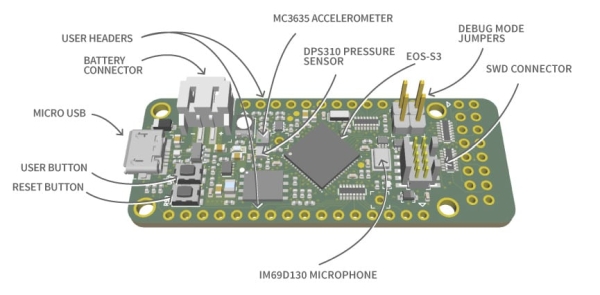
The QuickFeather board is powered by QuickLogic’s EOS™ S3, the first FPGA-enabled SoC to be fully supported in the Zephyr RTOS, with flexible eFPGA logic integrated with an Arm Cortex®-M4F MCU and functionality such as:
- 16-Mbit of flash memory
- MC3635 accelerometer
- Infineon DPS310 pressure sensor
- Infineon IM69D130 PDM digital microphone
- User button and RGB LED
- Powered from USB or a single Li-Po battery
- Integrated battery charger
- USB data signals tied to programmable logic
The QuickFeather development board was created to give developers a powerful and effective way to explore the functionality of the EOS S3 platform and enable compatibility with extensions available for the Feather PCB format from Adafruit, recently also added as a Zephyr Project member.
As announced in late 2019, the EOS S3 is supported in Antmicro’s Renode open source simulation framework for rapid prototyping, development and testing of multi-node systems, offering a more efficient hardware/software co-design approach. Utilizing Renode gives developers the flexibility and functionality to fully evaluate the QuickFeather development board across a number of deployment and configuration scenarios with or without access to hardware.
Read more: BRINGING LOW POWER MACHINE LEARNING TO ENDPOINT IOT DEVICES
- What is the QuickFeather board designed for?
It is designed to enable the next generation of low-power Machine Learning capable IoT devices. - Which operating system does the EOS S3 support on this board?
The EOS S3 is the first FPGA-enabled SoC fully supported in the Zephyr Real Time Operating System. - Can developers simulate the QuickFeather board without hardware?
Yes, Antmicro added support for the board in the Renode open source simulation framework for testing without access to hardware. - How is the QuickFeather board powered?
The board can be powered from USB or a single Li-Po battery. - Does the board have compatibility with other hardware formats?
It enables compatibility with extensions available for the Feather PCB format from Adafruit. - What type of processor is integrated into the EOS S3 chip?
The chip integrates flexible eFPGA logic with an Arm Cortex-M4F MCU. - Is the hardware design for the QuickFeather board open source?
Yes, the open source hardware design is available on GitHub. - What specific sensors are included on the board?
The board includes an MC3635 accelerometer, an Infineon DPS310 pressure sensor, and an Infineon IM69D130 PDM digital microphone.
