
Summary of BOXER-6641: DELIVERING MORE POWER FOR INDUSTRIAL COMPUTING
AAEON introduces the BOXER-6641, a high-performance fanless box PC featuring 8th Gen Intel Core and Xeon processors. It offers unmatched flexibility with two chipset options (H310 or C246), supporting up to 71W CPUs, 32GB DDR4 RAM, and dual hard drives. Designed for harsh environments, it includes wide voltage input, an all-metal chassis, and a broad operating temperature range. The system features extensive I/O, including six COM ports, multiple USB 3.2 ports, four Gigabit Ethernet ports, and two mPCIe slots for AI expansion.
Parts used in the BOXER-6641:
- 8th Generation Intel Core processors
- Xeon processors
- H310 chipset
- C246 chipset
- ECC or non-ECC DDR4 2666MHz RAM
- Two hard drive bays
- Six COM ports
- Up to eight USB 3.2 Gen 1 ports
- Four Intel Gigabit Ethernet ports
- Intel i219 chipset
- Intel vPRO support
- Active Management Technology (AMT)
- Two mPCIe slots
- AI Core X with Intel Movidius Myriad X VPU
- All-metal chassis
- Top heatsink
- Bottom panel
AAEON, an award-winning leader in industrial computing, announces the BOXER-6641, their latest fanless box PC, featuring 8th Generation Intel® Core™ and Xeon® processors. The BOXER-6641 is the most powerful fanless solution currently available on the market.
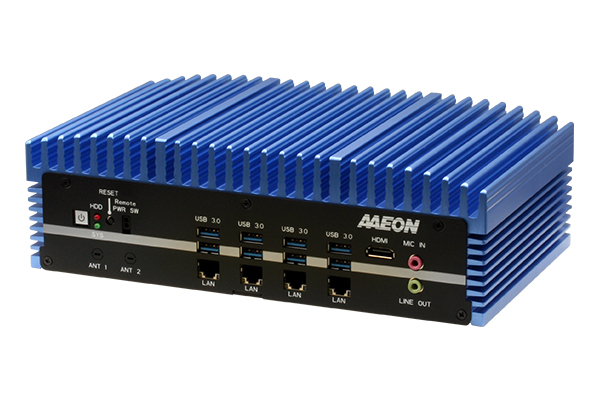
The BOXER-6641 is designed to provide users with unmatched flexibility and performance. Available with two chipsets, the H310 (BOXER-6641-A1) and C246 (BOXER-6641-A2), the system offers a range of processors from the 8th Generation Intel® Core™ and Xeon® processor family (formerly Coffee Lake), from Celeron® G4900T and Pentium® G5400T up to Xeon® E-2124G (up to 71W). Combined with up to 32GB of ECC or non-ECC DDR4 2666MHz RAM and support for two hard drives, the BOXER-6641 is currently the most powerful fanless industrial system available on the market.
The BOXER-6641 is built to easily integrate into any industrial application. I/O features include six COM ports and up to eight USB 3.2 Gen 1 ports (A2 model). The BOXER-6641 also comes with four Intel® Gigabit Ethernet ports, including one Intel® i219 chipset, with built-in support for Intel® vPRO and Active Management Technology (Intel® AMT) available on BOXER-6641-A2. The BOXER-6641 is expandable with two mPCIe slots, capable of supporting AI applications with solutions such as AAEON’s AI Core X with Intel® Movidius® Myriad™ X VPU.
The BOXER-6641 is designed with several key features to ensure reliable service in harsh industrial environments. In addition to fanless construction, the BOXER-6641 offers wide voltage input of 10V to 35V, wide operating temperature range from -20°C to 55°C (-20°C to 45°C with 71W processor), and an all-metal chassis. The BOXER-6641 is easy to maintain, with only six screws needed to remove the top heatsink to access the CPU, and removing the bottom panel provides easy access to the memory and storage devices.
Read more: BOXER-6641: DELIVERING MORE POWER FOR INDUSTRIAL COMPUTING
- What is the most powerful fanless solution currently available on the market?
The BOXER-6641 is currently the most powerful fanless industrial system available on the market. - Which chipsets are available for the BOXER-6641?
The system is available with the H310 chipset (BOXER-6641-A1) and the C246 chipset (BOXER-6641-A2). - How much RAM does the BOXER-6641 support?
The system supports up to 32GB of ECC or non-ECC DDR4 2666MHz RAM. - Can the BOXER-6641 support AI applications?
Yes, it is expandable with two mPCIe slots capable of supporting AI applications like AAEON's AI Core X with Intel Movidius Myriad X VPU. - What is the operating temperature range of the BOXER-6641?
The operating temperature range is -20°C to 55°C, or -20°C to 45°C when using a 71W processor. - How many COM ports does the BOXER-6641 feature?
The BOXER-6641 features six COM ports. - Does the BOXER-6641 support Active Management Technology?
Yes, Active Management Technology (Intel AMT) is available on the BOXER-6641-A2 model. - How easy is it to maintain the BOXER-6641?
Maintenance is easy as only six screws are needed to remove the top heatsink, and removing the bottom panel provides access to memory and storage.
