
Summary of SEEED’S ODYSSEY – STM32MP157C SBC FEATURES CORTEX-A7 AND M4 PROCESSOR
SeeedStudio's Odyssey-STM32MP157C is a single-board computer featuring an NPi-STM32MP157C baseboard and SOM-STM32MP157C system-on-module. Powered by an STMicroelectronics Arm Cortex-A7/M4 hybrid SoC, it offers high energy efficiency, up to 20% better single-thread performance than the Cortex-A5, and a 209 MHz Cortex-M4 core with FPU and DSP instructions. The board supports external SDRAM up to 8 Gbit, includes a Vivante GPU for 3D graphics, and provides extensive peripherals like ADCs, DACs, timers, RNG, and cryptographic acceleration.
Parts used in the Odyssey-STM32MP157C:
- NPi-STM32MP157C baseboard
- SOM-STM32MP157C system-on-module
- STMicroelectronics Arm Cortex A7/M4 hybrid SoC
- Cortex-A7 processor
- Cortex-M4 32-bit RISC core
- External SDRAM interface
- Vivante 3D graphics processing unit
- Two ADCs and two DACs
- Low-power RTC
- Twelve general-purpose 16-bit timers
- True random number generator (RNG)
- Cryptographic acceleration cell
- Digital filters for sigma-delta modulators
Odyssey-STM32MP157C joins τηε growing list of SBCσ developed by SeeedStudio. It comprises a baseboard device called the NPi-STM32MP157C and an SoM device based on an STMicroelectronics’ Arm Cortex A7/M4 hybrid SoC called the SOM-STM32MP157C.
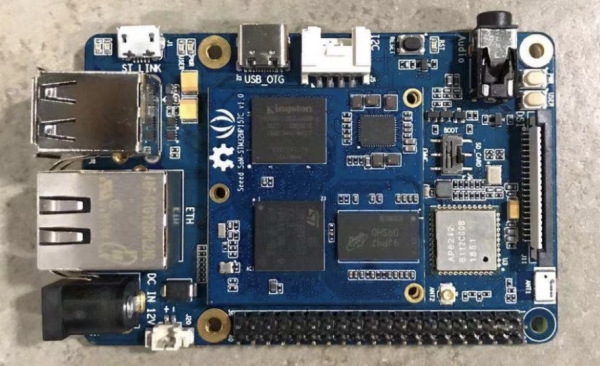
SeeedStudio explains that it’s choice of the Cortex-A7 processor comes from it being a very energy efficient applications processor as it was designed to provide rich performance for high-end wearables, and other low-power embedded and consumer applications. It provides up to 20% more single-thread performance than the Cortex-A5 and provides similar performance to the Cortex-A9.
The device also embeds a Cortex -M4 32-bit RISC core operating at up to 209 MHz frequency. Cortex-M4 core features a floating-point unit (FPU) single precision which supports Arm single-precision data-processing instructions and data types. The Cortex-M4 supports a full set of DSP instructions and a memory protection unit (MPU) which enhances application security.
It provides an external SDRAM interface supporting external memories up to 8-Gbit density (1 Gbyte), 16 or 32-bit LPDDR2/LPDDR3 or DDR3/DDR3L up to 533 MHz.
The STM32MP157C also embeds a 3D graphics processing unit (Vivante – OpenGL ES 2.0) running at up to 533 MHz, with performances up to 26 Mtriangle/s, 133 Mpixel/s
The device offers two ADCs, two DACs, a low-power RTC, 12 general-purpose 16-bit timers, two PWM timers for motor control, five low-power timers, a true random number generator (RNG), and a cryptographic acceleration cell. The devices support six digital filters for external sigma-delta modulators (DFSDM) and also features standard and advanced communication interfaces
Read more: SEEED’S ODYSSEY – STM32MP157C SBC FEATURES CORTEX-A7 AND M4 PROCESSOR
- What components make up the Odyssey-STM32MP157C?
The device comprises a baseboard called the NPi-STM32MP157C and an SoM device called the SOM-STM32MP157C. - Why did SeeedStudio choose the Cortex-A7 processor?
It was chosen because it is very energy efficient and designed for high-end wearables and low-power embedded applications. - How does the Cortex-A7 performance compare to other cores?
It provides up to 20% more single-thread performance than the Cortex-A5 and similar performance to the Cortex-A9. - What are the specifications of the Cortex-M4 core?
It operates at up to 209 MHz and features a floating-point unit, DSP instructions, and a memory protection unit. - Does the STM32MP157C support external memory?
Yes, it has an external SDRAM interface supporting memories up to 8-Gbit density. - What graphics capabilities does the device offer?
It embeds a Vivante GPU running at up to 533 MHz with OpenGL ES 2.0 support. - Which communication and peripheral interfaces are included?
The device offers two ADCs, two DACs, twelve general-purpose timers, five low-power timers, and digital filters. - Is there security hardware available on the board?
Yes, it includes a true random number generator and a cryptographic acceleration cell.
