
Summary of NEW ARTIX-7 FPGA BOARD WITH M.2 INTERFACE FITS IN A LAPTOP
The Aller board enables FPGA-based acceleration by fitting into standard 2280 M.2 M-key slots found in modern laptops, desktops, and servers. It utilizes a Xilinx Artix-7 100T FPGA to offer a cost-effective solution for developing and integrating PCI Express designs. The board supports PCIe Gen1, includes DDR3 memory, and allows for seamless operation with open-source IP cores like litepcie, making it ideal for experimentation and various acceleration applications without requiring additional power sources.
Parts used in the Aller Board:
- Xilinx Artix 7 FPGA (XC7A100T-1FGG484C)
- 2Gb DDR3 (MT41J128M16JT-125:K TR)
- Onboard 1Gb QSPI flash memory
- JTAG header
- 100 MHZ CMOS oscillator
- Trusted Platform Module (AT97SC3205)
- M.2 Connector Interface, M-Key
- 1 RGB LED
- M.2-to-PCI Express Adapter (optional)
The Aller board is specifically designed for development and integration of FPGA based accelerated features into other larger designs, it can be used with laptops, desktops, and servers featuring standard 2280 M.2 form factor M-key slot.
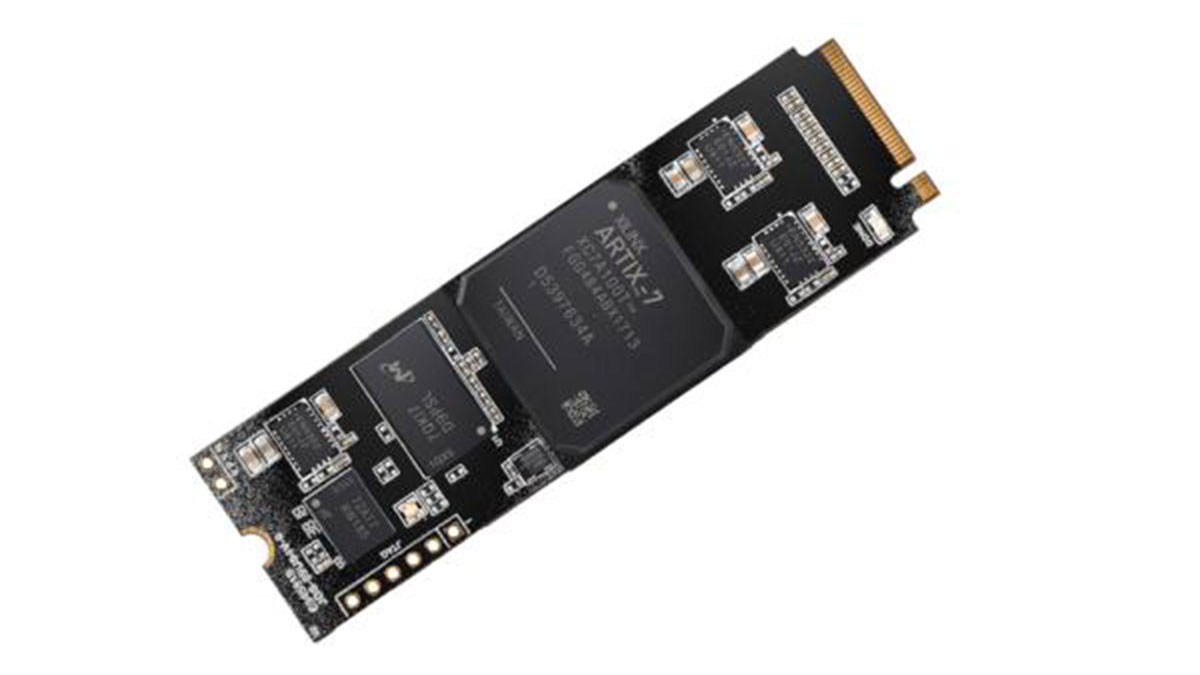
Nowadays, most of the new laptops come with M.2 M-key slots for NVMe storage modules and Aller can be seamlessly used with those slots. Open source PCI Express IP cores such as litepcie make the development of PCIe designs very cost-effective.
According to Rohit Sigh, Head of Development at the FPGA Division of Numato Lab, Aller was designed to help users with easier access to flexible and reconfigurable PCI Express infrastructure. With the decline of standard PCs and proliferation of M.2 connectors in Laptops, Servers and Desktop PCs, Aller breaks the barrier to PCI Express designs. Aller can also be used with standard PCI Express slots using M.2-to-PCI Express Adapter without any loss of functionality.
Aller is targeted for the users who want to experiment with PCI Express based FPGA designs using simple and cost-effective hardware. But this does not limit the usage of Aller. It can be used for a variety of PCIe acceleration applications.
The board features a Xilinx Artix-7 100T FPGA, the second-most powerful FPGA in the Artix-7 family. Xilinx FPGAs are at the forefront of the FPGA technology and are the most widely used FPGAs globally. The competitive pricing of Artix-7 puts Aller in the category of affordable PCI Express boards.
Features
- Device: Xilinx Artix 7 FPGA (XC7A100T-1FGG484C)
- DDR3: 2Gb DDR3 ( MT41J128M16JT-125:K TR )
- 4 lane PCIe Gen1 (2.5GT/s)
- Onboard 1Gb QSPI flash memory for FPGA configuration
- JTAG header for programming and debugging
- 100 MHZ CMOS oscillator
- 1 x Trusted Platform Module (AT97SC3205)
- M.2 Connector Interface, M-Key
- Powered from M.2 connector
- 1 RGB LED for custom use
The Artix-7 100T FPGA features ~101K LUTs, ~126K Flip-flops, ~600KiB Block RAM and 240 DSP slices making it very suitable for acceleration applications.
Read more: NEW ARTIX-7 FPGA BOARD WITH M.2 INTERFACE FITS IN A LAPTOP
- What is the primary purpose of the Aller board?
The Aller board is designed for the development and integration of FPGA based accelerated features into larger designs. - Can the Aller board be used with laptops?
Yes, it fits seamlessly into standard 2280 M.2 form factor M-key slots found in most new laptops. - Does the Aller board require external power?
No, the board is powered directly from the M.2 connector. - Which FPGA chip does the Aller board feature?
The board features a Xilinx Artix-7 100T FPGA (XC7A100T-1FGG484C). - How many lanes of PCIe does the Aller board support?
The board supports 4 lane PCIe Gen1 operating at 2.5GT/s. - Is an adapter required to use the board in a desktop?
An M.2-to-PCI Express Adapter can be used with standard PCI Express slots without any loss of functionality. - What memory components are included on the board?
The board includes 2Gb DDR3 and 1Gb QSPI flash memory for configuration. - Can the Aller board be used with open source tools?
Yes, it works with open source PCI Express IP cores such as litepcie for cost-effective design development.
