
Summary of DIY IKEA Wireless Qi Charging
The article details a DIY wireless charging solution for the Mikroelektronika Hexiwear, addressing its limited USB connector lifespan by repurposing IKEA VITAHULT Qi receivers. The author disassembled these inexpensive covers to extract the internal receiver coil and circuit board, noting the presence of a Flux Field Directional Material (FFDM) that enhances efficiency. This approach bypasses the need for proprietary Apple-compatible hardware or complex custom builds, offering a cost-effective method to add wireless charging capability to the device.
Parts used in the Hexiwear Wireless Charging Project:
- Mikroelektronika Hexiwear
- IKEA VITAHULT Qi receivers
- Qi Wireless Charging Transmitter (Adafruit kit)
- Flux Field Directional Material (FFDM)
- Receiver coil
- Receiver circuit
- Battery connector
The Achilles Heel of the Mikroelektronika Hexiwear is its charging: the charging and USB connector are only designed for a limited number of plug-unplug cycles, and it does not have a wireless charging capability like the Apple iWatch. Until now! I have built a DIY wireless charging system for the Hexiwear ? :
Wireless Qi Charging? IKEA!!!!
I have been experimenting with wireless charing for a few weeks, including building a Qi charging station using a kit from Adafruit (see “Qi Wireless Charging Transmitter with 3D Printed Enclosure“). The problem is that getting Qi charging receivers seems not to be that simple. With my research I have found that the Apple iWatch is using Qi technology, but they tweaked it in a way that it only works with the Apple chargers/receivers (see “Apple tweaked the Qi charging standard so that Apple Watch only works with its own chargers“). Interestingly, the furniture company IKEA is selling Qi transmitters and receivers (http://www.ikea.com/us/en/catalog/categories/departments/wireless_charging/). To my surprise, when I visited a nearby IKEA store yesterday, the older iPhone and Samsung Galaxy S4 (VITAHULT) Qi receivers were on sale for CHF 0.95 (about US$1): what could be wrong with buying a few of them? At this point, I should probably mention the ‘rolling eyes’ of my wife ;-).
Opening
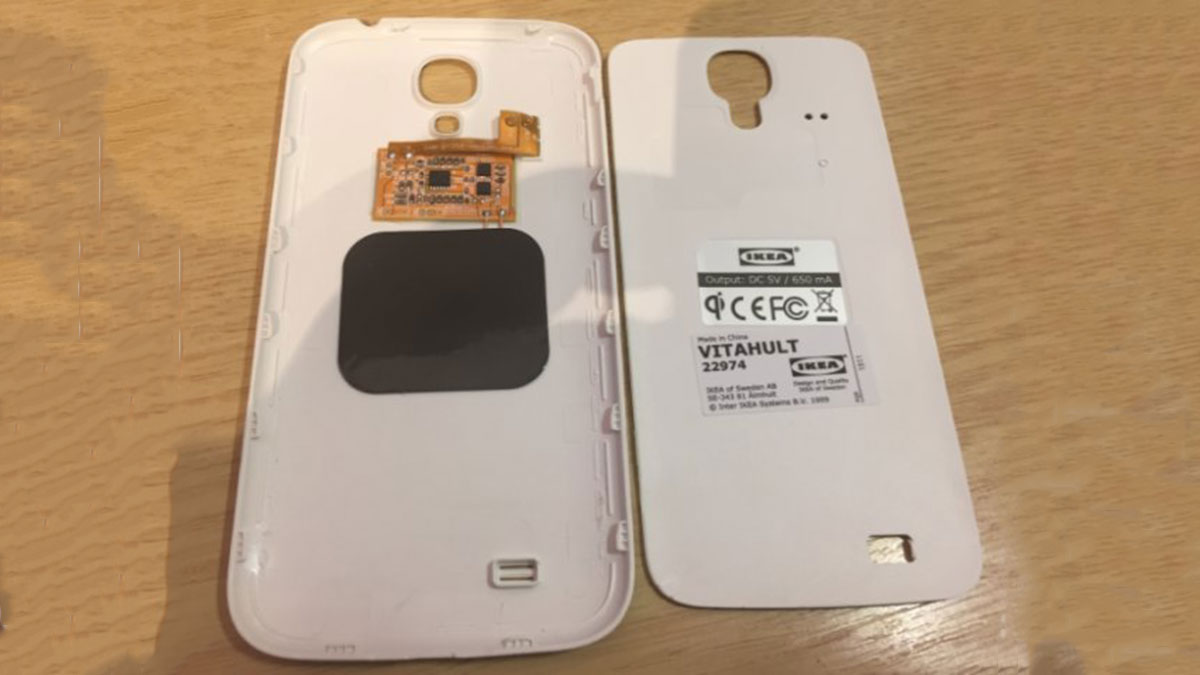
The question is: can I use these for my projects? So I decided to open up the wireless phone cover. The cover has to plastic parts, and with a bit tweaking I was able to separate them. Insider there is the battery connector, the receiver circuit and the charging coil under a black FFDM (Flux Field Directional Material):
The FFDM is a high magnetic permeability and low energy loss material which enhances the power transfer efficiency. The FFDM can be easily removed. Under the FFDM there is the receiver coil:
Read more: DIY IKEA Wireless Qi Charging
- What is the main problem with the Hexiwear's original charging?
The charging and USB connector are only designed for a limited number of plug-unplug cycles. - Can I use IKEA products for this project?
Yes, the older iPhone and Samsung Galaxy S4 VITAHULT Qi receivers from IKEA can be used. - How much did the IKEA receivers cost?
The receivers were sold for CHF 0.95, which is about US$1. - What material is located under the black FFDM?
Under the FFDM there is the receiver coil. - What does FFDM stand for?
FFDM stands for Flux Field Directional Material. - Does the FFDM enhance power transfer efficiency?
Yes, it is a high magnetic permeability and low energy loss material that enhances power transfer efficiency. - How did the author separate the plastic parts of the cover?
The author separated them with a bit of tweaking. - Why was the Apple iWatch mentioned?
It was mentioned because it uses Qi technology but has been tweaked to only work with Apple chargers.
