
Summary of A very simple DIY solar-powered USB charger
Summary: I made a simple DIY solar USB charger for a TP-Link 10400mAh power bank using a 6V/3.5W solar panel and a TD1410-based 5V buck converter module. I wired the solar panel outputs to the buck converter input, used its built-in input diode for polarity protection, and mounted the enclosed converter on the panel. The TD1410 supports 5V output with input from 5.5V–20V and up to 2A output.
Parts used in the DIY solar-powered USB charger:
- 6V 3.5W solar panel
- TD1410-based 5V step-down buck converter module with USB-A female output
- Two wires for input connection
- Plastic enclosure for the buck converter (included with module)
- Adhesive/glue to mount the converter to the panel
I built a very simple DIY solar-powered USB charger for my TP-link 10400mAh USB Power Bank. All I needed was a 6V/3.5W solar panel and the TD1410-based 5V buck converter module. I bought both of them on Aliexpress for less than $8.
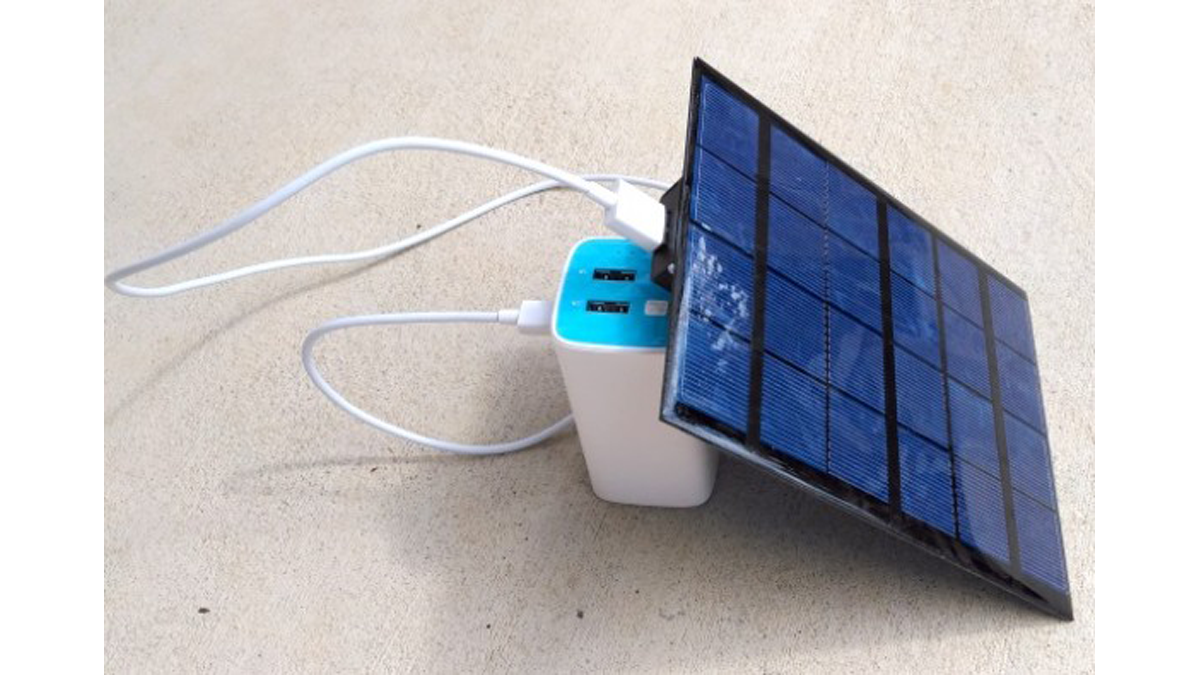
It was one of the easiest projects I built. All I needed to do was to connect the input of the 5V step-down buck converter to the output of the solar panel using two wires.
From TD1410 datasheet,
The TD1410 is a 380 KHz fixed frequency monolithic step down switch mode regulator with a built in internal Power MOSFET. It achieves 2A continuous output current over a wide input supply range with excellent load and line regulation. The device includes a voltage reference, oscillation circuit, error amplifier, internal PMOS and etc.
For 5V output from TD1410, the input voltage can range from 5.5V to 20V (from the datasheet). I measured the solar panel open-circuit voltage under sunny conditions to be ~ 6.5V. Under the load of 200 mA, the solar panel output voltage was reduced to ~6.0V. The TD1410-based 5V buck converter module that I purchased on Aliexpress already has a diode at its input for polarity protection. So I didn’t need any extra diode for the solar panel output as it directly goes to the input of the buck converter. The nice thing about this buck converter is it has a USB-A female port for output, which is same as found in standard USB chargers. It also comes with a plastic enclosure (see pictures below).
The positive and negative outputs from the solar panel connects to the + and – inputs of the buck converter, respectively. I put the buck converter inside the enclosure and glued it on the back of the solar panel as shown below.
Read more: A very simple DIY solar-powered USB charger
- What components did I use to build the solar USB charger?
A 6V/3.5W solar panel, a TD1410-based 5V buck converter module with USB-A output, two wires, the module's plastic enclosure, and glue. - How did I connect the solar panel to the buck converter?
I connected the positive and negative outputs of the solar panel to the + and - inputs of the buck converter using two wires. - Does the buck converter need an extra diode for polarity protection?
No, the purchased TD1410-based module already includes a diode at its input for polarity protection, so I did not add another diode. - What is the measured open-circuit voltage of the solar panel in sun?
About 6.5V under sunny conditions. - What voltage did the solar panel output under a 200 mA load?
The panel voltage dropped to about 6.0V under a 200 mA load. - What input voltage range does the TD1410 support for 5V output?
According to the TD1410 datasheet, the input can range from 5.5V to 20V for 5V output. - How much continuous output current can the TD1410 provide?
The TD1410 achieves 2A continuous output current per the datasheet. - Does the buck converter provide a standard USB output port?
Yes, the module includes a USB-A female port for output, compatible with standard USB chargers.
