
Summary of Create laser range finder using arduino
Summary: The article describes two methods to build a laser rangefinder: a hobbyist approach using an Arduino and a blinkenlight shield to time laser reflections (challenged by Arduino clock resolution), and a professional solution using AMI 7555/7558 Rangefinder/Processor modules that include sensitive receivers, gain control, range correction, and serial interfacing for accurate, long-range measurements.
Parts used in the Arduino speed of light concept:
- Arduino (16 MHz)
- Blinkenlight shield (line scan light sensor)
- Laser pointer
- Mirror
- Optic fiber (optional, for extending path)
Parts used in the 7555/7558 Rangefinder project:
- AMI 7555 Series Rangefinder/Processor assembly (e.g., 7555-04)
- AMI 7558 Series Rangefinder/Processor assembly (e.g., 7558-03, 7558-04)
- 758A or 755A receiver (integrated in assemblies)
- APD detector with built-in high voltage bias supply
- TE cooler and heatsink (7558 Series)
- Interface test board (available for Model 7555)
- Supporting cabling for serial interface
1. TRYING TO MEASURE THE SPEED OF LIGHT WITH AN ARDUINO
We know that measuring the speed of light with an Arduino is possible. It’s just that the implementation is hard.
Last month we saw [Udo]’s blinkenlight shield that can be used as a line scan camera. It’s a neat piece of kit, but [Udo] really wants to submit something for the Buildlounge laser cutter giveaway, so he figured measuring the speed of light would be an easy project. If a kid and a chocolate bar can do it, surely it can’t be too hard.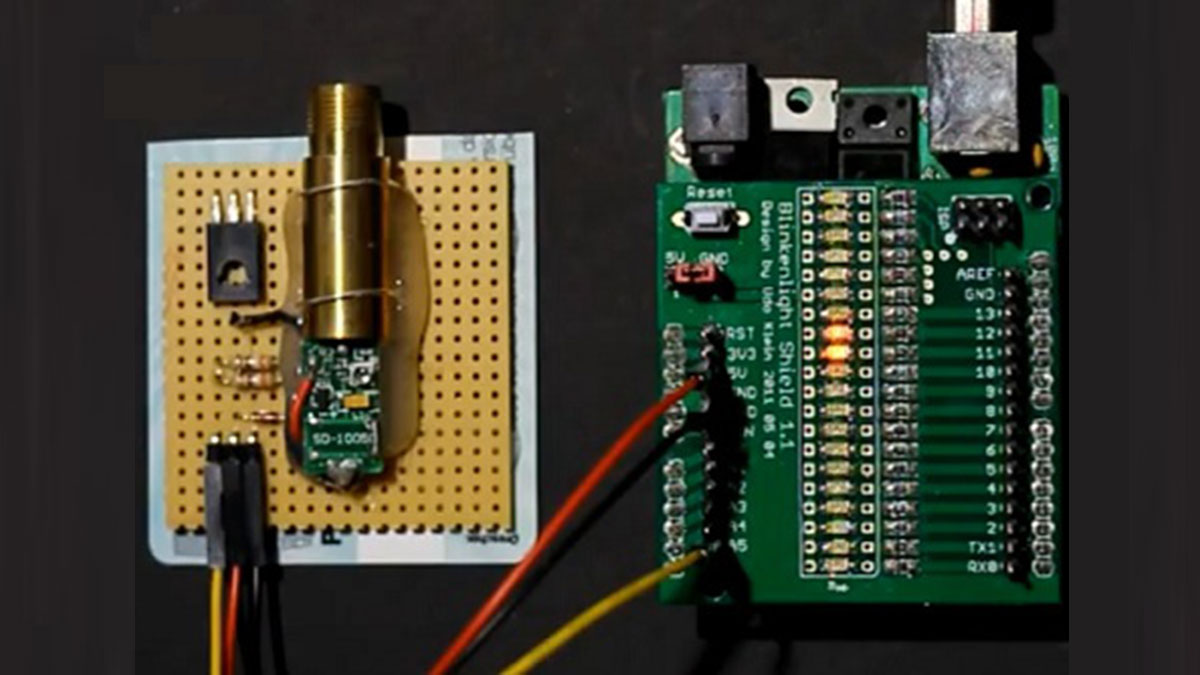
Despite using advanced coding techniques, it is uncertain whether detecting an emitted photon is feasible with clock speeds that are relatively slow. Consider buying a few hundred meters of optic fiber so the whole experiment can be placed on a desk, but please share any alternative suggestions in the comments. The demonstration of Udo’s combination of blinkenlights and lasers can be found below.
2. LASER RANGEFINDER RECEIVERS WITH RANGE PROCESSORS
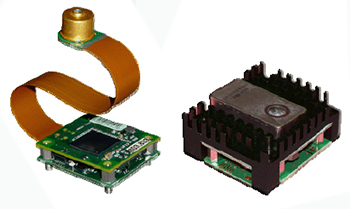
The Rangefinder/Processor assemblies in the 7558 and 7555 Series include a high-performing 758A or 755A receiver with small support electronics to deliver accurate range information to a main system. AMI’s patented technology calibrates the output of serial range data to reduce the impact of range errors caused by factors such as variations in return signal amplitude, including walk. The ability to detect very small amounts enables the use of low power lasers, or instead, operation over long distances. The modules offer high voltage bias, time programmed gain with noise tracking threshold, selection of first, last, and strongest pulses, and range gating. The 7558 line features a TE cooler controller and heatsink. There are also several user-manageable settings accessible through the serial interface. The condensed design enables placement of the optics to achieve the smallest possible system size.
- High Sensitivity down to 3nW (7558 Series)
- Fast Recovery from Overload
- Optimized for Multiple Targets
- Cooled Detector (7558 Series)
- Time Programmed Gain with Noise Tracking Threshold
- High Speed Range Counter
- Range Walk Correction to 1m RMS
- Digitally adjustable: APD Bias, Range Gates, False Alarm Rate
- Built-in HV Bias Supply for APD Detector
| Model | Detector Ø | Sensitivity (Typ) | Multiple Target Resolution (1:1 Low Gain) | Multiple Target Resolution (1:1 High Gain) | Dynamic Range | Min/Max Range |
|---|---|---|---|---|---|---|
| 7555-04 | 200µm | 5nW (20ns) | 15 meters | 30 meters | 106:1 | 50m to 65km |
| 7558-03 | 80µm | 3nW (6ns) | 10 meters | 20 meters | 107:1 | 50m to 65km |
| 7558-04 | 200µm | 5nW (6ns) | 10 meters | 20 meters | 107:1 | 50m to 65km |
Interface test board available for the Model 7555
Application Notes available for most models. Please contact us to request a copy of these ITAR controlled documents.
Specifications are typical and are subject to change without notice. See data sheet for details.
In the event these commodities will be transferred to a “foreign person” as defined in 22 CFR 120.16,either outside or within the United States, a validated US State Department license is required.
- Can an Arduino measure the speed of light?
The article says it is possible but implementation is hard due to Arduino clock resolution limiting distance measurement per clock cycle. - Why is Arduino timing challenging for laser reflection measurements?
At 16 MHz an Arduino covers about 19 meters per clock cycle, making precise photon detection difficult. - What simple components were used in the Arduino concept?
The concept uses an Arduino, blinkenlight shield as sensor, a laser pointer, a mirror, and optionally optic fiber. - What do the 7555 and 7558 Rangefinder/Processor assemblies provide?
They provide high-performing receivers with support electronics, serial range data, gain control, range gating, and range walk correction. - Do the 7558 modules include cooling?
Yes, the 7558 line features a TE cooler controller and heatsink. - Can the rangefinder modules handle low return signal amplitudes?
Yes, patented calibration and sensitivity enable detection of very small return signals, allowing low power lasers or long distances. - Are interface boards and application notes available?
An interface test board is available for Model 7555 and application notes are available for most models upon request. - What typical sensitivity is listed for the modules?
The 7558 Series lists sensitivity down to 3 nW (typically 6 ns); some 7555/7558 models list 5 nW.
