
Summary of Servo powered peristaltic pump controlled by Arduino
This article details the construction of a servo-powered peristaltic pump controlled by an Arduino Uno for transferring small liquid volumes, such as watering a Bonsai tree. The design utilizes a modified continuous-rotation servo, soft drip tubing, and a custom rotor with rollers to compress the tube against a circular casing, ensuring contamination-free and backflow-resistant fluid transfer without seals or check valves.
Parts used in the Servo powered peristaltic pump:
- Servo motor (modified for continuous rotation)
- Arduino Uno
- Soft tubing from a drip system
- Circular pump casing
- Rotating disk (from servo accessories)
- Screws
- Pipes
- Heat shrink tubing
- Rubber bands
This instructable shows you how to make a pump using a servo motor and an Arduino Uno to transfer small amounts of liquids.
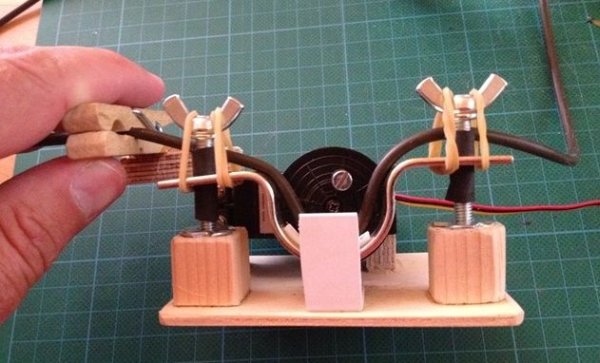
The pump is a peristaltic pump which consists mainly of a motor, flexible tubing and a circular pump casing. Two rollers attached to a turning rotor press the flexible tube to the circular pump casing wall. As the rotor turns, the part of the tube under compression is pinched closed thus forcing the fluid to be pumped to move through the tube (from Wikipedia modified).
Step 1: Advantage
Beside the fact that it is quite easy to make, without a seal and not noisy the peristaltic pump principle has the advantage not to contaminate any part of the installation. Because the only part of the pump in contact with the fluid being pumped is the interior of the tube. An aseptic application can be achieved when sterilizing agent is pumped through the tubing first e.g. Ethanol. Moreover the pump design prevents backflow without check valves.
Step 2: Design
The tricky part about the construction is to find tubing which can be compressed. Most tubing’s are quite rigid and therefore the servo motor has not enough power anymore to start rotating. This was solved by the use of soft tubing from a drip system to water plants and a circular pump casing which is pressed against the tube by the use of rubber bands. The pump was built to water a Bonsai tree in the Office.
Step 3: Modifying a standard servo into a continuous rotating servo
I had a standard servo left from a RC plane and therefore had to modify it into a continuous rotating model. Since this modification is widely spread in the Internet I do not describe it here. I was successful with the procedure given in the book “Make: Arduino Bots and Gadgets”, page 207.
Step 4: The rotor
Among the accessories that come along with a servo you will find a disk that can be used perfectly as rotor. The disk should be bigger in diameter than the diameter of the circular pump casing. The rollers (combination of screw, pipe and heat shrink tubing) will be mounted on the rotor. Make two holes in the rotor so the rollers fit into the circular pump casing leaving also some space for the tubing. The pipe should be free to move when put over the screw. A piece of heat shrink tubing is put over the pipe for protection.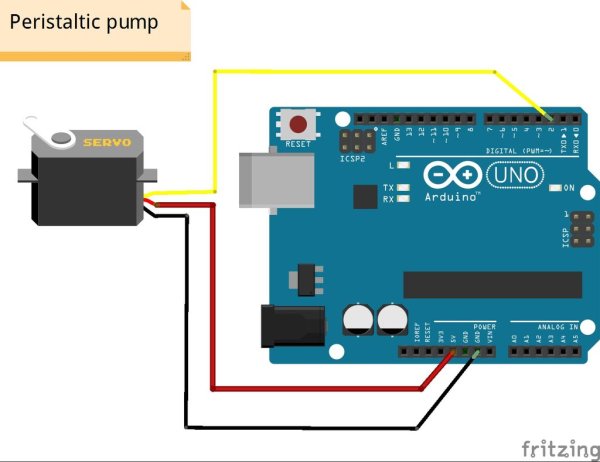
Step 5: The circular pump casing
The circular pump casing is a piece that can be bought in the local do-it-yourself/hardware store. In addition you need screws with a head where you can fix one part of the rubber band. The heat shrink tubing is used as a spacer.
For more detail: Servo powered peristaltic pump controlled by Arduino
- How does the peristaltic pump move fluid?
The turning rotor presses rollers against the flexible tube and circular casing wall, pinching the tube closed to force fluid through. - Can this pump prevent contamination?
Yes, because only the interior of the tube contacts the fluid, allowing for aseptic applications. - Does the pump require check valves to prevent backflow?
No, the pump design prevents backflow without the need for check valves. - What type of tubing is best for this project?
Soft tubing from a drip system for water plants is recommended because rigid tubing may be too difficult for the servo to compress. - How do you modify a standard servo for this project?
A standard servo must be modified into a continuous rotating model, a procedure found in books like Make: Arduino Bots and Gadgets. - What components make up the rollers on the rotor?
The rollers consist of a combination of screws, pipes, and heat shrink tubing. - How is the circular pump casing secured against the tube?
Rubber bands are used to press the circular pump casing against the tube. - Why was this specific pump built?
The pump was constructed specifically to water a Bonsai tree in an office setting.
