
Summary of 8 GHZ SAMPLING OSCILLOSCOPE FOR EXPERIMENTS
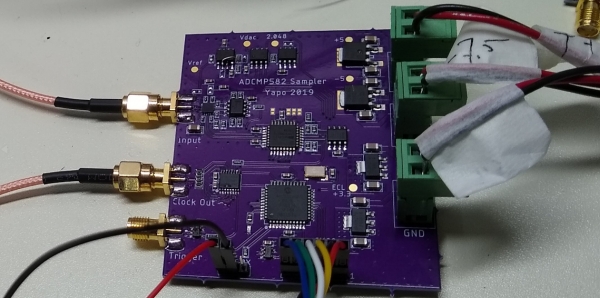
This article describes a budget-friendly, open-source multi-GHz sampling oscilloscope currently in development. It achieves 7–8 GHz bandwidth with >=100 GSa/s equivalent-time sampling using an Analog Devices ADCMP582 latched comparator on SiGe technology. The project consists of separate PCBs for the sampler and timebase calibrator, which are not yet fully integrated. While preliminary tests show rise times between 50 and 70 ps, the system is limited to 10 ns sweeps and requires manual calibration due to temperature drift.
Parts used in the Multi-GHz Sampling Oscilloscope:
- ADCMP582 latched comparator
- Analog Devices SiGe comparator chip
- Sampler PCB
- Timebase calibrator PCB (prototype)
A basic open-source multi-GHz sampling oscilloscope for experimenters on a budget. Still a work-in-progress, with key pieces on separate PCBs, but showing bandwidths in the 7-8 GHz range with >= 100 GSa/s equivalent-time sampling, and around 500 k comparisons/second real time. So far.
Note: this writeup is somewhat out of date, as it doesn’t cover many results that I ended up discussing at Supercon 2019. Until I get a chance to update these pages, you can check out the video of my talk:
This project is the culmination of some of the experiments over on #The Rise and Fall of Pulses. It may or may not have been obvious what the goals of that project were, but this scope was one of them. There are a handful of other designs in the pipeline as well at this stage, using various approaches to the GHz+ waveform sampling problem.
This particular project uses a latched comparator as a voltage sampler, specifically the ADCMP582 from Analog Devices. Built on SiGe, this $20 (single-quantity) comparator has a sampling aperture of 5 ps, and a typical front-end bandwidth of 8 GHz. This ultimately limits the bandwidth of the resulting instrument, but other factors in the current design reduce the system bandwidth into the 6 GHz range. Very preliminary tests estimate the rise time of the scope to between 50 and 70 ps, corresponding to between 7 and 5 GHz bandwidth, respectively. I’m calling it 6 GHz for now, and I expect it can be improved somewhat,
The basic idea is similar to a simple “toy” version I made on the other project with comparators I had on-hand at the time.
This project is a work-in-progress. Specifically, the first prototype that produced these results doesn’t have the capability to calibrate its own timebase, which experiences serious drift with temperature. I have a prototype of the timebase calibrator on another PCB, although the two have yet to be integrated. So, it’s not a scope you can just build and use quite yet.
Another thing that has yet to be integrated is an extended timebase that would allow you to capture longer sweeps. The first prototype is limited to sweeps of 10 ns, and while this is probably OK for many uses of a 6 GHz sampling oscilloscope, longer sweeps are sometimes very useful.
A word of caution: don’t get too excited about this project until you know the difference between a sampling oscilloscope and a real-time oscilloscope: they’re vastly different beasts, suited to different purposes, and behave in different ways. The ubiquity of cheap, real-time, (but low-bandwidth) digitizing scopes has created expectations that sampling scopes, or even analog scopes, can’t meet. For an introduction, you can check out this article on ElectronicDesign.
As usual, the real information for this project is in the build logs.
Read more: 8 GHZ SAMPLING OSCILLOSCOPE FOR EXPERIMENTS
- What is the estimated bandwidth of this oscilloscope?
The instrument shows bandwidths in the 7-8 GHz range with a calculated limit of around 6 GHz due to design factors. - Can this oscilloscope capture long sweeps automatically?
No, the current prototype is limited to sweeps of 10 ns as an extended timebase has not yet been integrated. - Does the timebase require manual calibration?
Yes, the first prototype lacks self-calibration capability and experiences serious drift with temperature. - How fast is the sampling aperture of the core component?
The ADCMP582 comparator features a sampling aperture of 5 ps. - What is the real-time comparison speed of the device?
The system performs approximately 500 k comparisons per second in real time. - Is this project considered complete and ready for immediate use?
No, it is a work-in-progress where key pieces remain on separate PCBs and have not been fully integrated. - What technology does the main comparator chip use?
The ADCMP582 is built on SiGe (Silicon Germanium) technology. - How does this device differ from a real-time oscilloscope?
They are vastly different beasts suited for different purposes and behave in different ways.
