
Summary of 433MHz wireless module configuration
The HC-12 is a low-cost 433MHz wireless serial communication module capable of up to 1800m range. It utilizes the SI4463 RF chip and supports various baud rates and power-saving modes (FU1-FU4) for applications like UAV telemetry, IoT devices, and sensor connectivity. The module accepts 3.2V-5.5V power and features 100 configurable channels with adjustable output power.
Parts used in the HC-12 Wireless Link:
- HC-12 module
- SI4463 RF chip
- Build-in microcontroller
- External antenna
Description
HC-12 are cheap 433MHz wireless serial port communication modules with a range up to 1800m in open space. Each costs about $5 when bought from China, and 2 of them can create wireless UART link that can be used, for example, to transfer telemetry data from UAV. Or drive IoT device. Or connect sensors. Or whatever else one can think of.
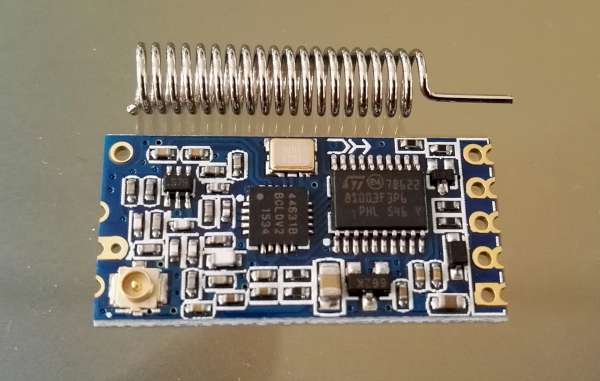
It is based on SI4463 RF chip, has build in microcontroller, can be configured using AT commands and allows to use external antenna. Working frequency is divided into 100 channels starting from 433,4MHz up to 473,0MHz with 400kHz channel separation. Maximum output power is 100mW (20dBm) and receiver sensitivity differs from -117dBm to -100dBm, depending on transmission speed. It accepts 3,2V-5,5V power supply and can be used with 3.3V and 5V UART voltage devices (5V safe).
HC-12 serial port supports following baud rates:
- 1200bps
- 2400bps
- 4800bps
- 9600bps (default)
- 19200bps
- 38400bps
- 57600bps
- 115200bps
Each HC-12 can work in one of following modes:
- FU1 – moderate power saving mode with 250000bps “over the air” baud rate. Serial port baud rate can be set to any supported value
- FU2 – extreme power saving mode with 250000bps “over the air” speed. Serial port rate is limited to 1200bps, 2400bps, 4800bps
- FU3 – default, general purpose mode. “Over the air” speed differs depending on serial port speed. The same goes for maximum range:
* 1200bps ~ 1000m- 2400bps ~ 1000m
- 4800bps ~ 500m
- 9600bps ~ 500m
- 19200bps ~ 250m
- 38400bps ~ 250m
- 57600bps ~ 100m
- 115200bps ~ 100m
- FU4 (available in version 2.3 or newer) – long range mode. “Over the air” speed is limited to 500bps and serial port speed to 1200bps. Because air speed is lower than port speed, only small packets can be send: max 60 bytes with interval of 2 seconds. In this mode range is increased to 1800m.
Pair of HC-12 that creates a wireless link has to work in the same mode (FU1, FU2, FU3, FU4) and with the same speed.
Read more: 433MHz wireless module configuration
- What is the maximum range of the HC-12 module?
The maximum range is up to 1800m in open space when using FU4 long-range mode. - How much does an HC-12 module cost?
Each module costs about $5 when purchased from China. - Can the HC-12 be used with 5V UART devices?
Yes, it is 5V safe and accepts 3.3V or 5V UART voltage devices. - What are the supported baud rates for the HC-12?
Supported rates include 1200bps, 2400bps, 4800bps, 9600bps, 19200bps, 38400bps, 57600bps, and 115200bps. - How many channels does the HC-12 have?
It has 100 channels starting from 433.4MHz up to 473.0MHz with 400kHz separation. - Does the HC-12 support external antennas?
Yes, the module allows the use of an external antenna. - What happens if two HC-12 modules are set to different modes?
A pair must work in the same mode and with the same speed to create a link. - What is the maximum packet size in FU4 mode?
In FU4 long-range mode, only small packets can be sent with a maximum of 60 bytes.
