
Summary of 3D PRINTING A MACRO PAD, SWITCHES AND ALL
This article details James Stanley's project of building a fully 3D-printed macro pad, including printing the mechanical switches themselves. Unlike traditional switches, these printed versions are twice as tall to accommodate an internal printed spring. A testing rig confirmed their durability, showing they can last hundreds of thousands of presses if defects are avoided early. The build requires copper contacts for functionality and is controlled by a USB-HID microcontroller like the Arduino Pro Micro, though an ESP32 could enable Bluetooth connectivity.
Parts used in the 3D Printed Macro Pad:
- 3D printed enclosure
- 3D printed keycaps
- 3D printed switches
- Printed springs
- Copper contacts
- USB-HID capable microcontroller (Arduino Pro Micro)
- ESP32 (optional for Bluetooth)
Building a macro pad inside of a 3D printed enclosure is hardly news these days. Neither is adding 3D printed keycaps to the mix. But if you go as far as [James Stanley] has, and actually print the switches themselves, we’ve got to admit that’s another story entirely.
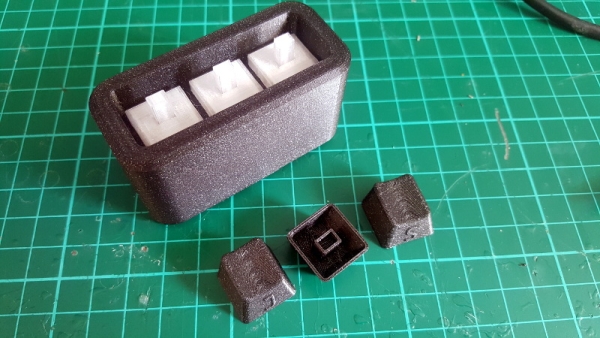
Now you might be wondering how [James] managed to print a mechanical keyboard switch that’s the size of your garden variety Cherry. Well, the simple answer is that he didn’t. While his printed switches have the same footprint as traditional switches, they are twice as tall.
The switches could probably made much smaller if it wasn’t for the printed spring, but using a “real” one would defeat the purpose. Though we do wonder if the mechanical design could be simplified by making it an optical switch.
But can printed switches really stand up to daily use? [James] wondered the same thing, so he built a testing rig that would hit the switches and count how many iterations before they stopped working. This testing seems to indicate that the keys will either fail quickly due to some mechanical defect, or last for hundreds of thousands of presses. So assuming you weed out the duds early, you should be in pretty good shape.
Naturally, there are a few bits of copper inside each printed switch to act as the actual contacts. But beyond that, all you need to build one of these printable pads yourself is a USB-HID capable microcontroller like the Arduino Pro Micro. If you used the ESP32, you could even make it Bluetooth.
Source: 3D PRINTING A MACRO PAD, SWITCHES AND ALL
- How tall are the printed switches compared to standard Cherry switches?
The printed switches are twice as tall as traditional switches. - What component acts as the actual contact inside the printed switch?
Bits of copper inside each printed switch act as the contacts. - Can the macro pad be made with Bluetooth capability?
Yes, using an ESP32 allows the device to make it Bluetooth. - How did the creator test the durability of the printed switches?
[James] built a testing rig that hit the switches to count iterations until failure. - What is the expected lifespan of the printed switches?
They can last for hundreds of thousands of presses if early mechanical defects are weeded out. - Why are the printed switches twice as tall as standard ones?
The extra height is required to fit the printed spring inside. - What microcontroller is recommended for a basic USB-HID version?
An Arduino Pro Micro is suggested as a USB-HID capable microcontroller.
