
Summary of +/- 1.7g Dual-Axis IMEMS Accelerometer Using ADXL203
The ADXL203 is a high-precision, low-power dual-axis accelerometer measuring dynamic and static acceleration with ranges of ±1.7g, ±5g, or ±18g. It features ratiometric sensitivity, adjustable bandwidth via external capacitors, and operates on a single 4.75V to 5.25V supply. Ideal for tilt sensing, vibration monitoring, and vehicle controls, it offers high zero-g bias stability and a wide temperature range.
Parts used in the ADXL203 Accelerometer Project:
- ADXL203 Dual-Axis Accelerometer IC
- Capacitor CX (External)
- Capacitor CY (External)
The ADXL203 Module is high precision, low power, complete dual-axis accelerometers with signal conditioned voltage outputs, all on a single, monolithic IC. The ADXL203 measure acceleration with a full-scale range of ±1.7 g, ±5 g, or ±18 g. The ADXL203 can measure both dynamic acceleration (for example, vibration) and static acceleration (for example, gravity).The typical noise floor is 110 μg/√Hz, allowing signals below 1 mg (0.06° of inclination) to be resolved in tilt sensing applications using narrow bandwidths (<60 Hz).The user selects the bandwidth of the accelerometer using Capacitor CX and Capacitor CY at the XOUT and YOUT pins. Bandwidths of 0.5 Hz to 2.5 kHz can be selected to suit the application.
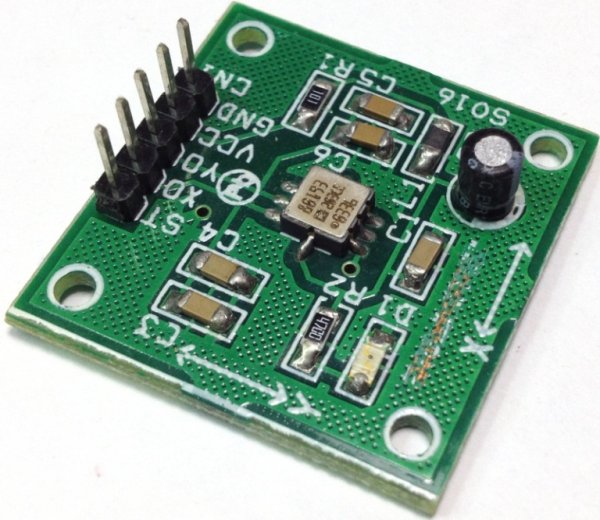
Features
- Supply 4.75V To 5.25V
- Output 1.4V To 3V ( 2.2V Center ) Aproxx.
- High performance, dual-axis accelerometer on a single IC chip
- 5 mm × 5 mm × 2 mm LCC package
- 1 mg resolution at 60 Hz
- Low power: 700 μA at VS = 5 V (typical)
- High zero g bias stability
- High sensitivity accuracy
- −40°C to +125°C temperature range
- X and Y axes aligned to within 0.1° (typical)
- Bandwidth adjustment with a single capacitor
- Single-supply operation
- 3500 g shock survival
- Sensitivity is essentially ratiometric to VCC For VCC = 4.75 V to 5.25 V, sensitivity is 186 mV/V/g to 215 mV/V/g.
- 4 Actual frequency response controlled by user-supplied external capacitor (CX, CY).
- 5 Bandwidth = 1/(2 × π × 32 kΩ × C). For CX, CY = 0.002 μF, bandwidth = 2500 Hz. For CX, CY = 10 μF, bandwidth = 0.5 Hz. Minimum/maximum values are not tested. 6 Self-test response changes cubically with VS.
- 7 Larger values of CX, CY increase turn-on time. Turn-on time is approximately 160 × CX or CY + 4 ms, where CX, CY are in μF.
Applications
- Vehicle dynamic controls
- Electronic chassis controls
- Platform stabilization/leveling
- Navigation
- Alarms and motion detectors
- High accuracy, 2-axis tilt sensing
- Vibration monitoring and compensation
Read more: +/- 1.7g Dual-Axis IMEMS Accelerometer Using ADXL203
- What acceleration ranges can the ADXL203 measure?
The device measures acceleration with full-scale ranges of ±1.7 g, ±5 g, or ±18 g. - How is the bandwidth of the accelerometer selected?
The user selects the bandwidth using Capacitor CX and Capacitor CY at the XOUT and YOUT pins. - Can the ADXL203 measure both dynamic and static acceleration?
Yes, it can measure dynamic acceleration like vibration and static acceleration like gravity. - What is the typical noise floor of this module?
The typical noise floor is 110 μg/√Hz. - What power supply voltage does the ADXL203 require?
The supply voltage ranges from 4.75V to 5.25V. - How does the value of CX and CY affect the turn-on time?
Larger values of CX and CY increase the turn-on time, which is approximately 160 × CX or CY + 4 ms. - What is the resolution at 60 Hz?
The module provides 1 mg resolution at 60 Hz. - Is the sensitivity affected by the supply voltage?
Yes, sensitivity is essentially ratiometric to VCC.
