
Summary of WEMO’S LAUNCHES W600-PICO THAT SUPPORTS MICRO-PYTHON FOR ONLY $2
The W600-PICO is a compact development board by Wemos featuring the Winner Micro W600 SoC with an ARM Cortex-M3 core. Unlike previous iterations, this board comes pre-loaded with MicroPython firmware, enabling easier programming via its micro USB port and CH340 chip. It offers 2.4GHz Wi-Fi connectivity, extensive GPIO expansion through dual headers, and hardware cryptography, making it distinct from ESP8266 boards while serving as a versatile IoT solution.
Parts used in the W600-PICO:
- Winner Micro W600 SoC
- ARM Cortex-M3 MCU
- Micropython firmware
- Micro USB port
- CH340 USB to TTL chip
- 10-pin headers (x2)
- GPIO pins
- PWM pins
- I2C interface
- SPI interface
- UART interface
- Wake Up pin
- Reset pin
- 5V supply pin
- 3.3V supply pin
W600 – PICO is currently the most recent board released by Wemos. The company is responsible for boards like the D1 and D32. This board is based on a Winner Micro – W600 SoC. The first time users had the opportunity to work with the chip when Seeed released multiple boards starting from late 2018. None of these boards allowed users to utilize the features the chip had to offer ultimately.
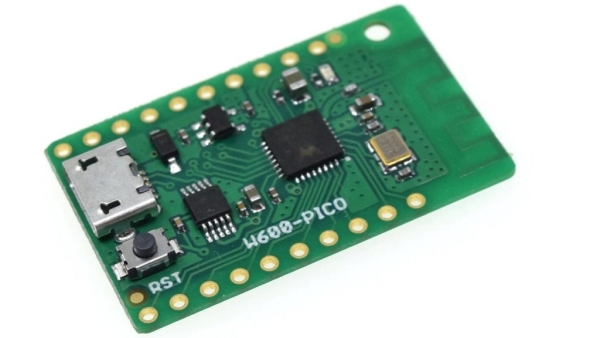
The W600 is an Arm Cortex M3 with a clock speed of 80 MHz and 1 MB of Flash. The chip supports hardware cryptography and a 2.4 GHz Wi-Fi. Initially, the W600 has been hinted to take over the ESP8266, but it was never really adopted by the maker community, just like other similar boards. It stayed as a Wi-Fi-to-Serial bridge and had features that already existed in the ESP8226. Nevertheless, the W600 board is still appealing to some users because it houses an ARM core, unlike the ESP8226, which is based on the Xtensa cortex giving it some advantages when used in specific ways.
However, the new board is now changing things as it comes pre-loaded with the Micropython firmware on board. There is a micro USB port available as a source of power and for loading programs. It is connected using a CH340 USB – TTL chip. On both sides of the board, there are 10 pin headers. Some of these are the Wakeup, reset, +5V, and GND pins.
Board Specification
- SoC – Winner Micro W600 Arm Cortex-M3 MCU @ 80MHz with 1MB Flash.
- Wireless Connectivity – 2.4GHz 802.11 b/g/n Wi-Fi 4 up to 150 Mbps.
- USB – 1x Micro USB port (via CH340 USB to TTL chip)
- Expansion –
- 2x 10-pin headers with 15x GPIO
- 9x PWM.
- 1x I2C.
- 1x SPI
- 1x UART.
- Wake Up.
- Reset Pin
- 5V and 3.3V supply.
- Power Supply – 5V via micro USB port.
- Operating Voltage: 3.3V
- Dimensions – 33.0mm by 20.3mm
- Weight – 3g
Read more: WEMO’S LAUNCHES W600-PICO THAT SUPPORTS MICRO-PYTHON FOR ONLY $2
- What processor does the W600-PICO use?
The board uses a Winner Micro W600 SoC which is an Arm Cortex M3 MCU running at 80MHz. - Can I program the W600-PICO using MicroPython?
Yes, the new board comes pre-loaded with Micropython firmware on board. - How do I connect the board to a computer for power and programming?
You can use the micro USB port which connects via a CH340 USB to TTL chip. - Does the W600-PICO support Wi-Fi connectivity?
Yes, it supports 2.4GHz 802.11 b/g/n Wi-Fi up to 150 Mbps. - What are the available expansion interfaces on the board?
The board features 9 PWM pins, 1 I2C, 1 SPI, 1 UART, and 15 GPIOs across two 10-pin headers. - Is the W600-PICO based on the same architecture as the ESP8266?
No, the W600 houses an ARM core unlike the ESP8226 which is based on the Xtensa cortex. - What is the operating voltage of the W600-PICO?
The operating voltage is 3.3V while power is supplied via 5V through the micro USB port. - How much flash memory does the W600 chip have?
The chip includes 1 MB of Flash memory.
