
Summary of Water Softener LED Display
Many U.S. homes have hard water with dissolved minerals; a water softener exchanges salt for those minerals, requiring periodic brine tank refills. The author built a Water Softener Monitor: a wall-plate device with a color LED bar graph showing brine salt level, a room photocell to only light the display when someone is present (auto-off after three minutes), and a remote photocell in the softener closet that causes the display to blink if the closet light is left on.
Parts used in the Water Softener Monitor:
- Color LED bar graph display
- Wall plate enclosure (plain white)
- Room photocell (light sensor)
- Remote photocell (closet light sensor)
- Microcontroller or control electronics
- Power supply for LEDs and electronics
- Wiring and connectors
- Mounting hardware for wall plate
Many homes in the United States have water that contains higher concentrations of dissolved minerals, which is called hard water. Although there is nothing toxic about hard water, it is less desirable for cleaning, it leaves mineral deposits, and it can shorten the lifetime or efficiency of equipment such as water heaters.
A water softener is a household appliance that commonly exchanges salt for some of the dissolved minerals, resulting in softer water. The salt supply is stored in a brine tank and must be refilled every month or so. If you forget to refill the tank, the water softener is rendered temporarily ineffective.
As you might guess, I often forget to refill the brine tank. My first clue of an empty tank comes when my wife suggests the dishwasher, soap, or shampoo isn’t working very well. I decided it was time to create an electronic sensor to monitor the salt levels.
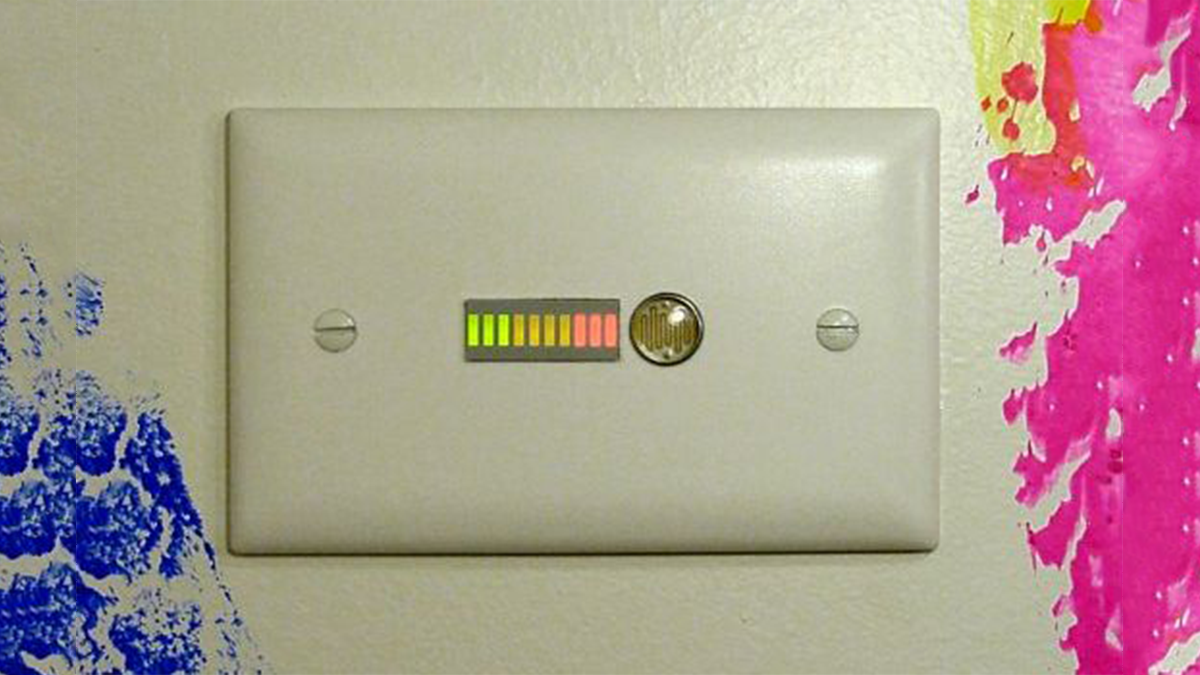
Water softener monitor wall plate on a decorated wall.
The Water Softener Monitor device features a color bar graph to indicate the salt level in the water softener brine tank. The color bar graph is better than a numeric display, since colors can be discerned from across the room.
The Water Softener Monitor wall plate includes a photocell to detect a change in room brightness. This allows the LED display to be off until someone turns on the room light or approaches the monitor panel (their shadow trips the light sensor). After three minutes, the display turns off again. This saves electricity and increases LED longevity.
And, finally, the Water Softener Monitor has a remote photocell in the closet where the water softener equipment is located. The Water Softener Monitor will blink if the closet light is accidentally left turned on (I wonder who did that?). This avoids having an unattended light burning in the closet for a month.
A common plain white wall plate was chosen to enclose the water softener monitor display, so as not to detract from the wall decor.
For more detail: Water Softener LED Display
- What does the Water Softener Monitor indicate?
It shows the brine tank salt level using a color LED bar graph. - How does the display conserve power?
A room photocell keeps the display off until the room light changes, and the display auto-turns-off after three minutes. - Can the monitor detect a closet light left on?
Yes, a remote photocell in the closet causes the monitor to blink if the closet light is left on. - Why use a color bar graph instead of a numeric display?
Colors can be seen from across the room, making the level easier to discern at a distance. - Where is the monitor installed?
It is installed in a common plain white wall plate to blend with decor. - Does the monitor require regular maintenance?
The article does not specify maintenance requirements beyond standard installation and power. - What problem prompted building the monitor?
The author frequently forgot to refill the brine tank and wanted an early warning indicator. - How long does the display stay on after detecting light?
The display turns off after three minutes.
