
Summary of Touch Sliders With A Softpot + Arduino
### Summary The article introduces the 3M Softpot, a linear touch potentiometer that functions like a traditional knob but responds to touch. Ideal for prototyping surface buttons or rotary wheels without complex capacitive sensors, it connects directly to an Arduino's analog pin. The sensor outputs values between 0 and 1023 based on touch location. A critical warning advises against touching both ends simultaneously or pressing the bottom center of round versions, as this causes rapid overheating and potential damage.
Parts used in the Touch Sliders With A Softpot + Arduino:
- 3M Softpot (linear touch potentiometer)
- Arduino
- Analog input pin
- Paper with printed buttons (for prototyping)
You all know the potentiometer, you turn it, and you can read on your arduino where it was turned to. Well 3M makes a product called the softpot that is a linear touch potentiometer. So instead of turning a knob, you touch it.
The really nice thing about these is that they are great for prototypes because you can tell where someone touched it. So if you place a piece of paper with some printed buttons over it, you can mock up surface touch buttons. Or if you need to prototype a rotary touch wheel like the old ipods, but don’t want to get involved with complex capitative sensors, you can do that too.
There are a million uses for these, and they come in a few sizes, shapes, and even offer high temperature versions.
Hooking it up
The softpot sensors change their resistance depending on where they are touched. And because they work just like potentiometers you don’t need any extra parts to use them with your arduino. We can just plug in the middle pin to an analog in pin on the arduino and we are ready to go.
The arduino analogRead will vary between 0 and 1023 depending on where you touch it, (1023 when not being touched) and is linear, so it will be about 512 if touched in the middle.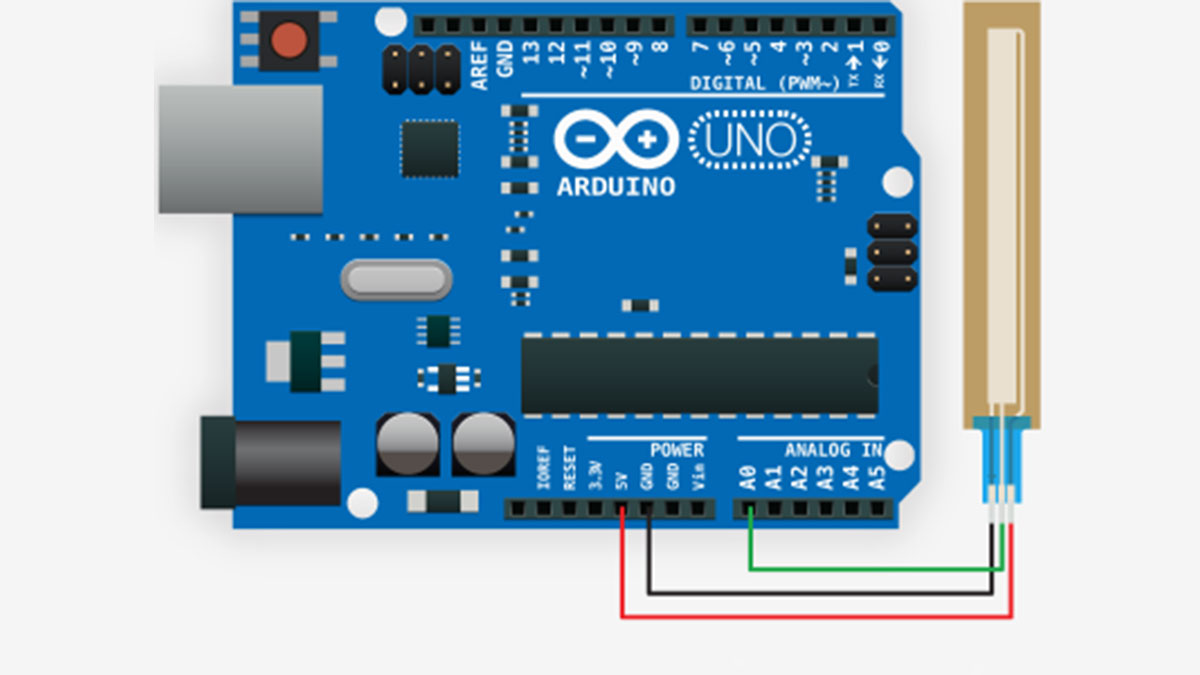
WARNING!!!!!
If you touch the softpot at the top and the bottom at the same time, it will get really hot, really quick, and if you leave it for more than a second, you may burn it up. I have no clue why. But beware!
This is especially an issue on the round version. If you press down dead center on the bottom (where the straight parts come off of), you will be pressing on both sides of the pot and it will again get super hot and melt. SO DONT PRESS IT IN THE MIDDLE BOTTOM
For more detail: Touch Sliders With A Softpot + Arduino
- How does a softpot differ from a traditional potentiometer?
A softpot is a linear touch potentiometer that detects where you touch it instead of requiring a knob to be turned. - Can I use a softpot to prototype surface touch buttons?
Yes, placing a piece of paper with printed buttons over the softpot allows you to mock up surface touch buttons. - Do I need extra parts to connect a softpot to an Arduino?
No, because they work just like potentiometers, you only need to plug the middle pin into an analog in pin on the Arduino. - What range of values does arduino analogRead return when using a softpot?
The value varies between 0 and 1023 depending on where you touch it, with 1023 when not being touched and about 512 if touched in the middle. - Why should I avoid touching the top and bottom of the softpot at the same time?
Touching both ends simultaneously will cause the device to get really hot very quickly and may burn it up if left for more than a second. - Is there a specific area on the round version of the softpot I should not press?
Yes, you should not press down dead center on the bottom where the straight parts come off, as this presses both sides of the pot and can melt it. - Can I use a softpot to prototype a rotary touch wheel?
Yes, you can prototype a rotary touch wheel like old iPods without getting involved with complex capacitive sensors. - Are there different types of softpots available?
Yes, they come in a few sizes, shapes, and even offer high temperature versions.
