
Summary of This snake robot is large enough to ride upon
James Bruton's rideable snake robot bridges the gap between vehicle and robot. This full-scale machine features four caterpillar-like segments with wheels, capable of pivoting and tilting to manage rider weight and terrain. It utilizes ten motors controlled by three Arduino Mega 2560 boards, powered by LiPo batteries and operated via a custom remote. Although the unique steering geometry caused stability issues during turns, the project stands as a remarkable experimental vehicle.
Parts used in James Bruton's Rideable Snake Robot:
- Four caterpillar-like segments
- Eight wheels (four driven, four free)
- Motorcycle seat
- Four Hoverboard-style hub motors
- Three steering motors
- Three tilt motors
- Three Arduino Mega 2560 boards
- Stepper motor drivers
- Electronic speed controllers (ESCs)
- LiPo battery packs
- Custom universal robot remote
If a robot is rideable, is it still a robot or is it a vehicle? We would argue that if it rolls on standard automobile-style wheels or even tank tracks, it is a vehicle. But James Bruton’s eight-wheeled robot snake bike is quite clearly something else. This “vehicle” started as a small functional model that everyone would call a robot. Now Bruton has finished the full-size rideable snake robot and it is something to behold.
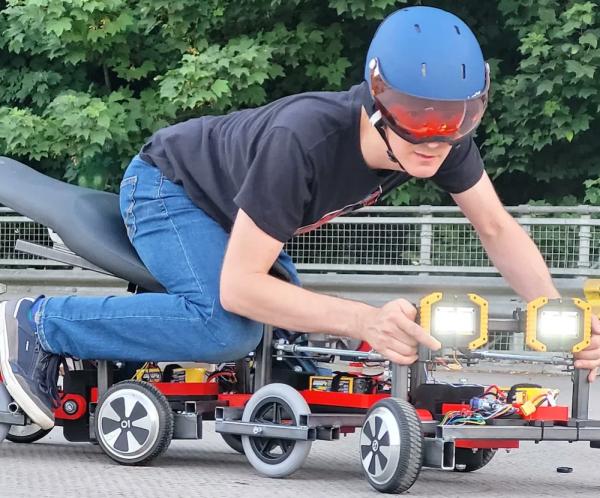
The robot consists of four caterpillar-like segments, each with a pair of wheels. Two of the segments have driven wheels, while the other two segments have free wheels. Each segment is able to pivot relative to its neighbor and can also tilt up/down. There are two reasons for the tilt actuation. The first is to compensate for the rider’s weight in order to keep all of the wheels on the ground. The second reason is to handle bumps and uneven terrain, similar to a car’s suspension. The rider sits on a motorcycle seat mounted to the third segment (which is driven), so their weight is roughly centered.
This unusual setup requires a total of ten motors: four Hoverboard-style hub motors, three steering motors, and three tilt motors. Coordinating the control of that many motors isn’t trivial, which is why Bruton used three Arduino Mega 2560 boards. Each Arduino sends signals through two stepper motor drivers to the steering and tilt motors. Two of the Arduinos control the hub motors through ESCs (electronic speed controllers). Power comes from several big LiPo battery packs and Bruton pilots the robot using the custom universal robot remote that he designed for projects like this.
Riding the strange snake robot didn’t go quite as well as Bruton had hoped, as the odd steering geometry doesn’t allow for lean and that causes the rider to fall off in turns. But it is still really cool to see in action and we love experimental vehicles!
Source: This snake robot is large enough to ride upon
-
How is the robot classified regarding vehicles and robots?
The article argues that while standard wheels make something a vehicle, this eight-wheeled robot snake bike is clearly something else entirely. -
What are the two reasons for the tilt actuation?
Tilt actuation compensates for the rider's weight to keep all wheels on the ground and handles bumps or uneven terrain like a car suspension. -
How many motors does the robot require in total?
The setup requires a total of ten motors, consisting of four hub motors, three steering motors, and three tilt motors. -
Why were three Arduino Mega 2560 boards used?
Three Arduinos were used because coordinating the control of ten motors is not trivial. -
How does the rider sit on the robot?
The rider sits on a motorcycle seat mounted to the third segment, which is a driven segment, placing their weight roughly centered. -
What power source is used for the robot?
Power is supplied by several big LiPo battery packs. -
How does the robot handle turning and why did it fail?
Riding was difficult because the odd steering geometry does not allow for leaning, causing the rider to fall off in turns.
