
Summary of THIS SIMPLE MEDIA PLAYER WILL INSPIRE BEGINNERS AND INVITE EXPERIMENTATION
This article describes a beginner-friendly pocket video player project by Alex of Super Make Something. It uses an ESP32 module, 1.8" LCD with SD card reader, audio amp and speakers, simple controls and optional LiPo battery. The PCB supports multiple configurations from audio-only to full video playback. Parts are inexpensive and accessible, soldering is minimal aside from the ESP32 module. The build is designed to be approachable and hackable, suitable as an introduction to electronics.
Parts used in the Pocket Video Player:
- ESP32 module
- 1.8 inch LCD screen with SPI interface
- MicroSD card reader/module
- Audio amplifier
- Speakers
- LiPo battery (optional)
- Control switches/buttons
- Custom PCB supporting multiple configurations
- Assorted passive components (resistors, capacitors)
- Wiring and connectors
While it would have been considered science-fiction just a few decades ago, the ability to watch virtually any movie or TV show on a little slab that fits in your pocket is today no big deal. But for an electronics beginner, being able to put together a pocketable video player like this one would be quite exciting, and might even serve as a gateway into the larger world of electronics design.
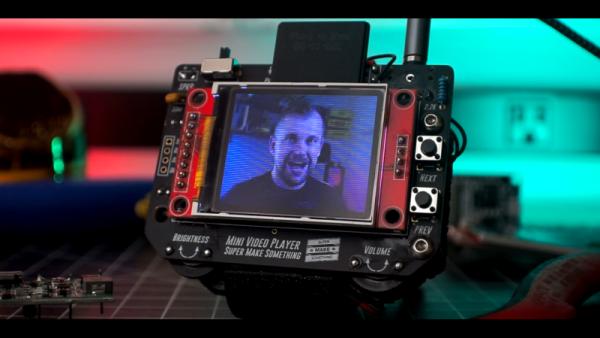
For inspiration, [Alex] from Super Make Something on YouTube looked to the Rickrolling keychain media players we featured back in January. His player is quite a bit larger and more capable, with a PCB design that allows the player to be built in multiple configurations, from audio-only to full video and a LiPo battery. The guts of the player center around an ESP32 module, with an audio amp and speakers plus a 1.8″ LCD screen with SD card reader for storing media files. Add in a few controls and switches and a little code, and you’ll be playing back media files in a snap. Build info and demo in the video below.
It may be a simple design, but we feel like that’s the whole point. [Alex] has taken pains to make this as approachable a build as possible. All the parts are cheap and easily available, and the skills needed to put it together are minimal — with the possible exception of soldering down the ESP32 module, which lacks castellated edge terminals. For a beginner, getting a usable media player by mixing together just a few modules would be magical, and the fact that it’s still pretty hackable afterward is just icing on the cake.
Source: THIS SIMPLE MEDIA PLAYER WILL INSPIRE BEGINNERS AND INVITE EXPERIMENTATION
- What is the core microcontroller used in the project?
The core microcontroller is an ESP32 module. - Can the project play video as well as audio?
Yes, the PCB supports configurations from audio-only to full video playback. - Does the project include a display?
Yes, it uses a 1.8 inch LCD screen. - How are media files stored for playback?
Media files are stored on a microSD card accessed via an SD card reader. - Is a battery required for portable use?
A LiPo battery is optional for portable power. - Are the parts difficult to obtain?
No, the parts are described as cheap and easily available. - Is soldering required to assemble the player?
Yes, soldering is required, with the ESP32 module soldering being the most challenging due to lack of castellated edges. - Does the build require advanced electronics skills?
No, the design is intended to be approachable for beginners with minimal skills. - Is the project hackable after assembly?
Yes, the project is described as remaining pretty hackable afterward.
