
Summary of THE TOP 10 LINEAR VOLTAGE REGULATORS ACCORDING TO SNAPEDA
This article discusses linear voltage regulators, highlighting their simplicity, low cost, and suitability for noise-sensitive applications like audio and medical devices. While they offer stable fixed outputs, they suffer from poor efficiency (30–60%) and heat generation compared to switching regulators. The text outlines selection criteria such as input/output voltage differences and current ratings, noting that most include overcurrent and thermal protection. It concludes by introducing a Top 10 list of regulators, featuring the Texas Instruments LP2985-33DBVR with specific electrical characteristics.
Parts used in Linear Voltage Regulators Project:
- LP2985-33DBVR
- Texas Instruments
In electronics, linear voltage regulators are commonly used to stabilize voltages. Regardless of the input voltages or load conditions, they will provide fixed output voltages, thus protecting devices from fluctuating outputs, which can cause inefficient performance or even damage.
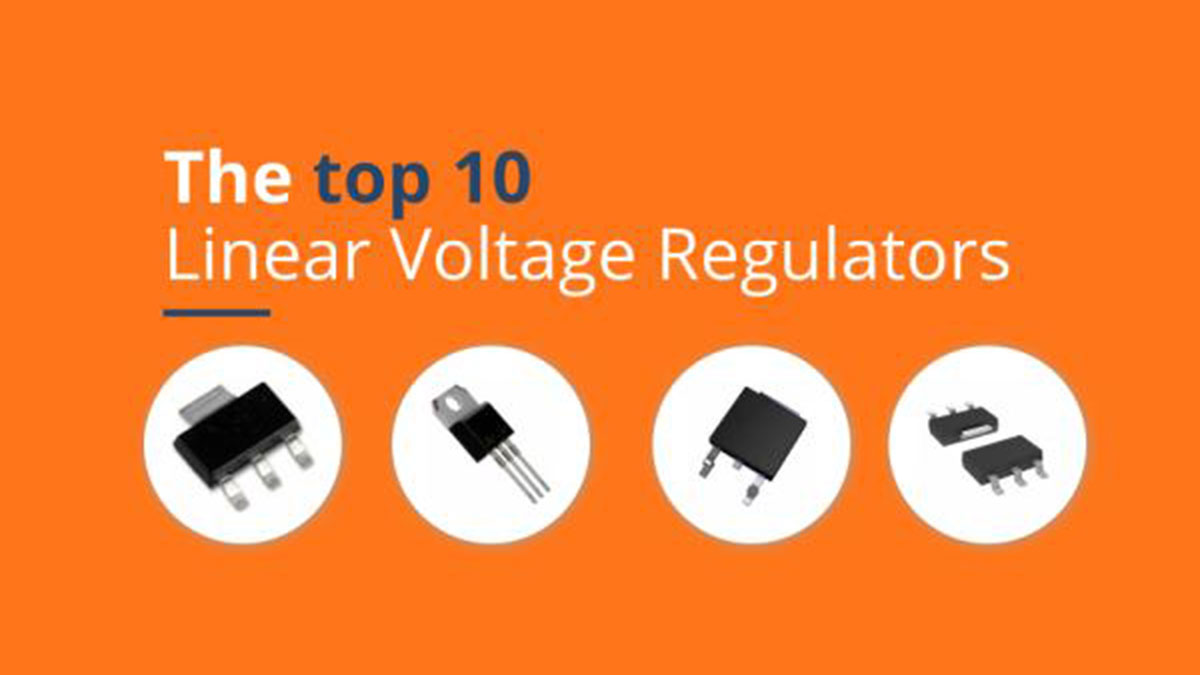
When designing a power supply for an application that requires a small difference between its input and output voltages, hardware designers should consider linear voltage regulators.
Simplicity and cost are the main advantages of using linear regulators over switching voltage regulators. Additionally, the absence of switching noise makes linear regulators particularly useful for audio and video communication, medical devices and other noise-sensitive applications.
On the downside, linear voltage regulators generate heat and their efficiency is rather poor, varying between 30% and 60%. This is why they are used mainly for low-powered devices and small differences between input and output voltages.
Compared to linear regulators, switching voltage regulators (also known as switch-mode regulators) are superior in terms of efficiency and generate much less heat, but are also more expensive and complex.
When choosing between different voltage regulators for your application, you should consider several factors, including their maximum input voltages, the differences between input and output voltages, current ratings, temperature ratings, and output noise.
Most of the linear voltage regulators in our Top 10 list have overcurrent and thermal protection. Most also have maximum input voltages ranging from 5.5V up to 40V and output voltages ranging from 3.3V to 15V. The most popular vendors for voltage regulators on SnapEDA are Diodes Inc, Richtek USA Inc, Microchip, STMicroelectronics, and Texas Instruments.
Let’s Now Take A Look At The Top 10 Linear Voltage Regulators On SnapEDA!
#10 – LP2985-33DBVR By Texas Instruments
This low dropout regulator has 16V Maximum input voltage, 3.3V output voltage, 150mA output current, 280mV Dropout voltage and -40°C to 125°C junction temperature range. The average price across distributors: $0.60
Read more: THE TOP 10 LINEAR VOLTAGE REGULATORS ACCORDING TO SNAPEDA
- Why should hardware designers consider linear voltage regulators?
They are suitable when there is a small difference between input and output voltages. - What are the main advantages of linear regulators over switching regulators?
Simplicity and cost are the primary benefits. - In which applications are linear regulators particularly useful?
They are ideal for audio and video communication, medical devices, and other noise-sensitive applications due to the absence of switching noise. - What is the efficiency range of linear voltage regulators?
Their efficiency varies between 30% and 60%. - How do switching voltage regulators compare to linear regulators?
Switching regulators are more efficient, generate less heat, but are more expensive and complex. - What factors should be considered when choosing a voltage regulator?
Consider maximum input voltages, input-output voltage differences, current ratings, temperature ratings, and output noise. - Do most linear voltage regulators have protection features?
Yes, most feature overcurrent and thermal protection. - What is the typical maximum input voltage range for these regulators?
Most have maximum input voltages ranging from 5.5V up to 40V.
