
Summary of Test Ideas: Protect USB measurement circuits
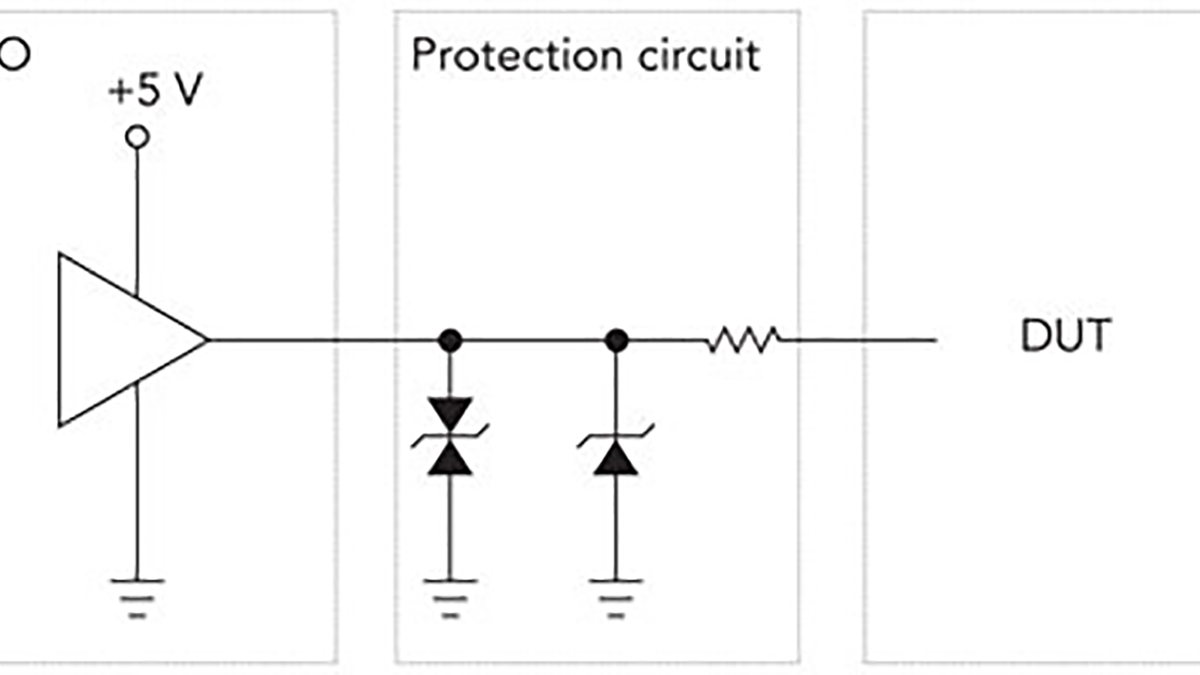
USB data-acquisition modules are cost-effective for manufacturing tests but require protection against defects like shorts to ground, VCC, or higher voltages that can damage input pins. Protection circuits must be placed between the Device Under Test (DUT) and the USB module to prevent voltage spikes from reaching the digital I/O ports.
Parts used in the USB Data-Acquisition Protection Project:
- USB DIO (digital I/O) module
- 8-bit bidirectional tristate ports
- Digital output pin
- Digital input pin
- Device Under Test (DUT)
- Protection circuits
USB data-acquisition modules offer good value and ease of use, which makes them an attractive choice for manufacturing test. But before you use the modules in a manufacturing test system, you need to take steps to protect them. During manufacturing test of circuit boards or subassemblies, a defect in an assembly may result in a condition that damages a data-acquisition module.
The typical USB DIO (digital I/O) module uses a set of 8-bit bidirectional tristate ports. Figure 1 shows a typical circuit that we test with one of those ports. We use one digital output pin from the USB module to drive the circuit and one digital input pin to read the circuit’s response. If the circuit works properly, we expect to see a clean digital signal from the circuit. For a circuit coming off the manufacturing line, however, the digital input pin of the DUT (device under test) could be shorted to ground, shorted to VCC, or shorted through some low impedance to a higher voltage. Any of these conditions can damage the USB module’s input pin.
If there’s a short across the 2-k resistor from the collector to the +15-V supply, that voltage will appear at the USB module’s input pin, which could damage it. To avoid such damage, we add protection circuits between the DUT and the USB module (Figure 2).
For More Details: Test Ideas: Protect USB measurement circuits
- Why do you need to protect USB data-acquisition modules?
Defects in assemblies during manufacturing tests can result in conditions that damage the data-acquisition module. - What specific circuit defects can damage a USB module?
The digital input pin of the DUT could be shorted to ground, shorted to VCC, or shorted through low impedance to a higher voltage. - How does a typical USB DIO module operate in this test setup?
It uses one digital output pin to drive the circuit and one digital input pin to read the response using 8-bit bidirectional tristate ports. - What happens if there is a short across the 2-k resistor to the +15-V supply?
The voltage will appear at the USB module's input pin, which could damage it. - Where should protection circuits be installed?
Protection circuits must be added between the DUT and the USB module. - What is the expected signal from a properly working circuit?
You expect to see a clean digital signal from the circuit. - Are USB data-acquisition modules considered good value for manufacturing tests?
Yes, they offer good value and ease of use, making them an attractive choice.
