
Summary of SPARKFUN RED-V REDBOARD – SIFIVE RISC-V
The SparkFun RED-V RedBoard is a low-cost development board featuring the SiFive Freedom E310 RISC-V SoC. It adopts the Arduino Uno R3 form factor and includes 32MB QSPI flash, an NXP K22 ARM Cortex-M4 for USB/JTAG connectivity, and a Qwiic connector. The board supports high-speed prototyping with a modern USB-C port, exposed JTAG interface, and pre-installed bootloader. Programming requires Freedom Studio or Zephyr RTOS environments.
Parts used in the SparkFun RED-V RedBoard:
- SiFive Freedom E310 SoC
- 32MB QSPI flash
- NXP K22 ARM Cortex-M4
- Qwiic connector
- USB-C connector
- JTAG connector
- Freedom E310 CPU Coreplex
- 16KB L1 Instruction Cache
- 16KB Data SRAM scratchpad
The SparkFun RED-V (pronounced “red-five”) RedBoard is a low-cost, development board featuring the Freedom E310 SoC which brings with it the RISC-V instruction set architecture (ISA).
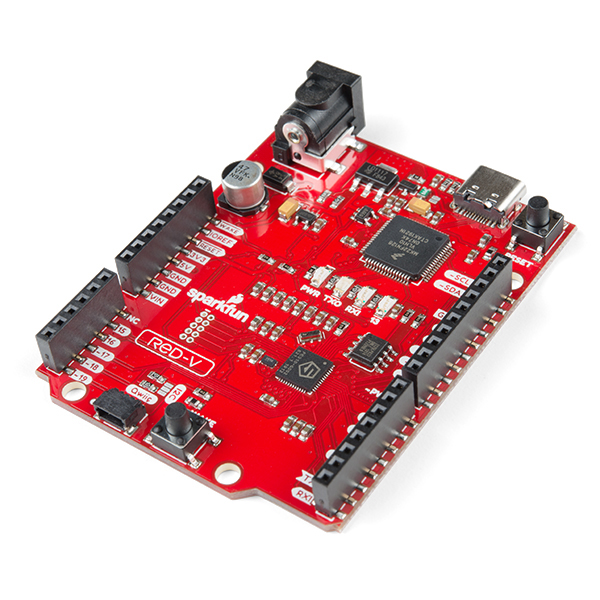
The RED-V RedBoard comes in the familiar Arduino Uno R3 form factor and includes the SiFive Freedom E310 core, 32MB of QSPI flash, an NXP K22 ARM Cortex-M4 for USB connectivity and operating as a JTAG interface, and a Qwiic connector to make future I2C offerings easy*. The modern USB-C connector makes it easy to program and for more advanced users who prefer to use the power and speed of professional tools, we’ve also exposed the JTAG connector. Additionally, it comes programmed with a simple bootloader making the RED-V the best way to start prototyping and developing your RISC‑V applications.
The on board Freedom E310 (FE310) is the first member of the Freedom Everywhere family of customizable SoCs from SiFive. Designed for microcontroller, embedded, IoT, and wearable applications, the FE310 features SiFive’s E31 CPU Coreplex, a high-performance, 32-bit RV32IMAC core. Capable of running at 320+ MHz, the FE310 is among the fastest microcontrollers in the market. Additional features include a 16KB L1 Instruction Cache, a 16KB Data SRAM scratchpad, hardware multiply/divide, a debug module, flexible clock generation with on-chip oscillators and PLLs, and a wide variety of peripherals including UARTs, QSPI, PWMs, and timers. Multiple power domains and a low-power standby mode ensure a wide variety of applications can benefit from the FE310. The RED-V requires Freedom Studio software or a Zephyr RTOS build environment set up to program the board and interface with it.
Read more: SPARKFUN RED-V REDBOARD – SIFIVE RISC-V
- What instruction set architecture does the RED-V use?
The board features the RISC-V instruction set architecture. - Does the RED-V match the size of an Arduino Uno?
Yes, it comes in the familiar Arduino Uno R3 form factor. - Can I program the board using professional tools?
Yes, advanced users can access the exposed JTAG connector for professional tools. - What software is required to program this board?
You need Freedom Studio software or a Zephyr RTOS build environment. - How fast can the FE310 core run?
The core is capable of running at speeds over 320 MHz. - Does the board have built-in memory for code storage?
It includes 32MB of QSPI flash. - What role does the NXP K22 chip play?
It handles USB connectivity and operates as a JTAG interface. - Is there a specific connector for future I2C devices?
Yes, the board includes a Qwiic connector for easy I2C offerings.
