
Summary of SMALL HIGH-CAPACITANCE THREE-TERMINAL MLCCS TARGET AUTOMOTIVE USES
Murata Electronics released two new three-terminal low-ESL multilayer ceramic capacitors (MLCCs) for automotive safety-critical applications: the 0402 (1.0×0.5 mm) NFM15HC105D0G3D, the world’s smallest three-terminal low-ESL MLCC, and the 0603 (1.6×0.8 mm) NFM18HC106D0G3L, offering the world’s highest 10 µF capacitance in that size. Both use Murata’s thin-layer, high-precision lamination, fine-particle, and homogenization technologies to achieve smaller size or much higher capacitance, enabling fewer capacitors, improved reliability, and reduced assembly complexity for ADAS and autonomous-driving electronic systems.
Parts used in the MLCC Automotive Safety Project:
- NFM15HC105D0G3D (0402 / 1.0×0.5 mm three-terminal low-ESL MLCC)
- NFM18HC106D0G3L (0603 / 1.6×0.8 mm three-terminal low-ESL MLCC, 10 µF)
- Thin-layer ceramic fabrication technology
- High-precision lamination technology
- Fine-particle ceramic material technology
- Homogenization technology for ceramic and electrode materials
Murata Electronics today announced the availability of two new multilayer ceramic capacitors (MLCCs) for automotive safety-critical applications. The 0402-inch size (1.0×0.5mm) NFM15HC105D0G3D is the world’s smallest three-terminal low parasitic inductance (ESL) MLCC.
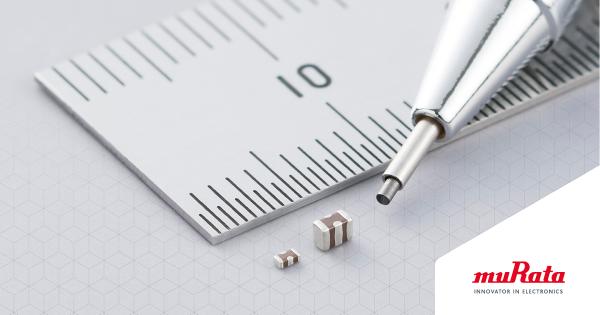
The NFM18HC106D0G3L is also a three-terminal low-ESL MLCC but delivers the world’s highest capacitance of 10µF in a 0603 (1.6×0.8mm) package.
The NFM15HC105D0G3D is approximately 60 percent smaller than conventional solutions with the same capacitance. The NFM18HC106D0G3L features a capacitance 10 times higher than that of similarly-sized products. These advancements are achieved by coupling Murata’s proprietary thin-layer and high-precision lamination technologies with fine-particle and homogenization technology for ceramic and electrode materials. Compared with traditional MLCCs, the three-terminal structure and resulting low ESL allows automotive engineers to reduce the number of capacitors needed to realize their design goals. The reduced capacitor count not only increases overall system reliability but reduces size and assembly complexity.
The emergence of automotive technologies, such as advanced driver assistance systems (ADAS) and autonomous driving, has led to an increased number of microprocessors used in each vehicle. To ensure that these components work correctly, more and more MLCCs are being integrated.
Read more: SMALL HIGH-CAPACITANCE THREE-TERMINAL MLCCS TARGET AUTOMOTIVE USES
- What are the new MLCC models announced by Murata for automotive safety-critical applications?
The models are NFM15HC105D0G3D and NFM18HC106D0G3L. - What is significant about the NFM15HC105D0G3D?
It is the world’s smallest three-terminal low parasitic inductance MLCC in an 0402 (1.0×0.5 mm) size. - What is significant about the NFM18HC106D0G3L?
It delivers the world’s highest capacitance of 10 µF in a 0603 (1.6×0.8 mm) package. - How do these MLCCs achieve smaller size or higher capacitance?
By combining Murata’s thin-layer and high-precision lamination technologies with fine-particle and homogenization technology for ceramic and electrode materials. - Why does the three-terminal low-ESL structure matter?
The three-terminal structure yields low ESL, allowing designers to reduce the number of capacitors needed and lower size and assembly complexity. - How does reducing capacitor count benefit automotive systems?
Reducing capacitor count increases overall system reliability and reduces size and assembly complexity. - What automotive trends are driving increased MLCC use?
Advanced driver assistance systems ADAS and autonomous driving are increasing the number of microprocessors and MLCCs used per vehicle.
