
Summary of SKEE-BALL SCORING WITH COIN SLOT SWITCHES
This article details [gcall1979]'s project to automate scoring for a Skee-Ball machine. The builder replaced manual tracking with arcade coin door switches and an Arduino Mega to display scores on 7-segment displays. A servo mechanism releases balls upon reset, while gravity returns them to the player. Although functional, the author notes occasional switch failures due to ball size discrepancies and plans to upgrade to IR break-beam sensors for future reliability.
Parts used in the Automatic Skee-Ball Machine:
- Arcade machine coin door switch with long wire actuator
- Arduino Mega
- Four large 7-segment displays for score
- Giant 7-segment display for number of balls played
- Servo motor
- Release door
Bowling is great and all, but the unpredictability of that little ball jump in Skee-Ball is so much more exciting. You can play it straight, or spend a bunch of time perfecting the 100-point shot. And unlike bowling, there’s nothing to reset, because gravity gives you the balls back.
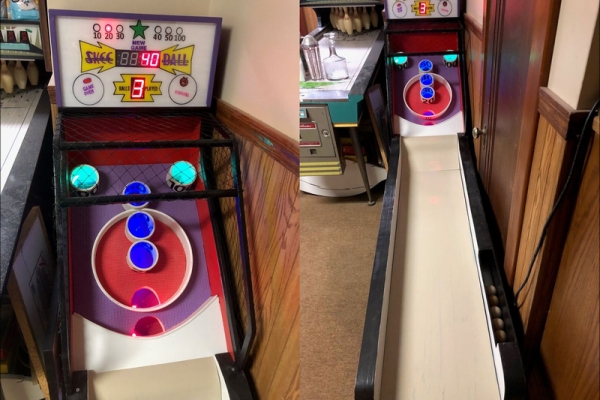
In one of [gcall1979]’s earlier Skee-Ball machines, gravity assisted the scoring mechanism, too: each ball rolls back to the player and lands in a lane labeled with the corresponding score, which is an interesting engineering challenge in its own right. He decided to build automatic scoring into his newest Skee-Ball machine.
At the bottom of each cylinder is an arcade machine coin door switch with a long wire actuator. These had to be mounted so they’re close enough to the hole, but out of the way of the balls.
Each switch is wired up to an Arduino Mega along with four large 7-segments for the score, and a giant 7-segment to show the number of balls played. Whenever the game is reset, a servo drops a door to release the balls, just like a commercial machine.
The arcade switches work pretty well, especially once he bent the wire into hook shape to cover more area. But they do fail once in a while, maybe because the targets are full-size, but the balls are half regulation size. For the next one, [gcall1979] is planning to use IR break-beam targets which ought to work with any size ball. If you prefer bowling, you won’t strike out with break-beam targets there, either.
Source: SKEE-BALL SCORING WITH COIN SLOT SWITCHES
- How does the new machine handle automatic scoring?
The machine uses arcade machine coin door switches mounted at the bottom of each cylinder connected to an Arduino Mega. - What components are wired to the Arduino Mega?
Four large 7-segment displays for the score, a giant 7-segment display for the number of balls played, and the arcade switches are all wired to the Arduino Mega. - How are the balls released when the game is reset?
A servo drops a door to release the balls, mimicking the action of a commercial machine. - Why did the author modify the wire actuators?
The wires were bent into a hook shape to cover more area and improve the performance of the arcade switches. - What issue was encountered with the current switching system?
The switches fail occasionally because the targets are full-size but the balls used are half regulation size. - What solution is planned for the next build?
The author plans to use IR break-beam targets which should work with any size ball.
