
Summary of SINGLE-ENDED, 2-CHANNEL GAN CLASS D AMPLIFIER – EVALUATION BOARD
The EVAL_AUDAMP24 is a 2-channel GaN HEMT-based half-bridge class D audio amplifier evaluation board from Infineon, offering 225 W/ch (4 Ω at ±43 V) or 250 W/ch (8 Ω at ±63 V) performance for high-end Hi-Fi applications. It uses the IGT40R070D1 CoolGaN transistor with the MERUS IRS20957SPBF controller, includes protection and housekeeping supplies, and employs a self-oscillating sigma-delta style PWM modulator for low component count, high performance, and robust error shaping. The design is scalable for power and channel count and targets premium audio systems.
Parts used in the EVAL_AUDAMP24:
- IGT40R070D1 E8220 CoolGaN gallium nitride transistor
- MERUS IRS20957SPBF controller IC
- Housekeeping power supply components (for required supplies)
- Protection circuit components (unspecified resistors, capacitors, diodes, etc.)
- PCB with optimized layout
- Passive components for self-oscillating PWM modulator (inductors, capacitors, resistors)
- Connectors and interface components for input/output and power
- Two-channel half-bridge switch network
The EVAL_AUDAMP24 e-mode GaN HEMT-based evaluation board from Infineon Technologies is a 2-channel, 225W/ch (4Ω at ±43V) or 250 W/ch (8Ω at ±63V) half-bridge class D audio power amplifier for high-end Hi-Fi audio systems. This evaluation board demonstrates how to use the IGT40R070D1 E8220 CoolGaN™ gallium nitride transistor together with the MERUS™ IRS20957SPBF controller IC, implement protection circuits, and design an optimum PCB layout.
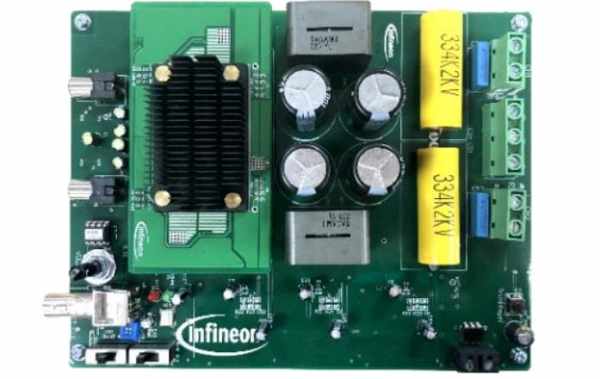
Potential applications include Hi-Fi amplifiers, AV receivers, Home theater systems, Powered speakers, Musical instrument amplifiers, and other premium audio designs.
The reference design provides all the required housekeeping power supplies for ease of use. The 2-channel design is scalable for power and the number of channels.
The EVAL_AUDAMP24 features a two-channels self-oscillating type pwm modulator for the lowest component count, highest performance and robust design. This topology represents an analog version of a second-order sigma-delta modulation, having a class D switching stage inside the loop.
The benefit of the sigma-delta modulation, in comparison to the carrier-signal based modulation, is that all the error in the audible frequency range is shifted to the inaudible upper-frequency range by nature of its operation. Also, sigma-delta modulation enables the designer to apply sufficient error correction.
Read more: SINGLE-ENDED, 2-CHANNEL GAN CLASS D AMPLIFIER – EVALUATION BOARD
- What is the power rating per channel of the EVAL_AUDAMP24?
The board provides 225 W per channel at 4 Ω (±43 V) and 250 W per channel at 8 Ω (±63 V). - Which GaN transistor is used on the EVAL_AUDAMP24?
It uses the IGT40R070D1 E8220 CoolGaN gallium nitride transistor. - Which controller IC is implemented on this evaluation board?
The MERUS IRS20957SPBF controller IC is used. - What modulation topology does the EVAL_AUDAMP24 employ?
It features a two-channel self-oscillating type PWM modulator, an analog version of second-order sigma-delta modulation. - What are the intended applications for this evaluation board?
Potential applications include Hi-Fi amplifiers, AV receivers, home theater systems, powered speakers, and musical instrument amplifiers. - Does the reference design include power supplies?
Yes, the reference design provides all required housekeeping power supplies for ease of use. - Is the 2-channel design scalable?
Yes, the 2-channel design is scalable for power and the number of channels. - What is the benefit of using sigma-delta modulation here?
Sigma-delta modulation shifts audible-range error to the inaudible upper-frequency range and enables sufficient error correction.
