
Summary of SHAKE, RATTLE, ROLL, WITH YOUR OWN SEISMOGRAPH
CompactDIY built a homemade seismograph using an Arduino and an accelerometer, driving a hobby servo to move a pen and a stepper motor to roll paper as a strip recorder. The system uses Visuino to generate Arduino code. The design is adaptable (e.g., circular chart recorder or clock motor drive) and demonstrates a charming physical data-logging alternative to PC plotting.
Parts used in the CompactDIY homemade seismograph:
- Arduino
- Accelerometer
- Hobby servo (to control the pen)
- Stepper motor (to roll paper)
- Pen or stylus for marking
- Paper strip (for strip recorder)
- Visuino software (to generate Arduino code)
- Mechanical mounting/frame components (to hold pen and motors)
We always love to see projects where you can build your own lab equipment so [CompactDIY’s] homemade seismograph caught our eye. The design uses an Arduino with an accelerometer and builds on one of their earlier projects. You can see a video of the device below.
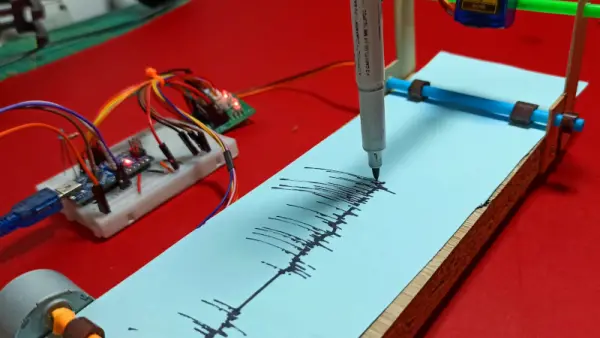
The principle is simple. A hobby servo controls a pen and a stepper motor rolls paper, creating a makeshift strip recorder. Its software uses the Visuino system, which is a flowchart-like system, but it outputs Arduino code. Honestly, we would probably have just plotted the data on a PC, but there’s a certain charm to the strip recorder and the idea would work for other types of data recording projects, too. We thought if you rearranged the stepper motor and cut a paper disk out, you could also have a circular chart recorder easily, which wouldn’t need to friction transport the paper. A clock motor would make it even less dependent on software, too.
If this project interests you, try a Raspberry shake, which isn’t as delicious as it sounds. Or, keep an eye on the entire globe, if you prefer.
Source: SHAKE, RATTLE, ROLL, WITH YOUR OWN SEISMOGRAPH
- What microcontroller is used in the project?
The project uses an Arduino. - What sensor detects motion in the seismograph?
An accelerometer is used to detect motion. - How is the pen moved to record vibrations?
A hobby servo controls the pen. - How is paper advanced for recording?
A stepper motor rolls the paper to create a strip recorder. - What software is used to produce the Arduino code?
Visuino is used; it outputs Arduino code from a flowchart-like system. - Can the design be adapted to a circular chart recorder?
Yes; rearranging the stepper and using a paper disk allows a circular chart recorder. - Is there an alternative to software-dependent paper transport suggested?
Yes; using a clock motor is suggested to reduce software dependence. - Does the article suggest plotting data on a PC instead?
Yes; the author notes they would probably plot the data on a PC, though they appreciate the strip recorder charm.
