
Summary of Sensing current on the high side
### Summary The article critiques high-side current sensing circuits, noting that while ground-leg sensing is simple, it isn't always feasible due to chassis grounding or ground loop issues. It advises against using discrete differential or instrumentation amplifiers for high-side sensing because achieving the necessary common-mode rejection (CMR) is expensive and prone to drift. Even with 80dB CMRR, supply voltage shifts can cause significant current measurement errors, such as a 240mA shift over a 12V range in a 0-10A application.
Parts used in the High-Side Current Sense Circuit:
- Sense resistor
- Differential amplifier
- Instrumentation amplifier
- Precision matched network
- Op-amp circuit
As EDN’s Design Ideas editor, I see a range of design submissions, from good, to not so good. A recent DI I turned down for several reasons included a high-side current sense circuit with implementation problems. This got me thinking about the different ways to accomplish current sensing on a voltage rail.
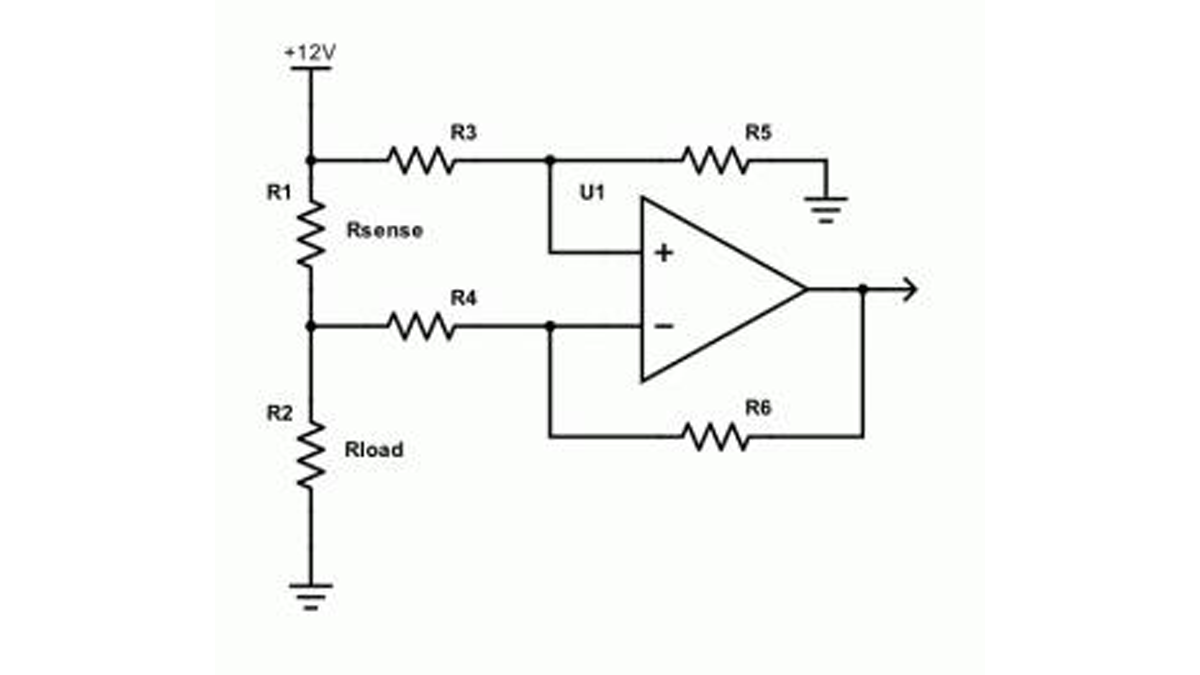
At their heart, the majority of DC current sense circuits start with a resistance in a supply line (though magnetic field sensing is a good alternative, especially in higher-current scenarios). One simply measures the voltage drop across the resistor and scales it as desired to read current (E = I × R (if I didn’t include this, someone would complain)). If the sense resistor is in the ground leg, then the solution is a simple op-amp circuit. Everything stays referenced to ground, and you only have to be careful about small voltage drops in the ground layout.
But often, placing the sense resistor in a supply lead is the preferred approach. Why? Ground might not be available (e.g., a chassis-grounded automotive device), or you may not want device ground to be different than supply ground, which can lead to ground loops and other problems. So, what are the options?
The most obvious and explicit method is to throw a differential or instrumentation amplifier (inamp) across the sense resistor, but in practice this is rarely a good way. To accurately sense current, extremely high CMR (common-mode rejection) is usually required, which is both expensive and prone to drift.
How so? Let’s consider an example design: 0-10A, 12V nominal, 5mΩ sense resistor:
Don’t even think about using discrete resistors for this, unless they’re part of a precision matched network (hence not really discrete of course). For a 1V shift in supply voltage, and 80dB of CMRR in the diff amp (which translates to ~0.01% resistor matching), you’ll see the equivalent of a 20mA shift in current (a 1V change with 80dB CMRR results in a 0.1mV shift referred to input; divide that by the 5mV/A scaling of the 5mΩ sense resistor).
For a 0-12V power supply, multiply that by 12: 240mA shift over the voltage range.
Read more: Sensing current on the high side
- Why might placing a sense resistor in the ground leg be problematic?
Ground might not be available, or device ground may need to match supply ground to avoid ground loops. - What is the most obvious method for high-side current sensing?
Using a differential or instrumentation amplifier across the sense resistor. - Why is using discrete resistors for high-side sensing discouraged?
Discrete resistors lack the precision matching required; a precision matched network is needed instead. - What happens if an amplifier has 80dB of CMRR with a 1V supply shift?
It results in a 20mA shift in measured current for a 5mΩ sense resistor. - How does a 12V power supply affect current measurement error in this scenario?
The error multiplies by 12, causing a total shift of 240mA over the voltage range. - What alternative sensing method is suggested for higher-current scenarios?
Magnetic field sensing is a good alternative for higher-current scenarios. - Why is extremely high CMR usually required for accurate current sensing?
High CMR is needed to reject common-mode voltage variations that would otherwise distort the small signal from the sense resistor.
