
Summary of ROBOTIC TUFTING GUN FIRES OFF CNC TEXTILES
This article describes a DIY robotic tufting system by Owen Trueblood, which converts a standard tufting gun into a CNC textile art tool. The project involves mounting the gun on a robot arm and replacing its original motor driver with an Arduino for remote control. The Arduino manages power via a digital input and speed via an analog input through a 3.5 mm stereo audio jack, allowing for arbitrary pattern creation.
Parts used in the Robotic Tufting Gun:
- Tufting gun
- Robot arm
- Arduino microcontroller
- 3.5 mm stereo audio jack
- Power switch (original)
- Speed control potentiometer (original)
- Trigger button (original)
Often used to make rugs, tufting is a process wherein a hollow needle is used to cram thread or yarn into fabric in some kind of pattern. This can be done by hand, with a gun, or with big machines. Some machines are set up to punch the same pattern quickly over and over again, and these are difficult to retool for a new pattern. Others are made to poke arbitrary patterns and change easily, but these machines move more slowly.
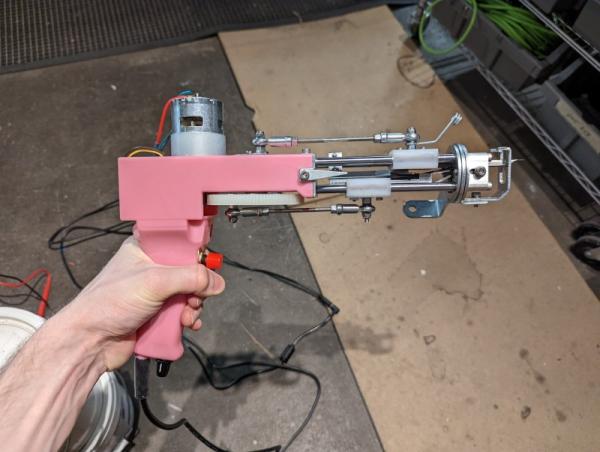
This robotic tufting system by [Owen Trueblood] is of the slow and arbitrary type. It will consist of a modified tufting gun strapped to a robot arm for CNC textile art. Tufting guns are manufactured with simple controls — a power switch, a knob to set the speed, and a trigger button to do the tufting. Once it’s affixed to the robot arm, [Owen] wants to remote control the thing.
The gun’s motor driver is nothing fancy, just a 555 using PWM to control a half H-bridge based on input from the speed control potentiometer. [Owen] replaced the motor controller with an Arduino and added an I/O port. The latter is a 3.5 mm stereo audio jack wired to GND and two of the Arduino’s pins. One is a digital input to power the gun, and the other is used as an analog speed controller based on input voltage. [Owen] is just getting started, and we’re excited to keep tabs on this project as the gun goes robotic.
This isn’t the first time we’ve seen robots do textiles — here’s a 6-axis robot arm that weaves carbon fiber.
Source: ROBOTIC TUFTING GUN FIRES OFF CNC TEXTILES
- How is the tufting process performed manually or with machines?
The process uses a hollow needle to cram thread or yarn into fabric in patterns, done by hand, with a gun, or with big machines. - Can the described machine create arbitrary patterns?
Yes, this specific robotic system is designed to poke arbitrary patterns and change easily, unlike machines that punch the same pattern repeatedly. - What controls were originally on the tufting gun?
The gun was manufactured with a power switch, a knob to set the speed, and a trigger button to do the tufting. - How does the new Arduino setup control the gun's speed?
One pin of the Arduino acts as an analog speed controller based on input voltage received through the audio jack. - How is the power for the gun managed in the modified system?
A digital input pin on the Arduino powers the gun through the 3.5 mm stereo audio jack wiring. - What component replaced the original motor driver?
[Owen] replaced the simple 555 PWM motor driver with an Arduino. - Is this the first time robots have been used for textiles?
No, this is not the first time; there has previously been a 6-axis robot arm that weaves carbon fiber. - What type of connections are used for the I/O port?
The I/O port is a 3.5 mm stereo audio jack wired to GND and two of the Arduino's pins.
