
Summary of ROBOT OPENS MASTER COMBINATION LOCKS IN LESS THAN A MINUTE
This article describes a DIY machine built by [Mew463] that automates the bypassing of vulnerable Master combination locks. Leveraging research by Samy Kamkar, the device applies pressure to the shackle while rotating the dial to detect internal friction points. Using an algorithm, it identifies the first and third numbers and narrows down the second number to eight candidates, opening the lock in under a minute. The project aims to repurpose old locks by exploiting their known mechanical weaknesses through automated testing.
Parts used in the Automated Lock Cracker:
- Master combination lock
- Stepper motor
- Servo motor
- Rack-and-pinion system
- Magnetic encoder
- Arduino Nano
- Custom PCB
- TMC2208 stepper driver
- Shackle
- Dial
A common trope in bank heist B-movies is someone effortlessly bypassing a safe’s combination lock. Typically, the hero or villain will turn the dial while listening to the internal machinery, then deduce the combination based on sounds made by the lock. In real life, high-quality combination locks are not vulnerable to such simple attacks, but cheap ones can often be bypassed with a minimum of effort. Some are so simple that this process can even be automated, as [Mew463] has shown by building a machine that can open a Master combination lock in less than a minute.
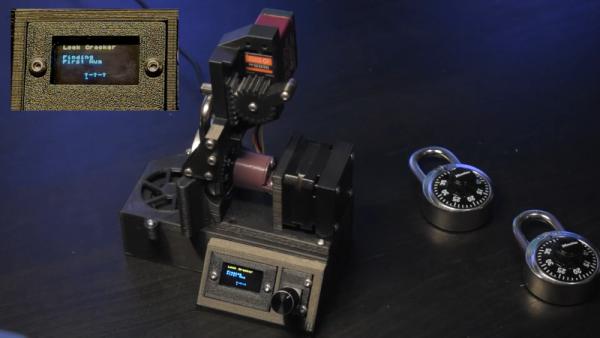
The operating principle is based on research by Samy Kamkar from a couple of years ago. For certain types of Master locks, the combination can be found by applying a small amount of pressure on the shackle and searching for locations on the dial where its movement becomes heavier. A simple algorithm can then be used to completely determine the first and third numbers, and find a list of just eight candidates for the second number.
[Mew463]’s machine automates this process by turning the dial with a stepper motor and pulling on the shackle using a servo and a rack-and-pinion system. A magnetic encoder is mounted on the stepper motor to determine when the motor stalls, while the servo has its internal position encoder brought out as a means of detecting how far the shackle has moved. All of this is controlled by an Arduino Nano mounted on a custom PCB together with a TMC2208 stepper driver.The machine does its job smoothly and quickly, as you can see in the (silent) video embedded below. All design files are available on the project’s GitHub page, so if you’ve got a drawer full of these locks without combinations, here’s your chance to make them sort-of-useful again. After all, these locks’ vulnerabilities have a long history, and we’ve even seen automated crackers before.
Source: ROBOT OPENS MASTER COMBINATION LOCKS IN LESS THAN A MINUTE
- How long does it take for the machine to open a Master combination lock?
The machine can open the lock in less than a minute. - Can cheap combination locks be bypassed with simple effort?
Yes, cheap locks can often be bypassed with a minimum of effort compared to high-quality ones. - What research inspired the operating principle of this machine?
The principle is based on research by Samy Kamkar regarding applying pressure to the shackle to find movement locations. - How many candidates does the algorithm produce for the second number?
The algorithm finds a list of just eight candidates for the second number. - What components are used to automate the turning of the dial and pulling of the shackle?
A stepper motor turns the dial while a servo and rack-and-pinion system pull on the shackle. - How does the machine detect when the motor stalls?
A magnetic encoder mounted on the stepper motor determines when the motor stalls. - Does the article mention if high-quality locks are vulnerable to sound-based attacks?
No, high-quality combination locks are not vulnerable to such simple attacks involving sounds. - Where can users find the design files for this project?
All design files are available on the project’s GitHub page.
