
Summary of RF mixers reduce distortion in 4G basestations
The IDT F1150 is a dual-channel RF to IF downconverting mixer optimized for 4G base station receivers. It operates on a single 5V supply, supporting RF bands from 1700–2200 MHz with high-side injection and IF frequencies between 50–450 MHz. The device offers ultra-linear performance with an Output IP3 of +40 dBm in standard mode or +36 dBm in low current mode. It features a drop-in replacement capability, power-down mode with fast settling, and is part of IDT's Zero-Distortion family to enhance SNR while reducing power consumption.
Parts used in the IDTF1150 Project:
- Dual channel device
- Single 5V supply
- Resistor values (4)
- Toggle pin
- Multi-mode Multi-carrier BaseStation Receiver
- 4G wireless basestations
IDTF1150
Dual RF to IF Downconverting Mixer
The F1150 dual channel device is designed to operate with a single 5V supply. It is optimized for operation in a Multi-mode, Multi-carrier BaseStation Receiver for RF bands from 1700 – 2200 MHz with High Side Injection. IF frequencies from 50 to 450 MHz are supported. Nominally, the device offers +40 dBm Output IP3 with 335 mA of ICC. Alternately one can adjust 4 resistor values and a toggle pin to run the device in low current mode with +36 dBm Output IP3 and 235 mA of ICC.
A member of IDT’s Zero-Distortion™ family, this RF to IF mixer reduces distortion for improved SNR while simultaneously reducing power consumption.
Features
- Dual Path for Diversity Systems
- 1700 to 2200 MHz freq range
- Ideal for Multi-Carrier Systems
- 8.5 dB Gain (200 MHz IF)
- Ultra linear +38 dBm IP3O (350 MHz IF)
- Ultra linear +40 dBm IP3O (200 MHz IF)
- Low NF < 10 dB
- 200 ohm output impedance
- Ultra high +13 dBm P1dBI
- Drop in replacement for existing radiocards
- 6×6 mm 36 pin package
- Power Down mode
- < 200 nsec settling from Power Down
- Minimizes Synth pulling in Standby Mode
- Low Current Mode : ICC = 235 mA
- Standard Mode: ICC = 335 mA
- Optimized for High Side Injection
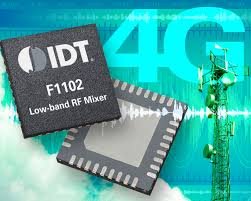
Integrated Device Technology has expanded its analogue wireless infrastructure product line with two low-distortion RF to intermediate frequency (IF) mixers for cellular basestations.
The IDT F1150 and F1152 are dual 1700-2200MHz RF to IF mixers with ultra linear (+42 dBm) third-order intercept point (IP3O) for good intermodulation rejection, making them suitable for multi-carrier, multi-mode cellular systems found in 4G wireless basestations.
“The low power consumption and low IM3 distortion of the IDT F1150 and F1152 address a key need for our customers’ 4G basestation solutions, which are being deployed at an intense pace,” said Tom Sparkman, general manager and v-p of the communications division at IDT.
According to the supplier, the devices are designed to improve system third-order intermodulation (IM3) performance and reduce power consumption, resulting in improved quality of service.
“This will result in smaller enclosures with increased reliability in 4G wireless infrastructure applications,” said IDT.
“The mixers reduce power consumption and improve IM3 distortion by over 15 dB for better signal-to-noise ratio (SNR), allowing customers to improve performance with a higher front-end gain,” said the supplier.
For more read: RF mixers reduce distortion in 4G basestations
- What frequency range does the IDTF1150 support?
The device supports RF bands from 1700 to 2200 MHz. - How much current does the device consume in standard mode?
The standard mode consumes 335 mA of ICC. - Can the device operate in a low current mode?
Yes, by adjusting four resistor values and a toggle pin, it runs at 235 mA. - Does the IDTF1150 offer high linearity?
It offers an ultra linear +40 dBm Output IP3 at 200 MHz IF. - What is the settling time from Power Down mode?
The settling time is less than 200 nsec. - Is the IDTF1150 suitable for multi-carrier systems?
Yes, it is ideal for Multi-Carrier Systems and 4G wireless basestations. - What package size does the device use?
It comes in a 6x6 mm 36 pin package. - How does the device affect signal-to-noise ratio?
It reduces distortion to improve SNR while simultaneously reducing power consumption.
