
Summary of Review: ScanaQuad – a super-small logic analyzer
Logic analyzers are ideal for digital device design and repair, often outperforming oscilloscopes for signal tracing. While professional units are costly and budget options lack software quality, Ikalogic's ScanaQuad series offers a cost-effective solution. These four-channel modules support common serial protocols like I²C and USB, with parallel operation enabling up to 24 channels. The series includes SQ25, SQ50, SQ100, and SQ200 models, distinguished primarily by sampling rates ranging from 25 MHz to 200 MHz, with higher-end variants offering expanded voltage ranges and differential measurement capabilities.
Parts used in the ScanaQuad Series:
- ScanaQuad SQ25 module
- ScanaQuad SQ50 module
- ScanaQuad SQ100 module
- ScanaQuad SQ200 module
- Accessory adapter
If you are mainly involved in designing or repairing digital devices, a logic analyzer is more useful than an oscilloscope for tracing signal through circuits. However, does this mean you should rush out and buy a logic analyzer? The instruments from the leading manufacturers are too expensive for home use or startup businesses, and the low-cost alternatives don’t do what you want or have half-baked software. That situation is slowly starting to change.
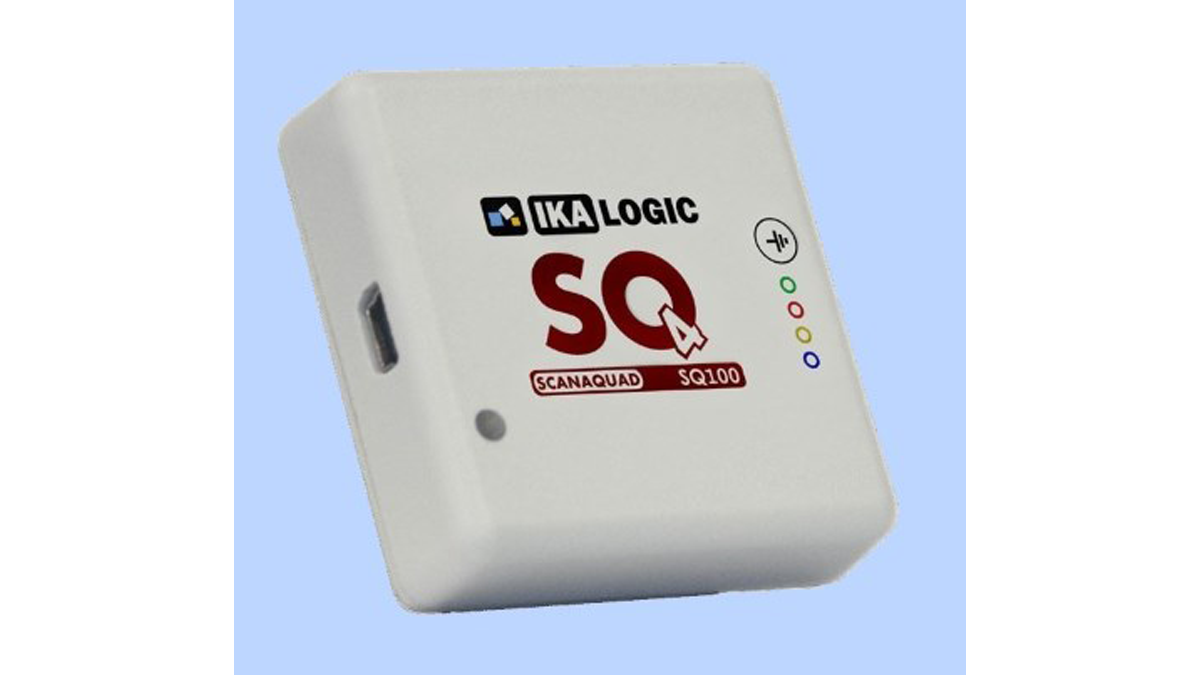
The French company Ikalogic has been making logic analyzers modules since 2010 with a USB port for connection to a laptop or desktop PC. Nothing special, you might say, but late last year they launched a new series of four-channel logic analyzer modules. Why not eight or more channels? If you think about it a bit, the answer is clear: most modern microcontrollers and digital circuits use serial links to save space and pin counts. Sensors, EEPROMs, communication with the outside world – they all run with I²C, I²S, 1-Wire, USB and so on. With all of these links you only need two, three or four lines, so why not limit yourself to a total of four channels? Ikalogic has worked this out nicely, and especially thanks to the integration of virtually all commonly used serial protocols into their software, you actually don’t need more channels with the ScanaQuad devices. If you nevertheless do require more, Ikalogic’s engineers have anticipated your need by allowing several analyzer modules to be operated in parallel with an accessory adapter, which gives you up to 24 channels.
The ScanaQuad series consists of four modules (SQ25, SQ50, SQ100 and SQ200), which mainly differ in the sampling rate. The number at the end of the type designation is the sampling rate in MHz per channel (for example, SQ25 means 25 MHz), regardless of the number of channels being used. Compared to the lower-end modules, the two top-end modules have a larger input voltage range (±15 V), more input and output configurations, and differential measurement capability.
Read more: Review: ScanaQuad – a super-small logic analyzer
- Why does the ScanaQuad series have only four channels?
Most modern microcontrollers use serial links like I²C and USB which require only two to four lines. - How can users expand the channel count beyond four?
Users can operate several analyzer modules in parallel using an accessory adapter to reach up to 24 channels. - What is the difference between the SQ25 and SQ200 models?
The primary difference is the sampling rate, with SQ200 offering 200 MHz per channel compared to 25 MHz for SQ25. - Do all ScanaQuad modules support the same input voltage range?
No, only the top-end modules feature a larger input voltage range of ±15 V. - Can the ScanaQuad devices measure differential signals?
Yes, the two top-end modules include differential measurement capability. - How are the ScanaQuad modules connected to a computer?
They connect via a USB port to a laptop or desktop PC. - What determines the model number suffix in the ScanaQuad series?
The number indicates the sampling rate in MHz per channel regardless of the channel count.
