
Summary of Researchers Developed a Very Powerful Mini Synchrotron That Can Fit On A Tabletop
This article describes the development of "Smart*Light," a compact, tabletop synchrotron designed by researchers from Eindhoven and Delft Universities. Unlike massive facilities like the Large Hadron Collider, this scaled-down version is under 4 meters long yet produces X-ray radiation with comparable intensity. It aims to revolutionize medical diagnostics, industrial manufacturing, and art conservation by allowing non-destructive, layer-by-layer chemical analysis in standard laboratory settings.
Parts used in the Smart*Light Synchrotron:
- Scaled down synchrotron design
- Compact tunable X-ray source
- Cyclic particle accelerator components
- Beam focusing system
- Beam bending mechanism
- Beam splitting components
- Tabletop enclosure (less than 4 meters long)
A synchrotron is a particular type of cyclic particle accelerator which is used to accelerate quantum level charged particles at a very high velocity, traveling around a fixed closed-loop path.
It is one of the first accelerator concepts to enable the construction of large-scale facilities because they are very efficient in beam focusing, bending, and splitting the beam into different components. The most powerful modern particle accelerators such as Large Hadron Collider (LHC) in Switzerland uses bigger versions of the synchrotron design.
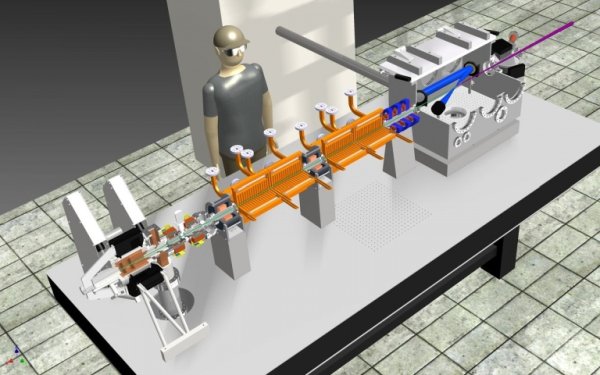
A synchrotron is mainly used for the production of X-ray in many medical, engineering or industrial fields. Researchers at Eindhoven University of Technology and Delft University of Technology will build and develop a new scaled down version of a synchrotron which will even fit on a tabletop. The intensity of the X-ray radiation of this device will be just as powerful as the larger ones. “Smart*Light” is the name of this new synchrotron which they officially took under research on 23rd January.
With Smart*Light, the consortium wants to build a ‘scaled down synchrotron‘. A compact and tunable X-ray source which is less than 4 meters long, which can be used in any lab. The potential of application for such a device is huge in medical diagnostics, high-tech industries, aircraft, car, and ship manufacturing.
Using Smart*Light there is the opportunity to analyze the chemical composition of old or new artworks layer by layer. This does not only have importance for conservation but, also for research into authenticity too.
Read more: Researchers Developed a Very Powerful Mini Synchrotron That Can Fit On A Tabletop
-
What is Smart*Light?
It is a new scaled down version of a synchrotron that fits on a tabletop. -
How large is the Smart*Light device?
The device is less than 4 meters long. -
Which universities are developing this project?
Researchers at Eindhoven University of Technology and Delft University of Technology are building it. -
Can the X-ray intensity match larger synchrotrons?
Yes, the intensity of the X-ray radiation will be just as powerful as larger ones. -
Does the Smart*Light fit in any lab?
Yes, it is designed to be used in any lab due to its compact size. -
What industries can benefit from this technology?
Medical diagnostics, high-tech industries, aircraft, car, and ship manufacturing can utilize it. -
How does it help in art conservation?
It allows analyzing the chemical composition of artworks layer by layer for conservation and authenticity research. -
When did researchers officially start researching Smart*Light?
They took it under research on 23rd January.
