
Summary of Product How-to: Ultra-low noise linear regulators for powering PLL/VCO and clocking ICs
This article discusses the critical need for ultra-low noise regulators in wideband communication systems to power VCOs and PLLs, ensuring clean 5-V, 3.3-V, or 2.5-V rails despite input ripple from switching elements. It highlights the ADM7150 and ADM7151 linear regulators, which offer low noise spectral density and high current output to minimize phase noise in applications like satellite communications and defense electronics.
Parts used in the Wideband Communication Power System:
- Inductive switching elements
- ADM7150 fixed-output ultralow-noise linear regulator
- ADM7151 adjustable-output ultralow-noise linear regulator
- User-adjustable capacitor
Wideband communication systems usually require an ultra-low noise regulator to power the VCOs and PLLs. The regulator must also be able to reject any ripple presented at its input. In a typical system, an ac input is converted to an isolated dc supply rail, –48-V, for example. This rail is then converted to an isolated 12-V or 5-V system rail that powers the main components in the communication system.
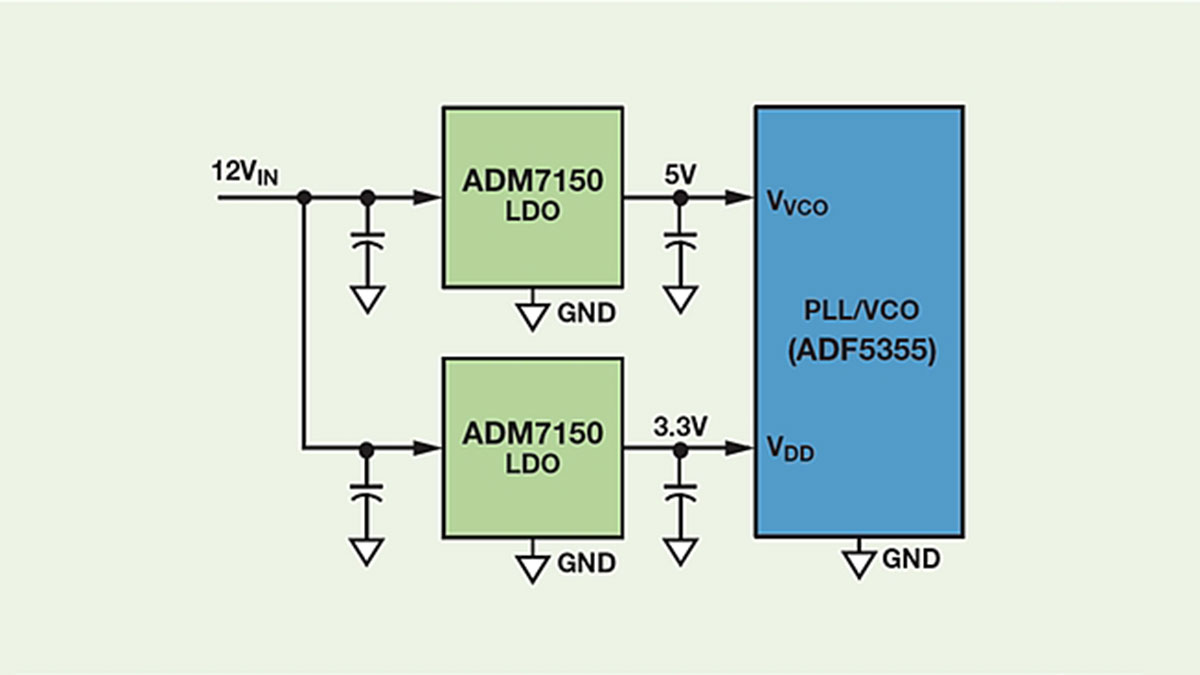
This 12-V or 5-V system rail is generated by inductive switching elements that create ripple and noise on the rail. To provide a clean power rail, an ultralow-noise regulator is required to generate the 5-V, 3.3-V or 2.5-V rail used to power the wideband PLL and VCO. Any noise or ripple present on the 5-V, 3.3-V or 2.5-V rail will degrade the performance of the PLL or VCO.
The fixed-output ADM7150 and adjustable-output ADM7151 ultralow-noise linear regulators for RF signal devices operate from 4.5 V to 16 V, provide up to 800 mA of output current, and support output voltages from an input voltage of 1.5 to 5.0 V. The LDOs achieve 1.4-nV/√Hz output noise spectral density (NSD) from 10 kHz to 1 MHz, significantly reducing VCO phase noise in point-to-point microwave radios, satellite communications, defense electronics, and other wideband systems. In addition, a user-adjustable capacitor can significantly reduce low-frequency noise (8 nV/√Hz at 100 Hz) for precision analog front-end measurement systems. The total solution size is only 7.62 mm × 5.21 mm.
For More Details: Product How-to: Ultra-low noise linear regulators for powering PLL/VCO and clocking ICs
- Why is an ultralow-noise regulator required?
Any noise or ripple on the rail will degrade the performance of the PLL or VCO. - What voltage rails are generated by the ultralow-noise regulator?
The regulator generates 5-V, 3.3-V, or 2.5-V rails. - How much output current do the ADM7150 and ADM7151 provide?
They provide up to 800 mA of output current. - What is the output noise spectral density range of these LDOs?
They achieve 1.4-nV/√Hz output noise spectral density from 10 kHz to 1 MHz. - Can the low-frequency noise be reduced further?
Yes, a user-adjustable capacitor can reduce low-frequency noise to 8 nV/√Hz at 100 Hz. - What is the total solution size of these regulators?
The total solution size is only 7.62 mm × 5.21 mm. - Which systems benefit significantly from reducing VCO phase noise?
Point-to-point microwave radios, satellite communications, and defense electronics benefit. - What is the operating voltage range for the ADM7150 and ADM7151?
They operate from 4.5 V to 16 V.
