
Summary of Portable Arduino Lab
### Summary This article describes a project converting a standard Arduino Uno into a "Portable Arduino Lab." The modification addresses the original board's lack of internal power and fragile PCB by adding an integrated Li-ion battery system with a boost converter, charging circuit, and low-voltage indicator. A protective casing is also included to ensure durability and portability for students and hobbyists working outside a traditional lab environment.
Parts used in the Portable Arduino Lab:
- Arduino Uno board
- Li-ion cell
- Boost converter
- Intelligent charger circuit
- Low voltage indicator circuit
- SMD components
- Protective covering/casing
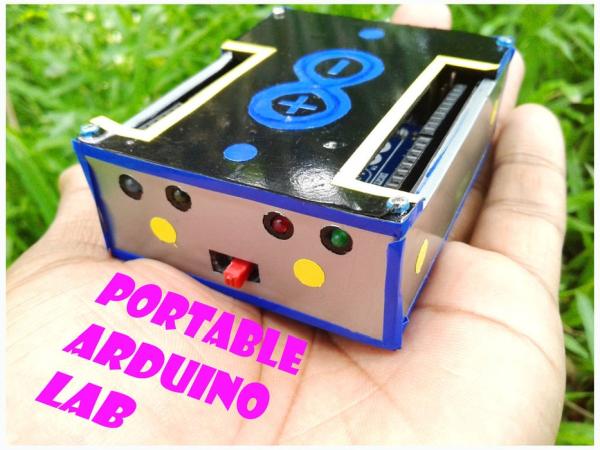
Portable Arduino Lab
All are familiar with Arduino. Basically, it is an open-source electronics prototyping platform. It is a single board micro-controller computer. It is available in different forms Nano, Uno, etc… All are used to make electronic projects. The attraction of Arduino is that it is simple, user-friendly, open-source and cheap. It is designed for every one which are not familiar with electronics. So it is widely used by students and hobbyists to fulfill their projects more attractive.
I am an electronics student, so I am familiar with Arduino. Here I modified the Arduino Uno for Arduino users who do not come from an electronic background (or for everyone). So here I converted the Arduino Uno board to a “Portable Arduino Lab”. It helps everyone who needs it portable. The problem associated with the Arduino board is that it needs an external power supply and it is a bare PCB, so the rough use damages the PCB.
So here I add an internal power-supply with multi-function and provide a protective covering to the whole circuit. By this method, I created a “Portable Arduino Lab” for everyone. So I created an electronic lab that fits in your pocket. If you are not in your home or in the lab, but you need to test a new idea into the circuit, then this makes that practical. If you like it, please read the making steps…
My plan is to add a power supply unit and a cover for the whole. So first we plan about the power-supply.
Power-supply
For powering the Arduino we add a Li-ion cell. But its voltage its only 3.7V. But we need a 5V supply, so we add a boost converter which makes 5V from 3.7V. For the charging, the Li-ion cell adds an intelligent charger circuit which maintains the Li-ion cell in a good condition.
For indicating the battery low voltage condition add an extra circuit to indicate that it needs charging. This is the planning for the power-supply section.
Here we only use SMD components for this project. Because we need a small size PCB. Also, this SMD work improves your skills. Next is the protective covering.
Read More
-
Why was the Arduino Uno modified?
The modification adds an internal power supply and protective covering to solve issues with external power needs and PCB damage from rough use. -
How is the device powered internally?
A Li-ion cell provides power, which is stepped up to 5V using a boost converter since the cell alone outputs only 3.7V. -
What ensures the battery remains in good condition?
An intelligent charger circuit is added to maintain the Li-ion cell in good condition during charging. -
How does the user know when the battery is low?
An extra circuit is included to indicate when the battery voltage is low and needs charging. -
Why were SMD components chosen for this project?
SMD components were used to achieve a small size PCB and to improve the builder's skills. -
Who is the target audience for this portable lab?
The project is designed for everyone, including users who do not come from an electronic background or are students.
