
Summary of PLAY A GAME OF MULTIMETER
The article describes a project where a ClockworkPi handheld console is repurposed into a functional multimeter. The device features graphing capabilities and instant readings by integrating an Arduino board for analog-to-digital conversion, utilizing opto-couplers for electrical isolation. A three-way switch allows users to select between voltage, current, and resistance ranges. The interface runs on Python code available on GitHub, offering potential for further expansion despite lacking adequate input protection at this stage.
Parts used in the ClockworkPi Multimeter:
- ClockworkPi handheld console
- Arduino board
- Opto-couplers
- Three-way switch
There are many different single board computers that are general purpose, but there’s another breed targeted at specific applications. One such is the Clockworkpi, a handheld Game Boy-style games console, which may be aimed at gamers but has just as much ability to do all the usual SBC stuff. It’s something [UncannyFlanigan] has demonstrated, by turning the Clockworkpi into a multimeter. And it’s not just a simple digital multimeter either, it’s one that sports graphing as well as instantaneous readings.
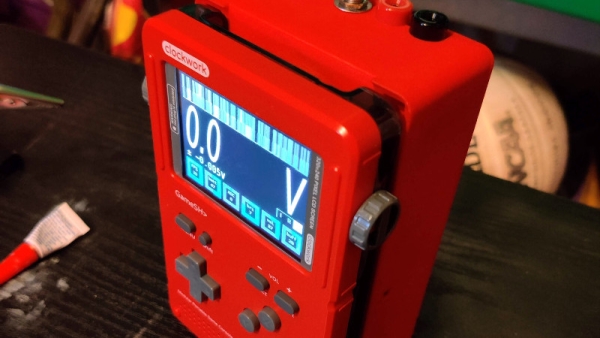
At its heart is an Arduino board that supplies the analogue to digital conversion, with opto-couplers for isolation between the two boards. A simple three-way switch selects voltage, current, and resistance ranges, and the ClockworkPi interface is written in Python. We can see that this could easily be extended using the power of the Arduino to deliver more functionality, for which all the code is handily available in a GitHub repository. It’s not a perfect multimeter yet because it lacks adequate input protection, but it shows a lot of promise.
If you’re intrigued by this project then maybe you’ll be pleased to know that it’s not the first home made multimeter we’ve featured.
Source: PLAY A GAME OF MULTIMETER
- What components are used as the heart of the multimeter?
An Arduino board supplies the analogue to digital conversion. - How is isolation achieved between the two boards?
Opto-couplers provide isolation between the Arduino and the ClockworkPi. - Can the device measure multiple types of electrical values?
Yes, it measures voltage, current, and resistance using a three-way switch. - What programming language is used for the ClockworkPi interface?
The interface is written in Python. - Is the source code for the project available?
Yes, all the code is available in a GitHub repository. - Does the current version of the multimeter have full input protection?
No, it lacks adequate input protection at this time. - Does the multimeter support graphing functions?
Yes, it sports graphing as well as instantaneous readings.
