
Summary of PINTHING MECHANIZES PIN ART
Summary:
The PinThing is a mechanized pin art display designed by [hugs] as an entry for the 2021 Hackaday Prize. Unlike standard pin art, it uses larger pins to accommodate small geared DC motors within 3D-printed lead screw mechanisms. The system is controlled by an Arduino Uno running Firmata, driven by a stack of motor driver shields and managed via a Node.js app with the Johnny-Five library. While functional as a proof of concept, the design highlights high costs associated with pixelated mechanical displays and suggests mechanical multiplexing as a solution to reduce actuator requirements.Parts used in the PinThing:
- Small geared DC motors
- 3D-printed lead screw mechanisms
- Motor driver shields
- Arduino Uno
- Firmata protocol
- Node.js app
- Johnny-Five library
Pin art is one of those things that simply cannot be left alone if it’s within arms reach, and inevitably end up with a hand or face imprint. [hugs] is also fascinated by them, so he designed the PinThing, a mechanized pin art display.
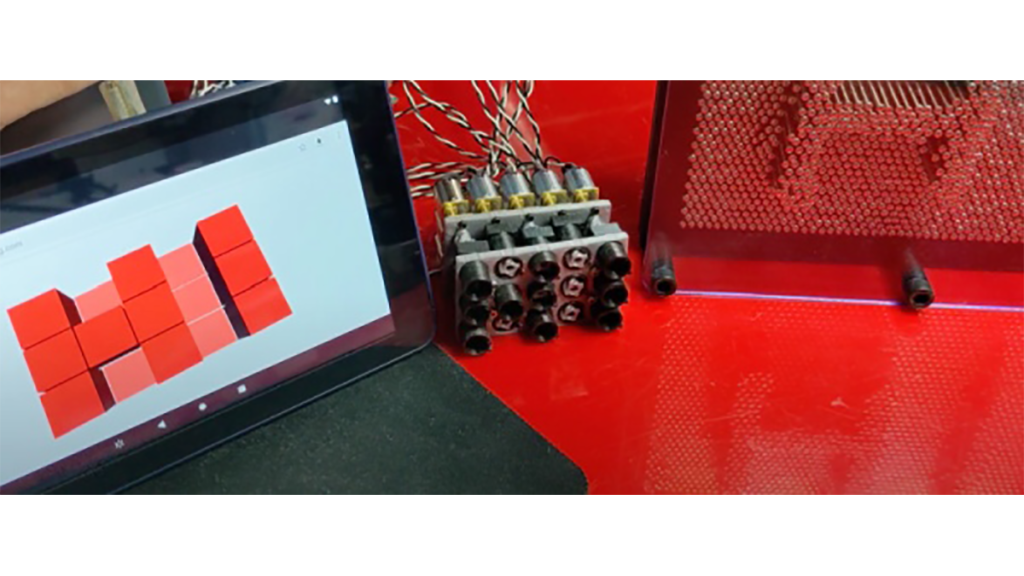
The PinThing pin diameters are much larger than standard pin art, but this is to fit small geared DC motors. Each pin is a short 3D-printed lead screw mechanism. The motors are driven with a stack of motor driver shields on top of an Arduino Uno, which uses Firmata to receive instructions over serial from a Node.js app using the Johnny-Five library. This may be a simple 3×5 proof of concept, but then it could be used for everything from displays to interactive table surfaces.
One of the challenges with pixelated mechanical displays like this, the inFORM from MIT, or even flip dot displays, are the costs in actuators and driver electronics. A small 10×10 array requires 100 motors and drivers, which quickly adds up as you expand, even if individual components are quite cheap.
If you are willing to sacrifice instantaneous response from each pixel, you can use a mechanical multiplexer. It consists of some sort of moving carriage behind the display with mounted actuators, so you’ll only need an actuator per row, not for every pin. This also means the pins can be closer together since the actuators can be staggered on the carriage.
PinThing project was an entry to the Rethink Displays Challenge of the 2021 Hackaday Prize, for which the finalists were just announced.
Source: PINTHING MECHANIZES PIN ART
- What is the PinThing?
The PinThing is a mechanized pin art display designed by [hugs]. - How do the pin diameters compare to standard pin art?
The PinThing pin diameters are much larger than standard pin art. - Why are the pins larger in this project?
The larger size is required to fit small geared DC motors inside each pin. - What hardware controls the motors?
A stack of motor driver shields on top of an Arduino Uno drives the motors. - Which software libraries are used for control?
The system uses Firmata on the Arduino and a Node.js app using the Johnny-Five library. - What challenge did the project enter?
The PinThing was an entry to the Rethink Displays Challenge of the 2021 Hackaday Prize. - What is a major challenge with pixelated mechanical displays?
The costs in actuators and driver electronics quickly add up as the array expands. - How can you reduce the number of actuators needed?
You can use a mechanical multiplexer with a moving carriage to use one actuator per row.
