
Summary of PID Theory Explained
This article explains Proportional-Integral-Derivative (PID) control, a robust industrial algorithm using three coefficients for optimal response. It details closed-loop systems where sensors measure process variables like temperature to compare against set points, driving actuators while minimizing disturbances. The text also introduces the LabVIEW PID toolset for implementation and tuning.
Parts used in the PID Control System:
- Sensor
- Process Variable
- Set Point
- Control Algorithm (Compensator)
- Actuator
- Plant (System)
- Disturbance Source
- LabVIEW PID Toolset
Overview
Proportional-Integral-Derivative (PID) control is the most common control algorithm used in industry and has been universally accepted in industrial control. The popularity of PID controllers can be attributed partly to their robust performance in a wide range of operating conditions and partly to their functional simplicity, which allows engineers to operate them in a simple, straightforward manner.
As the name suggests, PID algorithm consists of three basic coefficients; proportional, integral and derivative which are varied to get optimal response. Closed loop systems, the theory of classical PID and the effects of tuning a closed loop control system are discussed in this paper. The PID toolset in LabVIEW and the ease of use of these VIs is also discussed.
1. Control System
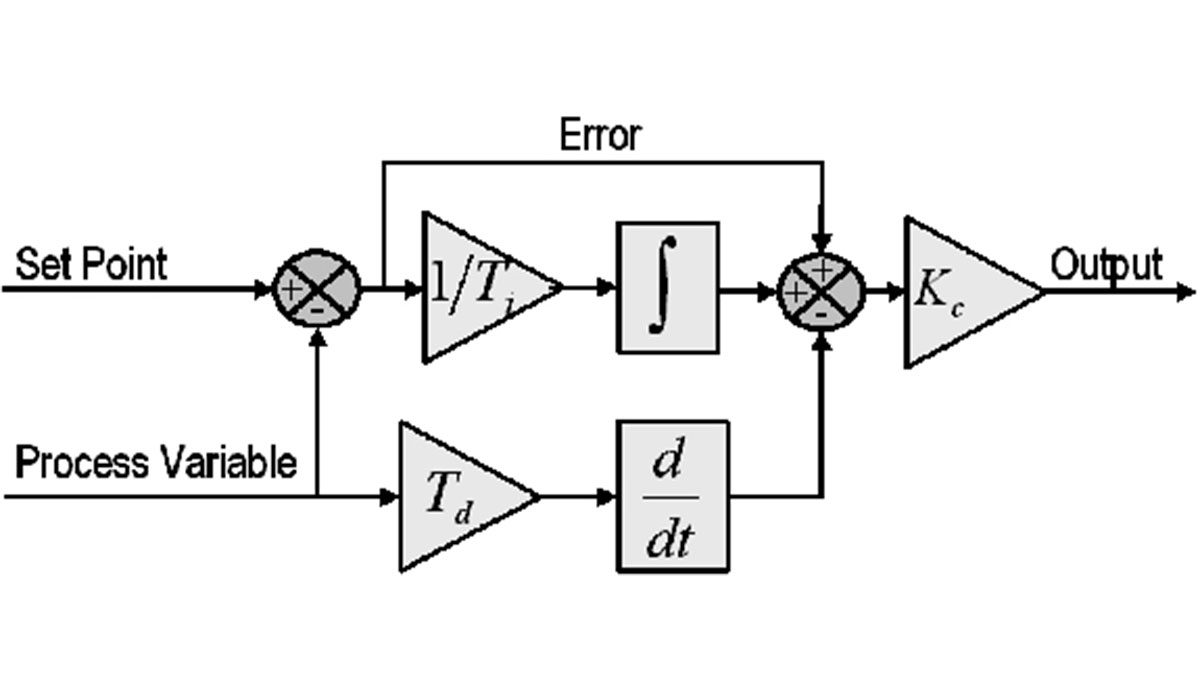
The basic idea behind a PID controller is to read a sensor, then compute the desired actuator output by calculating proportional, integral, and derivative responses and summing those three components to compute the output. Before we start to define the parameters of a PID controller, we shall see what a closed loop system is and some of the terminologies associated with it.
Closed Loop System
In a typical control system, the process variable is the system parameter that needs to be controlled, such as temperature (ºC), pressure (psi), or flow rate (liters/minute). A sensor is used to measure the process variable and provide feedback to the control system. The set point is the desired or command value for the process variable, such as 100 degrees Celsius in the case of a temperature control system. At any given moment, the difference between the process variable and the set point is used by the control system algorithm (compensator), to determine the desired actuator output to drive the system (plant). For instance, if the measured temperature process variable is 100 ºC and the desired temperature set point is 120 ºC, then the actuator output specified by the control algorithm might be to drive a heater. Driving an actuator to turn on a heater causes the system to become warmer, and results in an increase in the temperature process variable. This is called a closed loop control system, because the process of reading sensors to provide constant feedback and calculating the desired actuator output is repeated continuously and at a fixed loop rate as illustrated in figure 1.
In many cases, the actuator output is not the only signal that has an effect on the system. For instance, in a temperature chamber there might be a source of cool air that sometimes blows into the chamber and disturbs the temperature.Such a term is referred to as disturbance. We usually try to design the control system to minimize the effect of disturbances on the process variable.
For more Details: PID Theory Explained
- What are the three basic coefficients of the PID algorithm?
The PID algorithm consists of proportional, integral, and derivative coefficients. - How does a closed loop system determine actuator output?
The system calculates the difference between the process variable and the set point to determine the desired actuator output. - What is the role of a sensor in a control system?
A sensor measures the process variable and provides feedback to the control system. - Can you give an example of a disturbance in a temperature chamber?
A source of cool air blowing into the chamber that disturbs the temperature is referred to as a disturbance. - Why is PID control popular in industry?
Its popularity is attributed to its robust performance in various conditions and its functional simplicity. - What does the term plant refer to in this context?
The plant refers to the system being driven by the actuator output. - How often is the feedback loop repeated in a closed loop system?
The process is repeated continuously at a fixed loop rate. - What toolset is mentioned for implementing PID control?
The PID toolset in LabVIEW is discussed for its ease of use.
