
Summary of PARALLEL PROCESSING WAS NEVER QUITE DONE LIKE THIS
This article discusses a 2008 project where Michael built a massively parallel processing array using eight-core Parallax Propeller microcontrollers on a breadboard. While the Propeller chip is now considered an intriguing oddity due to its high cost and complex tools compared to modern alternatives, the project offers valuable insights into the architectural strategies of parallel processing. It highlights that building such systems requires more than just connecting chips; it involves careful planning of task distribution and architecture design beyond simple sequential execution.
Parts used in the Massively Parallel Processing Array:
- Parallax Propeller microcontrollers
- Breadboard
Parallel processing is an idea that will be familiar to most readers. Few of you will not be reading this on a device with only one processor core, and quite a few of you will have experimented with clusters of Raspberry Pi or similar SBCs. Instead of one processor doing tasks sequentially, the idea goes, take a bunch of processors and hand out the tasks to be done simultaneously.
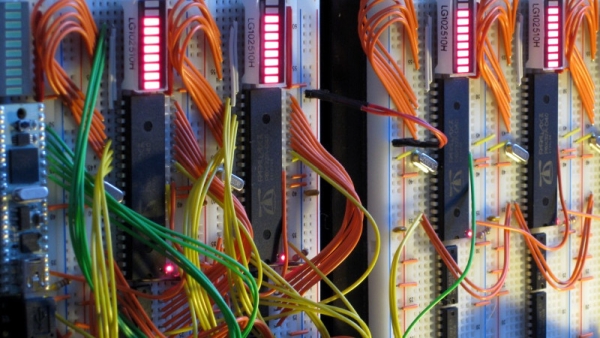
It’s a fair bet though that few of you will have designed and constructed your own parallel processing architecture. [BB] sends us a link which though it’s an old one is interesting enough to bring you today: [Michael] created a massively parallel array of Parallax Propeller microcontrollers back in 2008, and he did so on a breadboard.
The Parallax Propeller is an 8-core RISC microcontroller from the company that had found success in the 1990s with the BASIC Stamp, the PIC-based board that was all the rage before Arduino came into the world. In the last decade it was seen as an extremely exciting prospect, but high price and arcane development tools compared to a new generation of low-cost and easy to code competitors meant that it never quite caught on and remains today something of an intriguing oddity. So today’s value in this project lies not in something that you should run out and do yourselves, but instead in what the work tells us about the nuts and bolts of parallel processing architecture. It involves more than simply hooking up a load of chips and hoping for the best, and we gain some insight into the different strategies involved.
The Propeller certainly wasn’t the first attempt at a massively parallel microcontroller, and we doubt it will be the last. We’re certainly seeing microcontrollers with more than one core becoming more mainstream even in our community, but even with those how many of you have made use of the second core in your dual-core ESP32? Is a multicore microcontroller a solution searching for a problem, or will somebody one day crack it and the world will never be the same again? As always, the comments are below.
Source: PARALLEL PROCESSING WAS NEVER QUITE DONE LIKE THIS
- What device did Michael use to create his parallel processing array?
Michael created the array using Parallax Propeller microcontrollers. - How many processor cores does each Parallax Propeller have?
The Parallax Propeller is an 8-core RISC microcontroller. - Where was the parallel processing architecture constructed?
The project was constructed on a breadboard. - Why did the Parallax Propeller never quite catch on with mainstream users?
It failed to gain widespread adoption due to its high price and arcane development tools compared to low-cost competitors. - What company previously made the BASIC Stamp board?
The same company that makes the Propeller found success with the BASIC Stamp in the 1990s. - Does the article suggest most readers have designed their own parallel processing architecture?
No, the article states it is a fair bet that few readers have designed and constructed their own parallel processing architecture. - What is the main value of this specific project according to the text?
The value lies in gaining insight into the nuts and bolts of parallel processing architecture and different strategies involved. - Are multicore microcontrollers becoming more mainstream?
Yes, the article notes that microcontrollers with more than one core are becoming more mainstream even in the community. - What is the author's view on whether multicore microcontrollers solve real problems?
The author questions if a multicore microcontroller is a solution searching for a problem or if someone will eventually crack it to change the world.
