
Summary of New Sensors Could Allow Machines to Smell More Accurately Than Humans
Scientists have developed a new biosensor using odorant binding proteins and transistors to detect chiral molecules with human-like accuracy. This technology enables machines to distinguish mirror-image smells, such as spearmint versus caraway, which previous devices could not. The innovation, a collaboration between the University of Manchester and the University of Bari, allows for industrial applications like detecting spoiled food or atmospheric pollution by measuring unique current changes when proteins react to odours.
Parts used in the Biosensor Project:
- Odorant binding proteins
- Transistors
- Olfactory receptors (mimicked)
- Chiral molecules
- Carvone molecules
- Current measurement systems
Scientists have come up with a way of creating sensors which could allow machines to smell more accurately than humans.
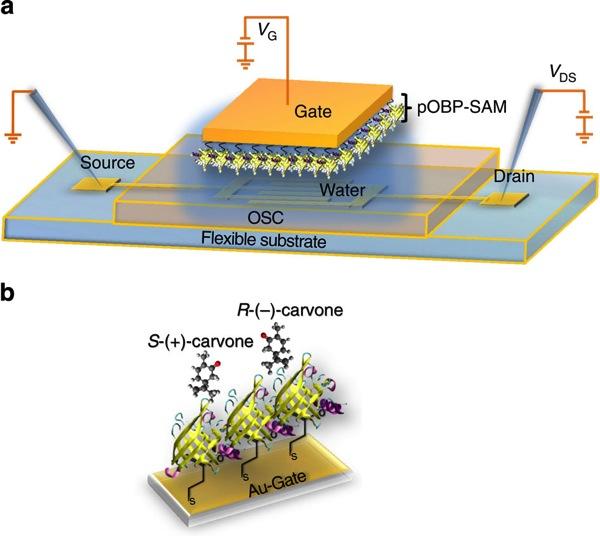
Every odour has its own specific pattern which our noses are able to identify. Using a combination of proteins coupled to transistors, for the first time machines are able to differentiate smells that are mirror images of each other, so called chiral molecules, something that has not been possible before. The human nose can distinguish between some of these molecules and the different forms of the same molecule of carvone, for example, can smell either like spearmint or caraway. Previous machines would not have been able to distinguish between the two.
The development will allow the creation of a new generation of biosensors with an acute ability to sniff out problems. These could have many industrial uses such as telling when food has gone off, and they could even be accurate enough to smell how much pollution is in the atmosphere.
A collaboration of academics from The University of Manchester and the University of Bari in Italy, have created a biosensor that utilises an odorant binding protein. The team’s findings are published today in the journal Nature Communications.
Odorant binding proteins are found in the mucus of the nose, which work olfactory receptors helping us to create our perception of smell. The team have found a method of manufacturing these proteins in quantities that would allow them to be used in biosensors.
They have developed methods to change the way the proteins react so that they can recognise different types of chemicals. Using a type of transistor incorporating these proteins the scientists were able to measure the unique changes in current as the proteins reacted to odours, and record them. This is in effect the machine smelling the odour and then sending the message, which can then be decoded.
The system is incredibly sensitive with a detection limit that approaches that of the human nose.
Professor Krishna Persaud, lead author of the paper at The University of Manchester, said: “It has been challenging to get machines to be able to differentiate between smells that are mirror images of each other, which was a real barrier to creating machines which are able to smell as well or better than humans.
- How can machines now differentiate mirror image smells?
Machines use a combination of proteins coupled to transistors to recognize different types of chemicals. - What specific challenge did this new sensor solve?
It solved the barrier of distinguishing between smells that are mirror images of each other, known as chiral molecules. - Can you give an example of two smells the machine can now tell apart?
The sensor can distinguish between carvone forms that smell like spearmint and caraway. - Where were these findings published?
The team's findings were published in the journal Nature Communications. - Which universities collaborated on this project?
The University of Manchester and the University of Bari in Italy collaborated on the creation of the biosensor. - How does the system measure the presence of an odour?
The system measures unique changes in current as the proteins react to odours and records them. - What is the detection limit of this new system?
The system has a detection limit that approaches that of the human nose. - What are some potential industrial uses for this technology?
Uses include telling when food has gone off and accurately measuring how much pollution is in the atmosphere. - Where are odorant binding proteins naturally found?
They are found in the mucus of the nose where they work with olfactory receptors. - Who is the lead author of the paper describing this development?
Professor Krishna Persaud from The University of Manchester is the lead author.
