
Summary of NEW AIR VELOCITY SENSORS FOR DATA CENTER THERMAL MANAGEMENT
Posifa Technologies launched the PAV1000 series, a compact MEMS air velocity sensor for data center thermal management and HVAC filter monitoring. Available in 7 m/s and 15 m/s models, these sensors offer rapid 125 ms response times and high accuracy with minimal temperature drift. Their robust thermal isolation design prevents clogging and pressure shock, providing real-time airflow data to optimize cooling efficiency and extend filter life compared to traditional thermistor solutions.
Parts used in the PAV1000 Series:
- PAV1005V sensor (7 m/s)
- PAV1015V sensor (15 m/s)
- MEMS sensor core
- Third-generation thermal flow die
- Thermopiles pair
- Solid-state thermal isolation structure
Posifa Technologies today announced its new PAV1000 series of air velocity sensors for data center thermal management and HVAC applications such as filter monitoring . Measuring air velocity at 7 m/s (PAV1005V) and 15 m/s (PAV1015V), the devices offer extremely fast response times of 125 ms typical in a compact, robust package.
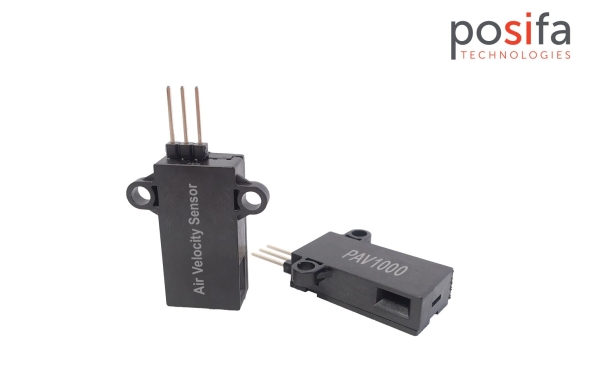
The PAV1000 series was designed as an economical, high-performance air velocity sensor for thermal management and filter monitoring in even the most space-constrained locations, such as rack enclosures with air cooling in data centers . Unlike thermistor-based solutions, the Posifa MEMS sensor core is minimally affected by ambient temperature changes and provides instant real-time feedback on proper air flow at critical locations .
Air velocity data perfect ly complement s temperature information to provide the best insight into thermal efficiency. By i dentifying areas that require unusually high air flow to maintain stable temperatures , layouts can be modified to reduce cooling demands f or increased energy savings. In HVAC applications , air velocity measurements can be used to determine when filter s need to be replace d. This ensures hardware is adequately protected during heavy use , while allowing customers with light usage requirements to benefit from extended change intervals.
The devices feature Posifa’s third-generation thermal flow die, which uses a pair of thermopiles to detect changes in temperature gradient caused by mass flow. The result is excellent repeatability of 1 % FS and accuracy of 5 % FS. The solid-state thermal isolation structure on the sensor die eliminates the need for a surface cavity or fragile membrane used in competing technologies, making the sensor resistant to clogging and pressure shock.
Read more: NEW AIR VELOCITY SENSORS FOR DATA CENTER THERMAL MANAGEMENT
- What are the primary applications for the PAV1000 series?
The devices are designed for data center thermal management and HVAC applications such as filter monitoring. - How fast is the response time of the PAV1000 sensors?
The devices offer extremely fast response times of 125 ms typical. - Does the sensor performance change with ambient temperature?
Unlike thermistor-based solutions, the Posifa MEMS sensor core is minimally affected by ambient temperature changes. - Can this technology help reduce energy consumption in data centers?
Yes, identifying areas needing high airflow allows layout modifications to reduce cooling demands for increased energy savings. - How does measuring air velocity assist with HVAC maintenance?
Air velocity measurements can be used to determine when filters need to be replaced, protecting hardware during heavy use. - What specific component detects the temperature gradient in these sensors?
The third-generation thermal flow die uses a pair of thermopiles to detect changes in temperature gradient caused by mass flow. - What are the accuracy and repeatability specifications of the device?
The devices feature excellent repeatability of 1 % FS and accuracy of 5 % FS. - Why is the solid-state thermal isolation structure beneficial?
It eliminates the need for a surface cavity or fragile membrane, making the sensor resistant to clogging and pressure shock.
