
Summary of MINIMAL TIC TAC TOE BUSINESS CARD
This article describes a unique PCB business card designed by Ryan Chan to help electronics engineers stand out. The card features a fully functional Tic-Tac-Toe game, allowing recruiters to play while reviewing contact details. Instead of an expensive OLED or thick LED matrix, the design utilizes 18 LEDs in two colors on a 3×3 grid, controlled by an ATmega328p microcontroller and a single SMD pushbutton. The button handles move selection, confirmation, and toggling between multiplayer and AI modes. Schematics and code are available for others to replicate this minimalist project.
Parts used in theTic-Tac-Toe Business Card:
- 18 LEDs (9 in each of two colors)
- ATmega328p with Arduino bootloader
- SMD pushbutton
- PCB board
The PCB business card has long been a way for the aspiring electronics engineer to set themself apart from their peers. Handing out a card that is also a two player game is a great way to secure a couple minutes of a recruiter’s time, so [Ryan Chan] designed a business card that, in addition to his contact information, also has a complete Tic-Tac-Toe game built in.
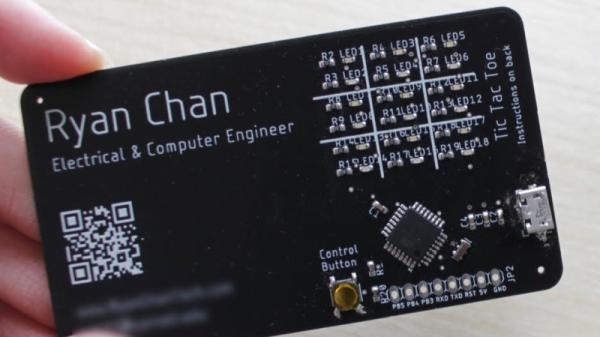
If you’d like to design a Tic-Tac-Toe business card for yourself, [Ryan] was kind enough to upload the schematics and code for his card. If you’re still pondering what kind of PCB business card best represents you, it’s worth checking out cards with an updatable ePaper display or a tiny Tetris game.
Source: MINIMAL TIC TAC TOE BUSINESS CARD
- Why did the designer choose 18 LEDs over an OLED display?
An OLED display was considered too expensive for a handout item. - How does the user control the game using the single button?
A short press moves the selection, a longer press finalizes the move, and a several-second press switches to single-player mode. - What microcontroller powers the business card?
The card uses an ATmega328p running the Arduino bootloader. - Does the game offer a single-player option?
Yes, holding the button for several seconds activates a single-player mode complete with AI. - Is the design thicker than a standard card?
No, the designer avoided an LED matrix because it would be too thick. - Can others build this specific project?
Yes, the schematics and code have been uploaded by the designer. - What other types of PCB business cards are mentioned as alternatives?
The article mentions cards with updatable ePaper displays or tiny Tetris games.
