
Summary of How to make a Smart Cane for the Visually Impaired with Arduino
This article details an open-source Arduino Smart Cane designed to assist visually impaired individuals in navigating independently. The project detects obstacles using an ultrasonic sensor and alerts the user via a vibration motor and buzzer. Built for under $10, it is affordable, easy to replicate, and requires minimal soldering.
Parts used in the Arduino Smart Cane:
- Arduino Uno
- HCSR04 Ultrasonic sensor
- Mini breadboard
- 9 volt battery
- 9 volt battery connector
- DC male power jack
- Buzzer
- Jumper wires
- Vibration motor salvaged from a broken cellphone
- Toggle switch
- 3/4 inch diameter PVC pipe
- 3/4 inch diameter PVC elbow
- Insulation tape
- Small screws for mounting Arduino
- Screwdriver
- Utility knife
- Instant adhesive Glue
- A Box for electronics
I wanted to make something for them to help the visually impaired become independent, so I created an open source Arduino project for a Smart Cane. This Arduino smart cane can assist with walking alone in new environments by taking inputs through an obstacle sensor (ultrasonic sensor) and providing feedback to the person through haptics (vibration motor). Check out the video below for the demo and working.
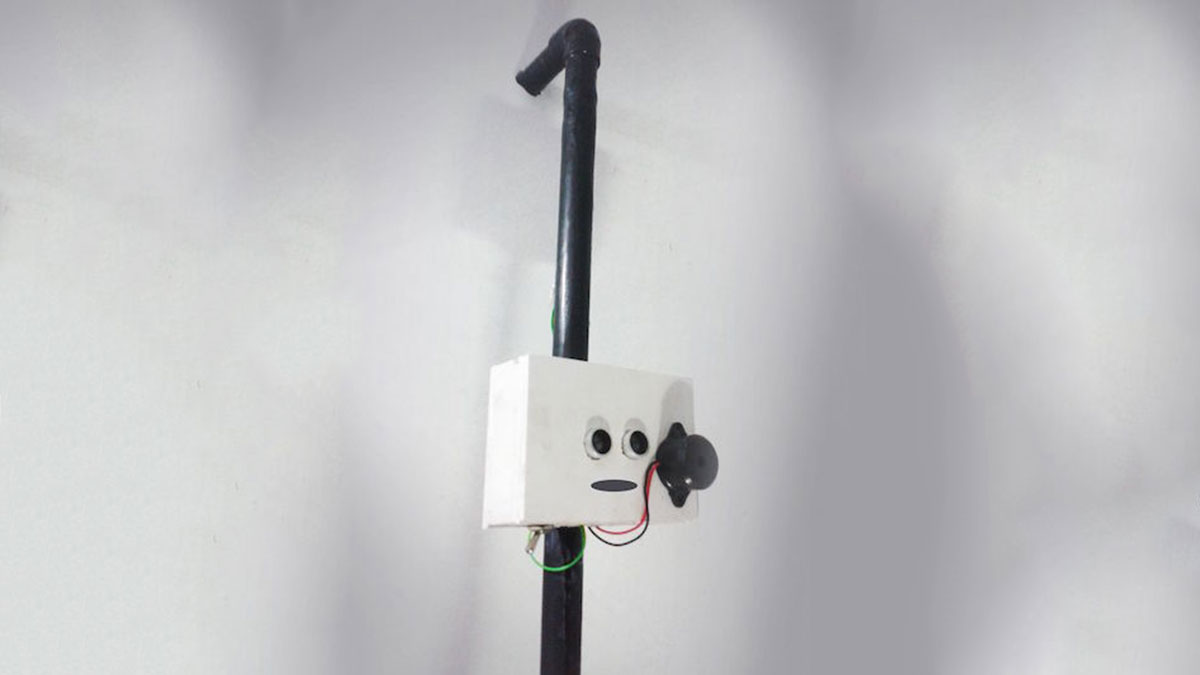
One day while I was walking to my college, I witnessed a blind person who was walking through the street. He was facing difficulty in walking in through that busy street. Fortunately, I was able to help him at that time. However, it was at that moment that I had an epiphany, I realized that I could use technology to assist people like him. It was that evening that I came up with this idea: The Smart Cane. I wanted it to be very cheap and easily replicable so that even a kid can make it easily in a couple of hours from scratch.
Using this Arduino Smart Cane, a visually impaired person can walk without anyone’s help. The cane can automatically detect the obstacle in front of the person and give them a feedback response by vibrating the walking stick and giving a warning sound. Through this tool, the blind person thus be aware of the obstacles in front of them. I used an Ultrasonic sensor with an Arduino for detecting the obstacles. It cost me just 10$ to make one. It is cheap and also easy to make without the need of much soldering. Now let’s get started!
Required Materials
- An Arduino uno.
- An Ultrasonic sensor (HCSR04).
- Mini breadboard.
- 9 volt battery.
- 9 volt battery connector.
- DC male power jack.
- A Buzzer.
- Some jumper wires.
- A broken cellphone (for the vibration motor).
- A Toggle switch.
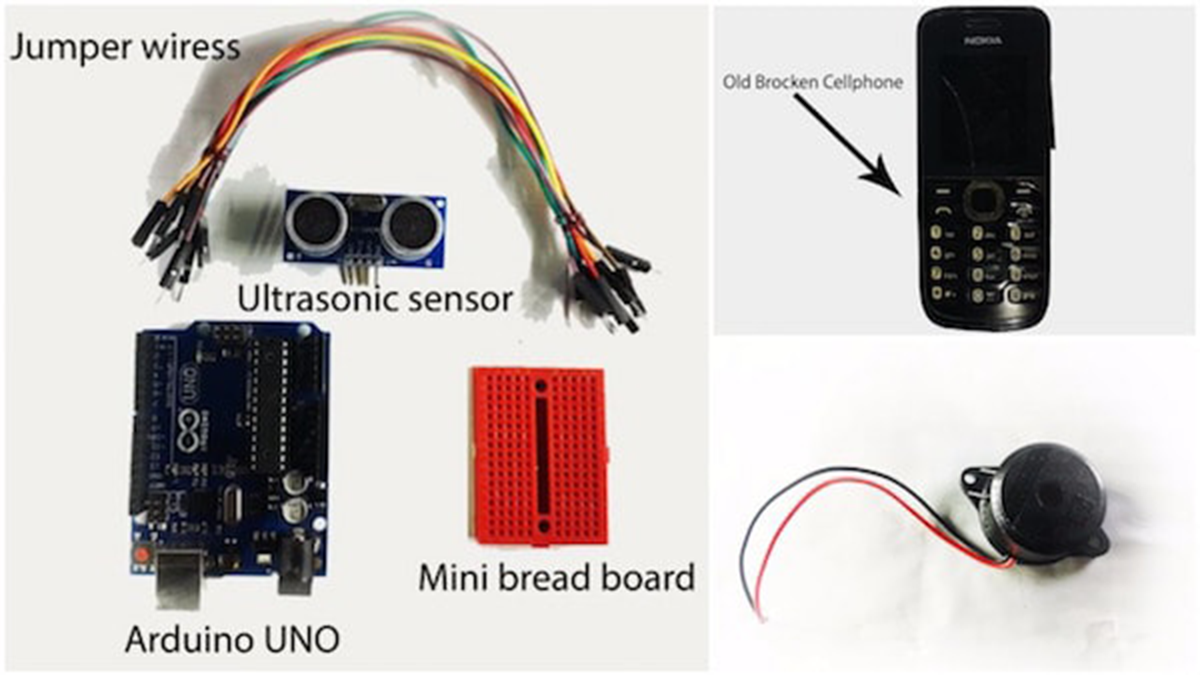
Other tools needed:
- 3/4 inch diameter PVC pipe (used for making the walking stick).
- 3/4 inch diameter PVC elbow.
- Insulation tape.
- Some small screws for mounting Arduino.
- Screwdriver.
- Utility knife.
- Instant adhesive Glue.
- A Box to put your Arduino and other electronics.
How Does it Work?
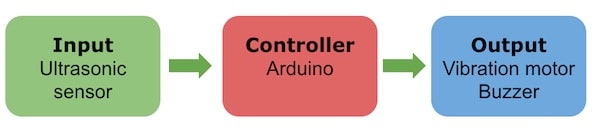
The technology behind the Arduino Smart Cane is pretty straight forward. There are mainly three blocks behind it: input, controller, and output. The input consists of an ultrasonic sensor that is capable of detecting obstacles in front of it at a range of up to 400cm. It is interfaced to a controller: the Arduino which determines if an obstacle is too close to the cane and triggers the output if it is. The output consists of a vibration motor to provide haptic response and a piezo buzzer. If you want to learn more about the ultrasonic sensor and interfacing it to an Arduino, check out this DIY Hacking tutorial from Jeff Salim.
Salvaging the Vibration Motor from A Cellphone
After finding a broken cell phone, we need to remove the vibration motor from it. You will have to do this step with care and patience. I used a micro vibrator motor from an old broken cell phone that was lying around my home. I have used this because of its very small size and as it works with low voltages.
Read More: How to make a Smart Cane for the Visually Impaired with Arduino
- How does the Smart Cane detect obstacles?
The cane uses an ultrasonic sensor capable of detecting obstacles up to 400cm away. - What feedback does the device provide to the user?
The cane provides haptic feedback through a vibration motor and a warning sound via a piezo buzzer. - Can a child make this project easily?
Yes, the project is designed to be cheap and easily replicable so that even a kid can make it in a couple of hours. - What is the cost to build one unit?
The total cost to make one Smart Cane is just 10 dollars. - Does the project require much soldering?
No, the project is easy to make without the need of much soldering. - Why was a vibration motor salvaged from a cellphone used?
A micro vibrator motor from an old phone was chosen because of its very small size and ability to work with low voltages. - What are the three main blocks of technology behind the cane?
The three main blocks are input (ultrasonic sensor), controller (Arduino), and output (vibration motor and buzzer). - How does the Arduino determine when to trigger an alert?
The Arduino determines if an obstacle is too close to the cane and triggers the output if it is.
