
Summary of IOTOUCH AN ESP32 WIRELESS DEVELOPMENT BOARD WITH 24-BIT RGB TFTS
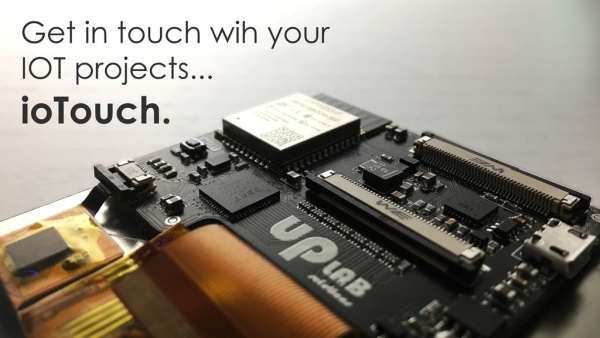
IoTouch is an ESP32-based IoT development board featuring a capacitive touchscreen and external FT813 GPU. It supports WiFi and Bluetooth for wireless connectivity, offering an event-driven framework for creating intuitive HMIs with minimal code. The board includes smart power management, an LED driver, and multiple display size options, currently at 85% completion before open-sourcing.
Parts used in the IoTouch Project:
- ESP32-WROOM dual-core Xtensa 32-bit LX6 MCU
- FT813 EVE2 video engine co-processor
- 24 RGB TFT glass capacitive display
- USB connector with UART transceiver
- Smart power management switch
- Integrated dimmable LED driver
- FFC connector for GPIO exposure
- 3M 200MP adhesive for mounting
IoTouch is an ESP-32 based board with touchscreen capabilities. Its got an external embedded GPU interfaced with a 24 RGB TFT glass capacitive display. It is specially built for IoT applications due to its Bluetooth and WiFi features. If you need a wireless device that has a good and intuitive HMI, IoTouch was made for you.
It’s pages and event-based framework allows you to make pages and transition between them smoothly. It uses a grid-layout and margins to assist in placing your objects on the screen without complex position or pixel calculations. Text buttons, sliders, progress bars, dial gauges, clocks, and other complex objects can be created with just one or two lines of code all with autonomous and graphical touch behavior.
Your application’s appearance or style (foreground, background, fonts e.t.c) can be declared using a clearly defined programming interface and applied globally without any change to your codebase.
IoTouch’s display consists of a capacitive touch screen with an oversized glass frame for an easy installation. It’s mountable with 3M 200MP adhesive and available in 3 different sizes and resolutions.
Some specification and features of the display include:
- ESP32-WROOM with dual-core Xtensa® 32-bit LX6 MCU, 16MB flash
- WIFi 802.11 b/g/n (802.11n up to 150 Mbps) 2.4 GHz ~ 2.5 GHz
- Bluetooth v4.2 BR/EDR and BLE specification
- FT813 EVE2 video engine co-processor with 1MB dedicate Graphic-RAM, 24bit RGB interface, capacitive touch engine, audio engine, and PWM backlight output.
- A USB connector with UART transceiver for autonomous boot and very useful for monitor purposes.
- Smart power management with an internal switch to power from 5V (USB /external on FFC) or a Battery with an enable pin.
- Integrated dimmable LED driver to control the display backlight.
- FFC connector to expose all ESP32 usable pin (except ones used by internal flash), USB, enable pin and FT813 audio output.
- All in 47 x 57mm dimension enables you to use it from 3.5″ to 5.0″ displays.
According to Rocco Taurasi (the project creator), the project can be said to be 85% complete as the prototyping and testing of the hardware and firmware has been done with only some marginal bug-fix and Arduino/PlatformIO integration left on the firmware. Rocco also mentioned most parts of the project will be open-sourced after the development process.
Read more: IOTOUCH AN ESP32 WIRELESS DEVELOPMENT BOARD WITH 24-BIT RGB TFTS
- What is IoTouch?
IoTouch is an ESP32 based board with touchscreen capabilities specifically built for IoT applications. - How does the framework handle screen layout?
It uses a grid-layout and margins to assist in placing objects without complex pixel calculations. - Does the device support wireless connectivity?
Yes, it features Bluetooth v4.2 and WiFi 802.11 b/g/n for wireless functionality. - What processor drives the graphics?
The board uses an FT813 EVE2 video engine co-processor with 1MB dedicated Graphic-RAM. - Can the application style be changed globally?
Yes, appearance settings like fonts and colors can be declared using a programming interface applied globally. - How is the device mounted?
It is mountable with 3M 200MP adhesive due to its oversized glass frame. - What is the current status of the project?
The project is 85% complete with prototyping done and only marginal bug-fixes remaining. - Will the source code be available?
Most parts of the project will be open-sourced after the development process finishes.
