
Summary of IoT PCR: Low Cost DNA Replication Connected to the Internet.
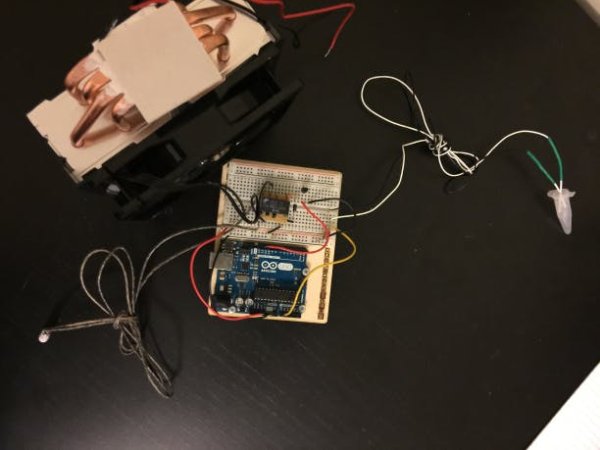
This article describes a low-cost, internet-connected PCR thermocycler designed by high schoolers for educational use. Unlike expensive commercial models, it features an app-controlled interface with presets to simplify operation for students with minimal prior knowledge. The device automates the temperature cycling required for Polymerase Chain Reaction (PCR), enabling DNA replication through precise heating and cooling steps. This project aims to make advanced genetic analysis accessible and affordable for personal and classroom settings.
Parts used in the IoT PCR Thermocycler:
- Polymerase Chain Reaction machine
- Internet connection module
- Control application
- Temperature control system
- User preset configurations
An internet-connected, easy to use PCR Thermocycler designed by high schoolers, for high schoolers.
Story
What is a PCR thermocycler?
A PCR Thermocycler is a device that can change between desired temperatures in a controllable manner in order to properly carry out a Polymerase Chain Reaction(PCR).
What is a PCR?
A polymerase chain reaction is a type of reaction used to replicate certain parts of DNA. The process of replicating DNA comprises of many steps. Here is a simplified version:
Step 1.) DNA is heated up to 95 C in order to denature the DNA. When heated, the hydrogen bond between the base pairs start breaking off, separating the helices in the DNA, which yields 2 complementary strands of DNA.
Step 2.)The sample is then lowered to 55 C for 20-40 seconds to allow the primers(small strands of DNA that serve as starting points for the polymerase) to bond to the DNA.
Step 3.) The sample is then raised to the optimum temperature of the polymerase used(typically Taq polymerase), which then allows the polymerase to bind to the primer and begin completing the DNA strand by adding nucleotides.
Step 4.) Repeat process
This can be continued indefinitely, given that you have enough polymerase, primers, and nucleotides. Each time the cycle is repeated, the amount of DNA doubles.
What will I make that is different than that of commercial PCR Thermocyclers?
Lab-Grade and commercial PCR thermocyclers cost tens thousands of dollars, and are designed to hold hundreds of samples. They are hard to use, and you need extensive knowledge of the polymerase you are using in order to carry out a successful reaction. I am aiming for a Low-Cost, easy to use thermocycler that can be used by high school students with very little knowledge on the subject. This is good for personal use and for education. Not only that, since we can control it through the internet, I will develop an app that will control the thermocycler, and develop a set of presets for the user, making it easier for him or her to operate the device.

What is PCR useful for?
Once amplified, the DNA produced by PCR can be used in many different laboratory procedures. For example, most mapping techniques in the Human Genome Project (HGP) relied on PCR. PCR is also valuable in a number of laboratory and clinical techniques, including DNA fingerprinting, detection of bacteria or viruses (particularly AIDS), and diagnosis of genetic disorders. Long story short, PCR is useful for almost anything that involves DNA/RNA.
Read more: IoT PCR: Low Cost DNA Replication Connected to the Internet.
- What is a PCR thermocycler?
A device that changes temperatures controllably to carry out a Polymerase Chain Reaction. - How does the PCR process replicate DNA?
The process involves heating DNA to denature it, cooling it to bond primers, raising the temperature for polymerase binding, and repeating the cycle. - Can this device be controlled via the internet?
Yes, the developer plans to create an app that controls the thermocycler through the internet. - What makes this design different from commercial thermocyclers?
This model is low-cost, easy to use, and includes presets for users with little subject knowledge, unlike expensive lab-grade machines. - What are some useful applications of amplified DNA produced by PCR?
Amplified DNA can be used for mapping techniques like the Human Genome Project, DNA fingerprinting, detecting bacteria or viruses, and diagnosing genetic disorders. - Does the device require extensive knowledge of polymerase to operate?
No, the device is designed for high school students with very little knowledge on the subject. - Why was this specific thermocycler developed?
It was created to provide an affordable, educational tool for high school students since commercial options cost tens of thousands of dollars.
