
Summary of Homemade Dual H-Bridge – L298 Breakout Board using Arduino
This project builds a homemade dual H-bridge breakout board using an L298N IC on a 13x26 perfboard to drive DC or stepper motors. It details component placement, soldering order, and provides schematics and Eagle files for download. The board includes diodes, capacitors, low-value resistors for current sensing, power connectors, and an Arduino-compatible header.
Parts used in the Homemade Dual H-Bridge - L298 Breakout Board using Arduino:
- 1 x perf board 13x26 holes (3.5 x 7.0 cm)
- 2 x AK300/3 connector
- 1 x 8-pin female header connector for Arduino
- 1 x L298N (Multiwatt15)
- 8 x 1N4001 diodes
- 2 x 100 nF capacitors
- 2 x 0.47 Ohm 1W resistors
- Wire (green and blue colors)
This is my homemade Dual H-Bridge using the IC L298N.
For control DC motors or step Motors ao other purposes just like you need.
 Breakout L298N.ppt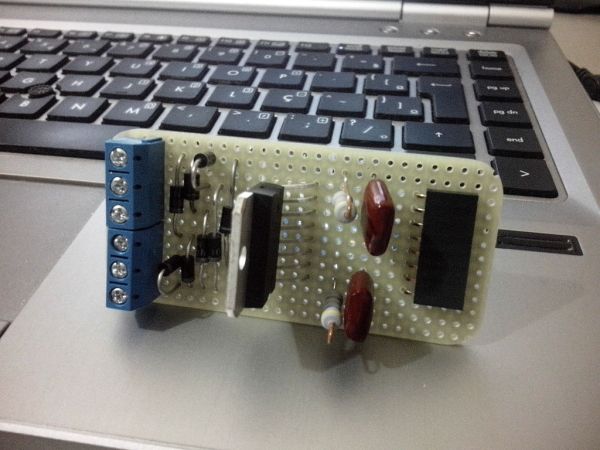
Step 1: Hardware and Materials
COMPONENTS:
1 x perf board 13×26 holes (3,5 x 7,0 cm)
2 x AK300/3 connector
1 x 8 Header female connector for Arduino
1 x L298N (Multiwatt15)
8 x 1N4001 Diode
2 x 100nF capacitor
2 x 0,47Ohm x 1W Resistor
Wire (green and blue colors)
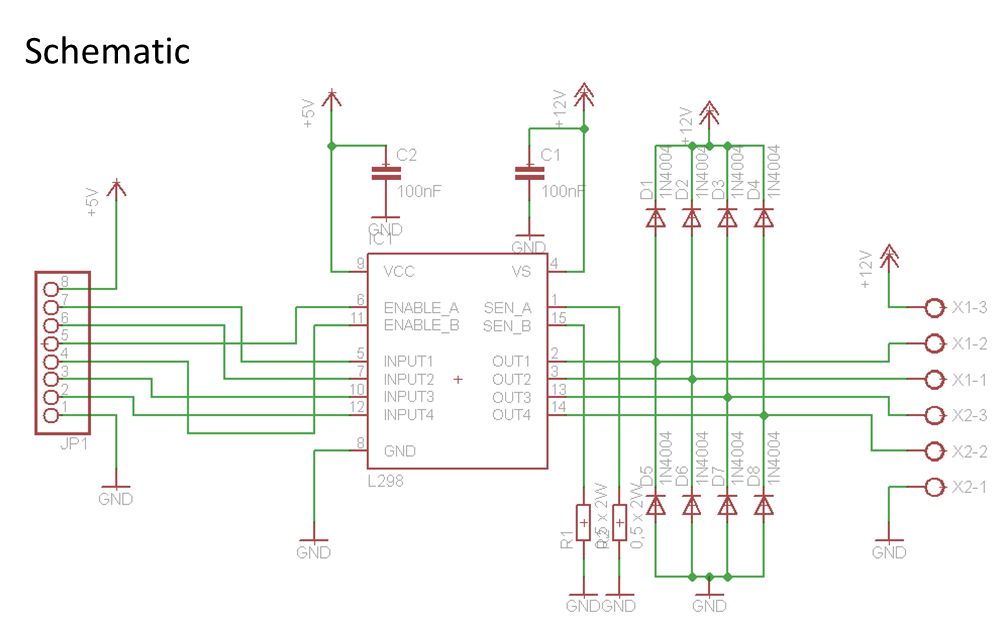
Step 2: Schematic
This is the basic schematic. It works perfectly.
A more advanced schematic and board for eagle cad, you can download from the link below.
http://www.4shared.com/file/T17oVW-z/PONTE_H_L298N.html
http://www.4shared.com/file/6VdOTgv5/PONTE_H_L298N.html
Step 3: 1st Step – Perfboard, holes location
Make a Board with 3,5 x 7,0 cm or 13 x 26 holes.
Locate in this board, all holes that we will use for the components.
Step 4: 2nd Step – Components
After sanding and cleaning the board, put all components in it according of the diagram above and schematic.
For this, bend components properly.
Do the soldering for each group of components independently, for example:
diodes first and then connectors and then capacitors and resistors and finally the L298N IC; or in what order you want or you are used to do.
2 x AK300/3 connector
1 x 8 Header female connector for Arduino
1 x L298N (Multiwatt15)
8 x 1N4001 Diode
2 x 100nF capacitor
2 x 0,47Ohm x 1W Resistor
Wire (green and blue colors)
For more detail: Homemade Dual H-Bridge – L298 Breakout Board using Arduino
- What is the purpose of this project?
To build a homemade dual H-bridge breakout board using the L298N to control DC motors or stepper motors. - What size perfboard is used?
A 13x26 holes perf board (3.5 x 7.0 cm) is used. - Which driver IC is used in this breakout board?
The L298N in a Multiwatt15 package is used. - How many diodes are required and which type?
Eight 1N4001 diodes are required. - Are there capacitors included and what value?
Yes, two 100 nF capacitors are included. - What resistors are used for current sensing?
Two 0.47 Ohm 1W resistors are used. - Is there an Arduino connector on the board?
Yes, an 8-pin female header connector for Arduino is included. - Does the project provide schematics or CAD files?
Yes, the article provides links to schematic and Eagle CAD files for download. - What is the recommended soldering order?
Solder in groups, for example diodes first, then connectors, capacitors and resistors, and finally the L298N IC.
