
Summary of HOMEBREW ROM READER SAVES DATA FROM A VINTAGE MINICOMPUTER
This article details [David Lovett]'s project to recover data from a vintage 1980 Centurion minicomputer. Unable to find a commercial ROM reader, he built a custom device using an Arduino Nano and 74LS161 counters. This DIY solution successfully read the machine's ROM chips, allowing for data backup despite unknown content. The setup utilized a breadboard to accommodate various pinouts, including those requiring -9 volts, ensuring the preservation of historical hardware.
Parts used in the Centurion Minicomputer ROM Reader:
- Centurion minicomputer
- ROM chips
- Arduino Nano
- 74LS161 counter chips (trio)
- Breadboard
Have you ever heard of a Centurion minicomputer? If not, don’t feel bad — we hadn’t either, until [David Lovett] stumbled upon a semi-complete version of the 1980-ish mini in all its wood-trimmed, dust-encased glory. And what does a hacker do with such an acquisition but attempt to get it going again?
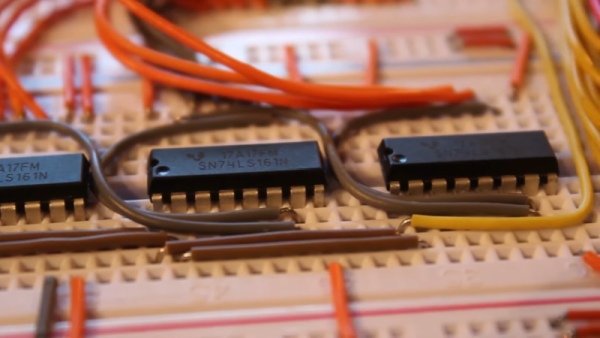
Of course, getting a machine from the Reagan administration running is not without its risks, including the chance of losing whatever is on the machine’s many ROM chips forever. When finding a commercial ROM reader supporting the various chips proved difficult, [David] decided to build his own. The work was eased considerably by the fact that he had managed to read one chip in a commercial reader, giving him a baseline to compare his circuit against. The hardware is straightforward — a 12-bit counter built from a trio of cascaded 74LS161s to step through addresses, plus an Arduino Nano to provide clock pulses and to read the data out to the serial port.
The circuit gave the same results as the known good read, meaning results would be valid for the rest of the chips. The breadboard setup made supporting multiple ROM pinouts easy, even for the chips that take -9 volts. What exactly the data on the ROMs mean, if anything, remains a mystery, but at least it’s backed up now.
Before anyone notes the obvious, yes, [David] could have used a 555 to clock the reader — perhaps even this one. We’d actually have loved that, but we get it — sometimes you just need to throw an Arduino at a job and be done with it.
Source: HOMEBREW ROM READER SAVES DATA FROM A VINTAGE MINICOMPUTER
- Why did David build his own ROM reader?
He could not find a commercial ROM reader that supported the specific chips used in the Centurion minicomputer. - What components were used to create the clock pulses and read data?
An Arduino Nano was used to provide clock pulses and read the data out to the serial port. - How many 74LS161 chips were used in the circuit?
A trio of cascaded 74LS161 chips was used to build the 12-bit counter. - Did the homemade circuit produce valid results?
Yes, the circuit gave the same results as the known good read from the first chip. - What advantage did the breadboard setup offer?
The breadboard made it easy to support multiple ROM pinouts, including chips requiring -9 volts. - Could a 555 timer have been used instead of the Arduino?
Yes, a 555 timer could have been used to clock the reader, though the author chose the Arduino. - Is the meaning of the data on the ROMs known?
No, what exactly the data on the ROMs mean remains a mystery. - What was the primary goal of this project?
The goal was to back up the data on the machine's many ROM chips to prevent loss.
