
Summary of Highly maneuverable search and rescue robot
The article details a successful prototype of a small, highly maneuverable search and rescue robot capable of climbing stairs, crossing gaps, and transmitting video/audio. Key components include an Arduino microcontroller, a motor controller board with eight drivers, an accelerometer, GPS connector, power regulation circuitry, four arm position sensors using resistive paper, and wireless communication systems. The robot achieved a 160-foot wireless range and 50-minute battery life during testing.
Parts used in the Highly Maneuverable Search and Rescue Robot:
- Arduino microcontroller
- Motor controller board
- Accelerometer
- GPS connector
- Eight individually controllable motor drivers
- Power regulation circuitry
- Output expanding IC
- Heat sinks
- Ethernet shield
- Ethernet cable
- Four arm position sensors (resistive paper potentiometers)
- Battery pack
- Wireless transmitter/receiver unit
- Color camera with nighttime illumination
- Laptop for command and feed viewing
Finalized Prototype
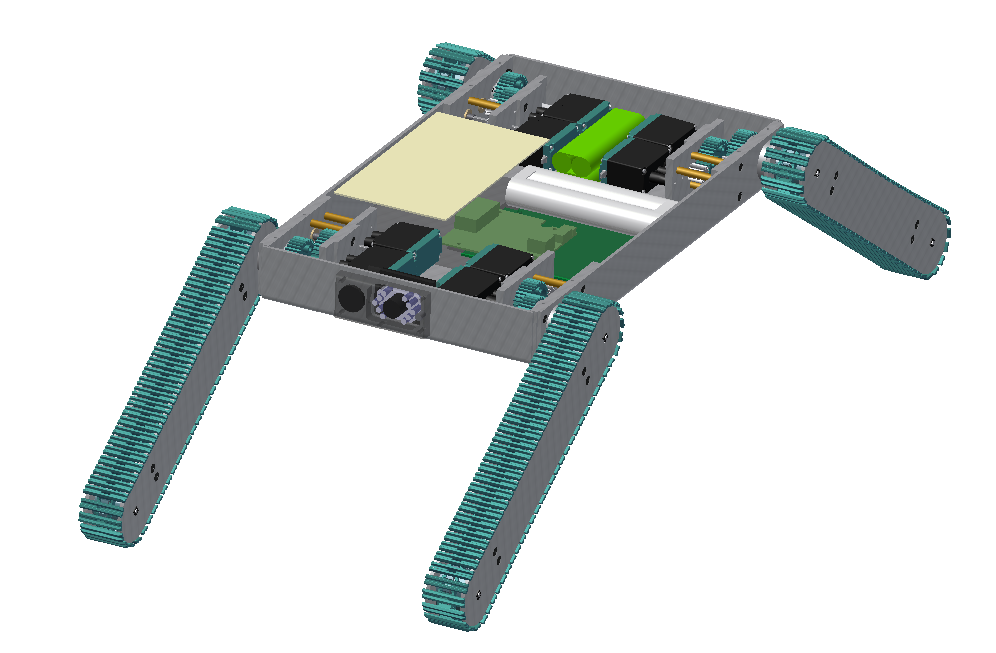
Shown below is the finalized prototype. The purpose of the prototype was to demonstrate the feasibility of a small, highly maneuverable search and rescue robot. As such, the completed prototype was successful. Capabilities include a ground speed of 10 inches per second, battery life of 50 minutes, wireless range of between 50 and 150 feet (depending on interference), weight of 14.5 pounds and the ability to climb stairs. The prototype is also capable of crossing a gap of at least 10 inches and of climbing a 21 inch tall ramp angled at 49 degrees from horizontal. It provides the operator with a color video feed (with nighttime illumination) and two-way audio communication.
Arm Rotation Sensors
The robot also features 4 arm position sensors to indicate the orientation of each leg relative to the body. The sensors are designed similarly to potentiometers with a C-shaped piece of resistive paper. As the arm rotates, it makes contact between the resistive paper and the output terminal. The output voltage is measured with the Arduino’s analog inputs.
First fully wireless test
This was the second major test of the prototype, the first test done entirely without external connections. Again, the laptop used to send commands and view the camera feed (as well as send and receive audio) is not shown. This test brought to light yet more software and hardware issues, which are being addressed.
Line of sight wireless range test
With the robot set up in the configuration shown in the above video, the team tested the line of sight wireless range. The team was able to remain in control of the robot at a distance of approximately 160 ft. More tests are planned to analyze the impact of structural interference.
First full motor test with wireless control
This was the first major test of the prototype. 6 of 8 motors were connected (all except front left rotation and translation). Some software bugs were discovered in the test and are being fixed. Not shown is the laptop connected wirelessly to the robot which is being used to control the motors. Also note that the camera is working with a video feed being sent to the desktop computer shown in the video.
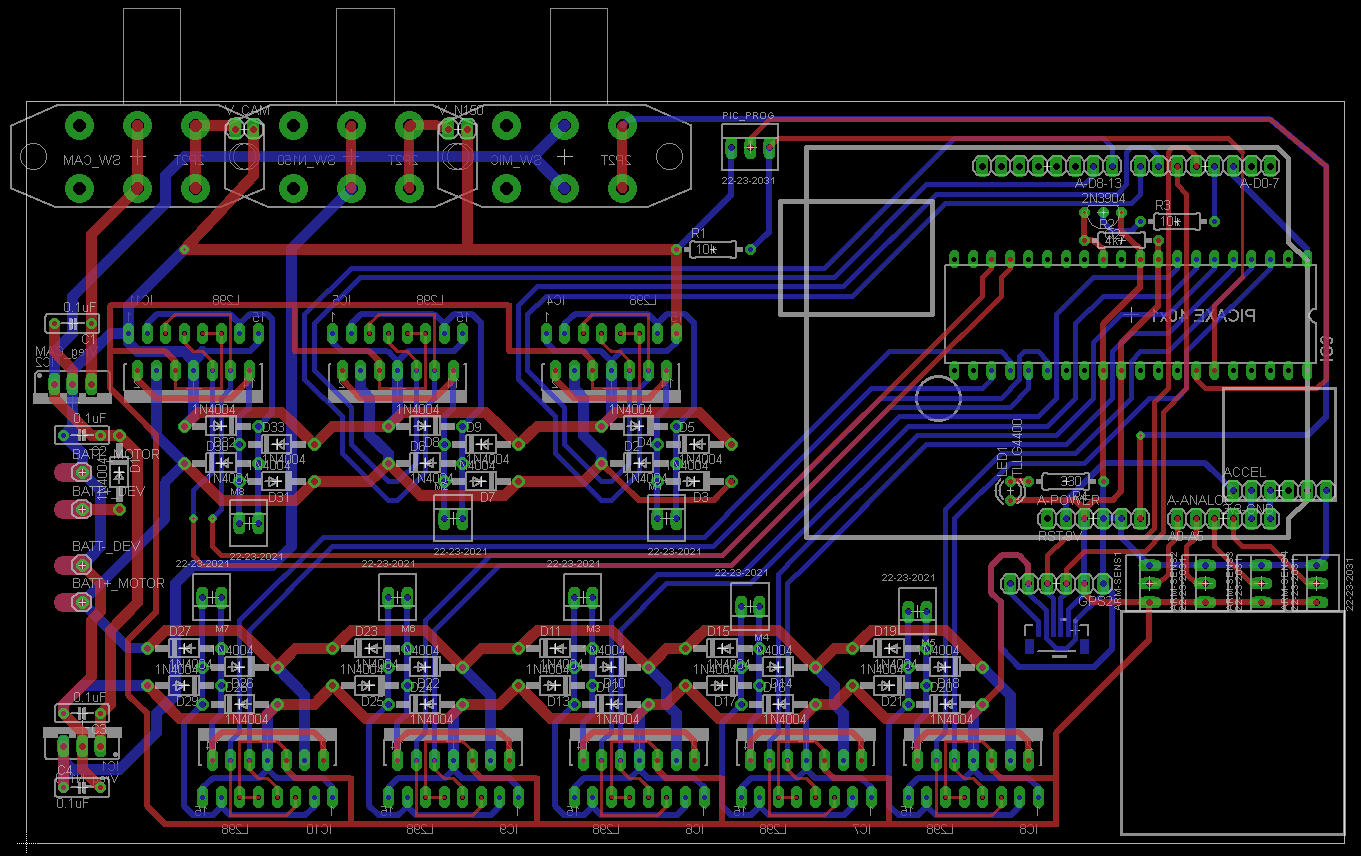
Shown above is the motor controller board connected to an Arduino microcontroller. The board has an accelerometer (red square in first image), a connector for a GPS (small bottom left connector), eight individually controllable motor drivers and power regulation circuitry. Most of the motor drivers are driven by an additional output expanding IC.
The motor drivers and voltage regulators are collinear so that two heat sinks may be attached. Also shown is an ethernet cable to connect the arduino to the ethernet shield.
For more detail: Highly maneuverable search and rescue robot
-
What is the ground speed of the finalized prototype?
The prototype has a ground speed of 10 inches per second. -
How long does the battery last on the robot?
The battery life is 50 minutes. -
Can the robot climb stairs or ramps?
Yes, the robot is capable of climbing stairs and can climb a 21 inch tall ramp angled at 49 degrees from horizontal. -
What type of sensors are used to indicate leg orientation?
The robot features 4 arm position sensors designed similarly to potentiometers with a C-shaped piece of resistive paper. -
What was the maximum line of sight wireless range tested?
The team remained in control of the robot at a distance of approximately 160 feet during the line of sight test. -
Does the robot provide audio and video feedback?
Yes, it provides a color video feed with nighttime illumination and two-way audio communication. -
What components are included on the motor controller board?
The board includes an accelerometer, a GPS connector, eight individually controllable motor drivers, and power regulation circuitry. -
How many motors were connected during the first full motor test?
Six of the eight motors were connected during the first major test.
