
Summary of HEDGEHOG GESTURE SENSOR BUILT WITH CHEAP TIME-OF-FLIGHT MODULES
This article describes an affordable gesture-tracking system built using four VL53L1X time-of-flight sensors with 16×16 scanning arrays communicating via I2C. An Arduino MKR1010 microcontroller controls the device, which features a hedgehog-shaped enclosure and an LCD screen displaying expressive faces. The system interprets user gestures to send USB keystrokes, control relays or servos, and emit IR signals for hardware like TVs.
Parts used in the Hedgehog Gesture Sensor:
- Four VL53L1X time of flight sensors
- Arduino MKR1010 microcontroller
- LCD screen
- I2C bus communication components
Time-of-flight sensors used to be expensive obscurities, capable of measuring the travel time of photons themselves and often used for tracking purposes. However, the technology is cheaper now, such that [jean.perardel] has used TOF sensors to build a useful and affordable gesture-tracking system.
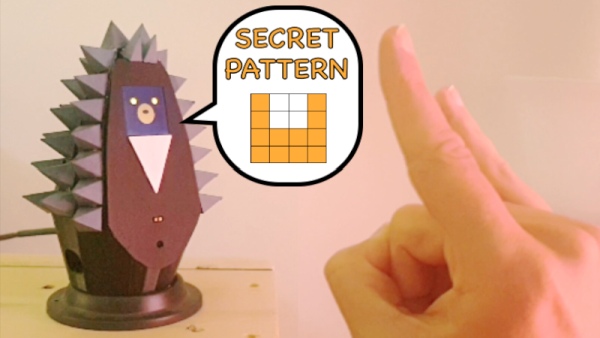
The system relies on four VL53L1X time of flight sensors, which have a 16×16 scanning array and communicate over the I2C bus. Controlling the show is an Arduino MKR1010, though the project should be achievable with a range of other microcontrollers, too.
The device is built into a cute hedgehog-like form factor, with an LCD screen acting as the face. It displays facial expressions which show how the system is interpreting and responding to gestures. It gives the project lots of personality, which makes using the system more fun. Gestures from the system can be used to send keystrokes over USB, control relays or servos, or even fire IR signals to control TVs and other hardware.
It actually seems like a useful gesture control interface, one that could become a useful part of a workstation setup. We’ve seen gesture controls put to other uses too, like controlling robot arms. Video after the break.
Source: HEDGEHOG GESTURE SENSOR BUILT WITH CHEAP TIME-OF-FLIGHT MODULES
- How does the system track gestures?
The system uses four VL53L1X time of flight sensors capable of measuring photon travel time. - Can this project work with other microcontrollers?
Yes, while an Arduino MKR1010 is used, the project should be achievable with various other microcontrollers. - What form factor does the device use?
The device is built into a cute hedgehog-like form factor. - How does the system show its status?
An LCD screen acts as a face to display facial expressions showing how the system interprets and responds to gestures. - What actions can the gestures perform?
Gestures can send keystrokes over USB, control relays or servos, or fire IR signals to control TVs. - Are these sensors expensive?
No, time-of-flight technology that was once expensive is now cheaper, allowing for affordable builds. - How do the sensors communicate with the controller?
The sensors communicate over the I2C bus. - Does the system have personality?
Yes, the facial expressions on the LCD screen give the project lots of personality.
